Reviews of Ste An Auto Tour and a Good Overview A Field Guide to Gettysburg, Second Edition. By Carol Reardon & Tom Vossler. Illustrations maps, notes, index, 488 pp., 2017, University of North Caroli
A Field Guide to Gettysburg was originally published in 2013 It garnered the Bachelder-Coddington Award as the best book on Gettysburg published that year. The University of North Carolina Press has published a Second Edition to the book this year. This updated edition makes the book even more valuable than its earlier version. The authors are Caron Reardon and Tom Vossler, and they are eminently qualified to write this guide. Reardon is a distinguished professor of histo at Pennsylvania State University and she has written several book on the Civil War. Vossler is a
better appreciate this pivotal engagement “from
War Books vide our readers with timely analy Battle There are those damn green perspectives of both the senior leaders and the privates in the ranks.” The authors succeed in doing so by applying a unique analysis to the battle. A Field Guide to Gettysburg is separated into 36 stops on the battlefield, divided among the three days of battle action. A thirty-seventh stop explores the Soldiers’ National Cemetery. Each stop starts with a concise orientation of the area. This information is helpful for novices as well as seasoned Gettysburg aficionados alike in setting the stage for what is to come. The authors provide a detailed analysis for each of the stops by answering six questions at each site what happened; who fought here; who commanded here; who fell here; who lived here; and what did they say about it later? These questions enable readers to obtain a clear understanding of the action that occurred at the stop, well as insight into who the participants were and what they had to say about it. The two extra stops in this edition add important information for visitors to the battlefie Stop 4 describes the fight on the Harmon farm. The site is located west of Willoughby Run and housed the Gettysburg Country Club golf course until a few years ago. Off the beaten path, this are saw fighting on the first day of the battle. It is also where Confederate Brigadier General James Archer was captured, the first of Robert E. Lee’s generals to be captured in the war. Stop 30 is th other addition to this edition. It is located at Powers Hill, another site that is rarely visited. Th
authors have included this as a new stop to allow visitors a bette
again! understanding of how this terrain served as a Federal artillery position. The addition of both stops is an excellent reason for people to pick up this book, even if they already have the first edition. The book does not have a bibliography, which is perhaps its only minor drawback. However, the footnotes to each stop supply readers with additional sources of research material for further study. The authors have also provided photographs for each stop that aid in establishing the reader’s orientation at the particular site. This is a helpful featur that authors of other guidebooks would be wise in following. There are a number of guidebooks for the Battle of Gettysburg Among the better of them are The Complete Gettysburg Guide by J. David Petruzzi and Steven Stanley, Gettysburg: A Battlefield Guide by Mark Grimsley and Brooks D. Simpson, and Guide to the Battle of Gettysburg by Jay Luvaas and Harold Nelson. Reardon and Vossler’s A Field Guide to Gettysburg deserves a place alongside those works. It is written as an auto tour, with driving directions provided from stop to stop. Yet the book is equally valu able as an important resource for readers to obtain an overview of the battle in general, and specifi areas of interest in particular.
Jay Jorgensen is a judge in New Jersey. He has written several books on Gettysburg. He is the editor and co-author of the recent released Top Ten at Gettysburg
Fighting Irish in the American Civil War and the Invasion of Mexico. Edited by Arthur H. Mitchell. Notes, bibliography, index, 272 pp., 2017. McFarland,
This collection of essays contains sixteen entries devoted to the participation of the Irish i the Civil War, preceded by two chapters which review their less er-known role in the Mexican War. The editor penned two of the entries himself; sixteen oth writers contributing one each. The essays on the Civil War cover Irish contributions to both North and South. The most interesting are the minibiographies of prominent Irish American military and civilian leaders. Of particular note is t entry on the Bishop of Charlesto Patrick Lynch. David Heisser gives an informative account of the bishop’s career, with an
on Patrick Cleburne. A chapter by Ann Caraway Ivins tells of Texas Irishman Dick Dowling and gives a solid account of the battle of Sabine Pass. Four entries examine the Irish immigrant communities in major Northern cities, communities that produced tens of thousands of recruits for the Union army. recurring theme in these essays the way military service provide a path for immigrants to prove their American bona fides and
overcome nativist anti-Irish and anti-Catholic prejudice.
Another theme is the role which Irish opposition to English rule affected their attitude toward t war. These are well written and carefully documented; however, in places they seem at once both too much and too little. They read like abridgements of longer articles, proceeding from one topic to the next without providing sufficient details on one left behind. Moreover, they are sometimes repetitious, as th story of the Irish in New York i not dissimilar from the story of the Irish in Boston, Philadelphi or Chicago. There is also a chapter on Irish women, and considerable discussion of Irish attitudes towards blacks and the instituti of slavery. One of the essays on the Mexican conflict contains an account of the San Patricios, Catholic Irishmen who deserted the U.S. Army and joined their co-religionists on the other sid These men fought with great determination to the very end, knowing their fate should they surrender. Desertion is a major offense; going to the other side during a war magnifies the crime. Those who were captured suffered brutal treatment and were executed by the army they deserted. However, villains to o side can be heroes to the other. To this day the San Patricios ar honored in Mexico. Fighting Irish covers one of numberless aspects of the Civil War worthy of study, the contributions a major immigrant population made to strengthen the armies of both the United States
facing the division commanded by Ireland’s Patrick Cleburne surely felt the same way.
Gould Hagler is the author of Georgia’s Confederate Monuments: In Honor of a Fallen Nation (Mercer University Press, 2014). His new book on Alabama’s Confederate monuments is to be published by Indiana University Press.
Wallace Hettle. Notes, index, 23 pp, 2017, Louisiana State Uni-
Author Wallace Hettle has combined 66 individual docu-
ments or groups of documents pertaining directly to the Civil War, specifically from the Confederate viewpoint. Many aspects of the war are treated by the va ious papers. These include Maj. Gen. Patrick Cleburne’s proposal for Confederate emancipation of
al to Those Interested signers), focusing on the human s (four the war, and they make in
combined documents), and President Jefferson Davis’ address to the city of Columbia, S.C., durin
includes many accounts by former slaves, often documenting their relationships with their ma ters, attempts both successful an not at escaping from slavery, and descriptions of life as a slave. Hettle divides the book into “chapters” for each year of the war. He begins the year 1861 with Mississippi’s “A Declaration of the Immediate causes Which Induce and Justify the Secession of Mississippi from the Federal Union” and the Ordinance of Secession, Jan. 26, 1861. Also included is a statement from Edmund Ruffin’s diary concerning his firing the first shot at Fort Sumter on April 12th. He continues with documents spread across each of the four remaining years of the Civil War. This places in the reader’s han a quick and valuable source of
information concerning the Confederacy. Hettle carefully cites the source of each document, providing an author or researcher with its origin. While there are other such books available, Hettle has found many lesser known documents
in Civil War Small Arms Use cases fascinating reading. For casual reader or serious resear er, this is a provocative and v useful book. Hettle has done us all an excellent service.
Lawrence K. Peterson is the author of Confederate Combat Commander: The Remarkable Life of Brigadier General Alfre Jefferson Vaughan Jr. (Universi of Tennessee Press, 2013). He i president of the Rocky Mountain Civil War Round Table. His next book, Decisions at Chattanooga: The Nineteen Decisions that Defined the Battle, is schedule to be published in 2018 by the University of Tennessee Press a part of the Command Decisions i America’s Civil War series.
The Men, Their Guns, Their Story. By Gary Yee. Notes, bibliography, index, 836 pp.,
By way of full disclosure, I was a member of the Company of Military Historians Review Board that initially classified Gary Ye
as a “standard reference” for the subject in American military history. I have neither seen nor hea anything since to dissuade me from that decision. This is indee a must-have book for any student of American military history – as well as any serious student of th Civil War. Gary Yee, a long-time museum curator, firearms student, writer and Civil War Round Table officer, has acquired considerabl expertise on the subject. Yee’s work covers the evolution, training and deployment of “sharpshooters” for a century and a half, which, by necessity, cove the Civil War, the largest American conflict during that period. significant segment of the book— more than half of it—is dedicated to the role of sharpshooters during that war. Yee’s research on the origins of the term sharpshooters, and the tactical employ ment of skilled riflemen in combat in previous conflicts, sets t stage for explaining their role i
the Civil War. Yee provides an understanding of the role of British and French work in small arms development, training and employment in the decades before the war. Sharpshooter training was unfortunately not implemented for most Civil War soldiers. The popular idea was that some rural squirrel hunter who could drop a rodent from a tree limb twenty-five yards away with a small caliber patched round ball rifle is a nat ral born sharpshooter. Designated sharpshooters in both Union and Confederate armies took seriously the European research, which had been reproduced in American manuals, and when possible included it in their training. Fami iarity with those facts is essent to any tactical assessment of the conflict. Likewise, the significa postwar National Guard and regular army interest in long-range small arms accuracy is directly r
lated to the army’s dissatisfacti with the lack of common soldier training and with poor marksmanship during the Civil War. Yee reports in detail on the role of sharpshooters in minor skirmishes as well as major battles in both the eastern and western theaters of the war. His book is supplemented by some interesting illustrations and features, exhaustive footnotes and an extensive bibliography. Sharpshooters 1750-190 not only covers well-known and publicized units like Colonel Berdan’s regiments, but other groups of designated sharpshooters down to company and individual levels. A trained gunsmith and black powder shooter, Yee also provides technical deals on sharpshooter rifles and ammunition. At the risk of redundancy, I would like to close by re-stating that this book is essential to th interested in small arms use in t Civil War.
Joseph G. Bilby contributes the monthly “Black Powder, White
onstruction in Georgia mic, Social, Political 1872. By C. Mildred son. Edited and with duction by William C. . Notes, bibliography, , 536 pp., 2017, Merce
rgia’s experience in R tion after the war was of the other ten ex-Co states—except when it The first professional to explain this was C. Thompson, in her Recon tion in Georgia: Econo
remarkable work, published in 1915, was the author’s doctoral dissertation, which she wrote at Columbia University under the distinguished scholar William A. Dunning. Long a staple of Reconstruction literature, Thompson’s history has just been reprinted b Mercer University Press. The real gifts in this edition come from William C. Bragg, professor emeritus at Georgia College. Dr. Bragg’s Introduction places Thompson’s work in historiographical context. Most importantly he has compiled a meticulous index, which the edition of 1915 sorely lacked. Bragg’s essay, “C. Mildred Thompson: A Liberal among the Dunningites,” offers her biography, and from it we learn that Mildred Thompson was an uncommon woman. “An Atlanta public school girl,” as Dr. Bragg writes, she went to college (Vassar, no less), excelled in histor and earned admission to Columbia for a master’s degree in 1906 before the university had become fully co-educational. There she caught the eye of Professor Dunning, one of the nation’s leading historians of Civil War Reconstruction. After earning her master’s, she stayed on at Columbia to earn her doctorate in American
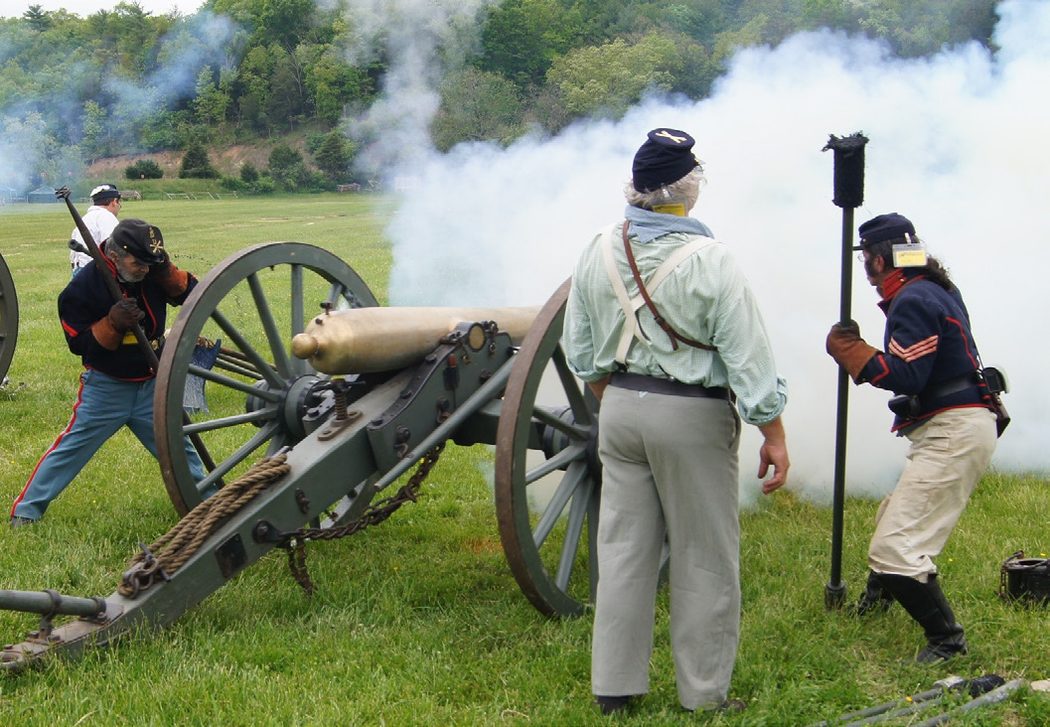
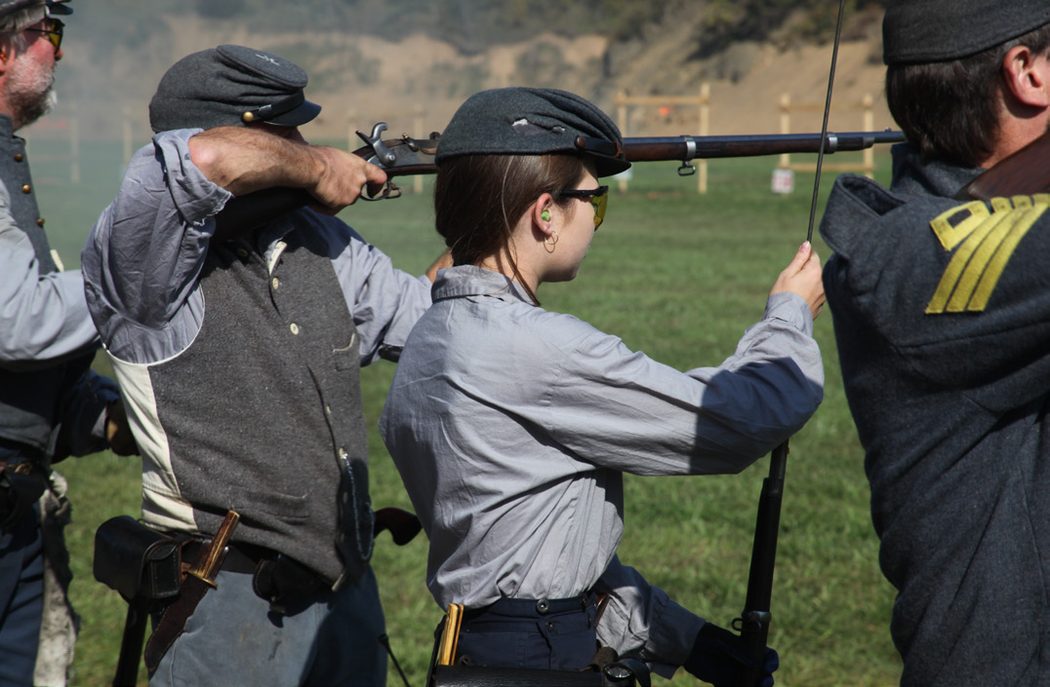
The N-SSA is America’s olde organization. Competitors s
with cannons and mortars. A regiment or unit and wears Dedicated to preserving our
history. Mind you, this was in 1907 and Miss Thompson, a twenty-five year-old single woman from Atlanta, had moved to New York City to get her Ph.D. Up to 1915 when she won it, nine out of ten doctoral degrees in history gran ed by American universities had gone to men. Dunning was one of the most influential scholars in American history. His own account of Reconstruction dates from 1907, bu during his years at Columbia he guided his students to produce others. Included among there are Walter Lynwood Fleming’s history of Reconstruction in Alabama (1905), and Charles W. Ramsdell’s of Texas (1910). Thompson’s dissertation, finished in 1915, covers Georgia. Columbia University Press published it th same year. Reconstruction in Georgia reminds us that the institution of slavery was more than an economic model in the antebellum South. It was a social order whi established relations between whites and African-American for over two hundred years. Little wonder, then, that when emancipation suddenly freed millions of Southern slaves, the first ye of Reconstruction were marked by vast uncertainty between the
represent a specific Civil War orm they wore over 150 years ago , period firearms competition an
races. In Georgia, whites and a half-million blacks tried to figu out how society and the economy would continue to function. President Andrew Johnson’s Reconstruction policies helped. In Georgia a Unionist, James Johnson, was appointed governor. In Oct. 1865 a constitutiona convention repealed the state’s secession ordinance and abolished slavery. The next month voters (whites who had taken the loyalty oath) elected a governor, state legislators and U.S. congressmen. When the General Assembly approved the Thirteenth Amendment, Johnson pronounced Georgia as readmitted to the Union. All of these events are summarized in “A Political Chronology,” another of Bragg’s helpful contributions. Meanwhile, the state legislatu enacted laws codifyi freedpeople’s rights (and lack of them, like the right to vote). The Freedmen’s Bureau helped oversee a “system” whereby blacks returned to the fields und contract labor. Then came Congressional Reconstruction, the policy by which Republicans, led by “Radicals,” made rights for the newly freed slaves key to restoring the ex-Rebel states. With moderates’ help, in April 1866 they passed a Civil Rights Act to protect freed men and stake out a route to the citizenship. Fearing the Supreme Court would invalidate it, Republicans passed and sent to the states a Fourteenth Amendment,
guaranteeing citizenship rights t black Americans. Ratification by Southern states became another requirement for readmission to the Union. Georgia joined every former Confederate state except Tennessee in rejecting it. An angry Congress enacted military rule for the South in March 1867; Gen. John Pope took command in Georgia. When voters were registered, 95,000 whites and 93,000 blacks were recorded. State elections followed, in which a Republican beat Gen. John B. Gordon (Democrat) for governor, and Republicans won numerous seats in the legislature. Carpetbaggers (Northern-born politicians) and scalawags (pro-Republican native whites) swarmed the corridors of government. She does not
exaggerate, but fairly describes the corruption and inefficiency of the new regime (example is the waste arising from the state’ leasing of the Western & Atlantic
Thompson recounts all of these developments, frequently citing and quoting sources now obscure. She tells of the sensational murder of Radical
George Ashburn, the rise of the Ku Klux Klan in the state, and the expulsion of black legislator after conservatives won control o the legislature. When the General Assembly rejected the Fifteenth Amendment (guaranteein black men the vote), Congress rescinded Georgia’s readmission, and granted it only when the state ratified the amendment in 1870. Thus was Georgia “reconstructed.” I asked Dr. Bragg for a reflec tion on Thompson’s achievement. In an email he thoughtfully reminded me that she crowned her academic career by becoming president of Vassar. “She excelled outside her native region a profession formerly forbidden to women,” he observed, adding that all the while “she kept her soft Southern accent.” Mildred Thompson was a product of her times. When she wrote that Congressional Reconstruction “attempted to subvert the social order of the Southern states by making the former masters impotent and putting the instrument of power into the hands of former slaves, and keeping it there by military force,” she was only saying what most white Southerners would have said about the period after the war. While she was skeptical of ex-slaves’ ability to implemen the full bounds of their new freedom, she avoided the racial
intolerance which marked many white Southerners at the time— hence Bragg’s epithet, “a liberal
among the Dunningites.” When she added th Congressional Reconstructio had created “a social problem that the South and the nation hav not yet in half a century been ab to solve,” she sounds even more a product of her times. In the 10 years since she wrote, the nation has indeed done much to address its problem of race relations. To the extent that it has not yet been perfectly able to do so—and just about all Americans today will agree that we haven’t— Mildred Thompson’s views of Reconstruction in Georgia deserve another look indeed. In this light, Bill Bragg’s and Mercer’s reprinting of her important book deserve our gratitude and appreciation.
Steve Davis of Atlanta is Book Review Editor for the Civil War News.
Submissions is the 20th of each month for the next issue.
Lincoln and Congress. By William C. Harris. Illustrations, 176 pp., 2017. Southern Illinois
The relationship between a President and Congress is always a key factor in the success of an given administration, indeed in the country’s success. That’s tru not only today but most certainly during the tumultuous days of the Lincoln presidency. In yet another in the excellent Concise Lincoln Library series published by Southern Illinois University Press, with Lincoln and Congress, William C. Harris has given us a rich view not only of the relationship between the two, but, to a lesser degree, a lesson the Constitution and a treatise o the political parties of the day. The purpose of the SIU “Concise” Series is to give the reade an opportunity to quickly achieve basic knowledge of a Lincoln-related topic. Harris’ specific sta goal in writing the book was to “give the reader a better understanding of the difficulties that Lincoln and Congress faced in saving the Union, abolishing slavery, and providing for a
The Maryland Campaign of September 1862: Vol. III: Shepherdstown Ford and the End of the Campaign. By Ezra A. Carman. Edited and annotated by Thomas G. Clemens. Maps, footnotes, appendices, bibliography, index, 325 pp., 2017. Savas
e Union While recovering at home Jersey, the governor appo
brighter future for America.” On both of these objectives, mission accomplished! Lincoln believed in legislativ supremacy, stating, “As a rule, I think it better that congress should originate, as well as perfect its measures, without external bias.” Harris ably details th political partnership between the president and legislative branch, from the beginning of Lincoln’s calling for the Thirty-Seventh Congress to convene early, on July 4, 1861 (though not immediately at the outbreak of the Civi War), and right through to the Wade-Davis Bill and Lincoln’s thoughts on Reconstruction. Regarding the convening, Harris points out that contrary to w has often been assumed (Lincoln wanted time to act freely without congressional intervention), the president actually wanted to allow time for three key activities: elections to Congress that still needed to take place in sev eral states, his writing of a for report on his actions to-date, an physical arrival of Congressmen in Washington. A key component of the book treats the activities of the Join Committee on the Conduct of the War, created to “guide the Lincoln administration on war policy, investigate military failure and seek the removal of incompetent and failed military commanders.” Harris taps into and makes great use of many primary and secondary sources, including the excellent The Radical Republicans: Lincoln’s Vanguard for Racial Justice (1969) by the late Hans Trefousse. The Radical Republicans believed that William Seward had too much influence on Lincoln (and did not influence him in the way they wanted). Harris details the story of Salmon Chase’s involvement with the Radicals to have Seward removed from the Cabinet, and Lincoln’s masterful handling of the situation—he received
Mountain (2010) and Volume II: Antietam (2014), Shepherdstown Ford and the End of the Campaign is the capstone for what will become the monumental study of the bloodiest single day in American history, and the cam-
paign which expanded the focus of the Civil War from a struggle
to preserve the Union to a crusad to abolish slavery. Volume III, r flecting Ezra Carman’s lifelong passion to preserve for perpetuit the history of the campaign, is
both Seward’s and Chase’s resignations. Harris argu convincingly that historians, in paying too much attention to Lincoln’s political nimbleness, have not given enough attention or credit to the legitimate worries of these Republicans and “their attempts to arrive at a reasonable accommodation with the President regarding thei concerns.” It was nice to see some of the lesser ‘mined’ members of Congress getting a good deal of atte tion throughout the book: Lyman Trumbull, William Pitt Fessenden, and Jacob Collamer (amongst others), and not just the expected Thaddeus Stevens, Charles Sumner, and Benjamin Wade, all of whom certainly do loom large, though. This provides a broader picture for the reader by bringin in some lesser known arguments and opinions. One quibble, albeit a minor on perhaps, is that in a book (thoug necessarily concise) titled Lincoln and Congress, not once is Lincoln’s one term in Congress mentioned or referred to (he served from Dec. 1847 to March 1849). Perhaps his personal experience as a congressman influenced how he chose to deal with Congress as President? Was it any factor at all? Harris does no venture into this—that’s too bad. As Lincoln famously wrote in his Dec. 1862 Message to Congress, “Fellow-citizens, we cannot escape history. We of this Congress and this administration, will be remembered in spite of ourselves.” Harris has helped ensure that they not only are remem bered, but that their motivations and rationales are understood a little better as well—perhaps that’s more important.
Steven R. Koppelman is President of The Lincoln Group of New York, a member of the Board of Advisors to The Lincoln Forum, and on the Board of Trustees to The New Jersey Historical Society.
not a stand-alone volume and is a companion to Carman’s two preceding books. Therefore, I decided to review this volume within the context of the entire trilogy Merchant turned warrior, Ezra
one capacity or another, served his country for over 40 years. He
began the war as the Lt. Col. of the 7th N.J. until May 5, 1862 at Williamsburg, Va., when a bullet in the right wrist ricocheted up his right forearm and broke it.
him colonel of the newly recruited 13th N.J., which he commanded throughout the end of the war. Leaving the service as a brevet brig. gen., he went on to become chief clerk of the U.S. Department of Agriculture, historian for the Antietam National Battlefield Board and Superintendant of the Chickamauga-Chattanooga National Military Park. Quite justifiably, his work on preserving the legacy of Antietam and the Maryland Campaign became his postwar obsession. While he had obviously seen action before Sept. 17, 1862, Antietam is where “his” regiment received its first fire. The memories of that day followed him the rest of his life. When reading his account of the regiment, I could sense a personal sadness at the loss of his men along the Hagerstown Pike (Vol. 2, 230233) and later in the West Woods (Vol. 2, 308-310). The battle cost his “green” regiment 101 officers and men. It is no coincidence, therefore, that the officer standi atop the New Jersey monument at Antietam is Capt. Hugh C. Irish, Co. K, 13th N.J., who was shot dead on the west side of the pike. This three-volume set on the Antietam Campaign is his legacy – an outstanding tribute to the men of both armies. Volume I covers the campaign from its commencement through the three battles on South Mountain on Sept. 14, 1862. It begins with a detailed analysis of the rise of General George B. McClellan to command of the Army of the Potomac, which I found particularly fascinating. Volume II is the most in-depth tactical level study of the Battle of Antietam I have yet read. Volume III concludes the series with a description of the bat tle of Shepherdstown, with Carman’s assessment of Abraham Lincoln’s, Henry Halleck’s and George McClellan’s handling of the campaign. At the same time, Volume III is the final chapter, but not the fin word on these pivotal events U.S. history. It is the fathomless well from which future, more specialized studies will possibly spring.
The three appendices in Volume 3 alone are worth the price of the book. The first two ap-
pendices are errata sheets for the corresponding volumes and the third is an annotated biographical dictionary of every individual Carman mentioned in his work –
CWN Book Review Editor, Ste 3670 Falling Leaf Lane, Cumming
a testament to Carman’s massive amount of research. Just as importantly, The Maryland Campaign is a tribute to the determination and scholastic tenacity of Thomas G. Clemens, Ph.D. His footnotes and annotations are invaluable. He meticulously documented as many of Carman’s sources as he could find. If Dr. Clemens were a foren sic detective, I would not want him on my trail. I have never seen, to date, such a thoroughly documented historical work. Fellow researchers can use his commentaries and citations as spring boards for further exploration of one of the most intricate battles in U.S. history. Not to embarrass him, but as historian Ted Alexander called him, Clemens is “Mr. Antietam.” The Maryland Campaign is the most thoroughly researched and edited trilogy I have had the privilege to review. Carman, as a veteran of the battle, wrote the most detailed analytical and tactical description of any battl I have yet read. Thomas G. Clemens, through his superb footnoting and editing has “raised the bar” by which other scholarly historical works will probably be judged. Both gentlemen have done a great service to the veter ans whose memories they have worked to preserve.
John Michael “Mike” Priest, a certified battlefield guide at Antietam, has edited or authored
several battle books on the Civil War, ranging from Antietam: The
Soldiers’ Battle (White Mane, 198 to “Stand to It and Give Them Hell”: Gettysburg As The Soldiers Experienced It From Cemetery Ridge To Little Round Top, July 2 1863 (Savas Beatie, 2014). He is currently working on another work on Gettysburg.
Well-researched Book on Uni The Yankee Plague: Escaped Union Prisoners and the Col lapse of the Confederacy. B Lorien Foote. Maps, notes, liography, index, 256 pp., University of North Carolin
“Never judge a book by it cover.” In this case, the t tainly applies to Lorien Fo The Yankee Plague. Though n a particularly enticing tit provides a refreshing narra emphasizing escaped Union prisoners as a contributing tor to Confederate collapse “plague” signifies not only masses of Union prisoners w escaped during the final da the Confederacy, but the in ential support of those wil to help the fugitives along way. These included newly l erated slaves, slaves on th of freedom, pro-Union citiz as well as women and childr swept into the maelstrom. Foote does not merely regurgitate the downfall of the political and military establishment within Confederacy. She directs he narrative from the numerous
Nobody even comes close to Civil War tent with as muc reinforcing the stress are Our extra heavy duty reinf
merican Slave ther some of the important actions s taking place on the front lines Exper reflection of her exhaustive research. In addition, she brings to life the internal and external struggle of a decaying Confederate government
a failing prison system. Past interpretations have a tendency to fall short, portraying Union fugitives as a ravenous, faceless mass. Foote’s fluid account does more than discuss prison conditions and the inmates’ escape. She introduces the reader to the complexities of escaped Union prisoners’ accounts, the routes they took and their interactions with others. By 1864 and 1865 the Confederate government was increasingly unable to defend large areas of its territory due to shortages of manpower, food, and weaknesses within itself. Foote argues that by this time the vicious cycle of depriving one territorial area to bolster another was worsened by having to secure and feed Federal prisoners. Department commanders such as Maj. Gen. Samuel Jones (commanding S.C., Ga., and Fla.) made unrealistic requests for men and supplies that the government could not hope to meet. Foote shines in her relating of the prisoners’ perspective. As Confederates moved prisoners from Columbia to Florence, South Carolina, her narrative reads like a novel of utter suspense. If you are looking for description of Gen. William T. Sherman’s March to Savannah and through the Carolinas (taking place roughly the same time in 1864-65), this may not be the book for you. Yet many of the war’s military events had a significant bearing on the prisoners’ fate, especially the fall of Atlanta in September of 1864 and the loss of the vital sea port of Wilmington in 1865. Yankee Plague still manages to flow chronologically, noting
Battlefield Of Franklin Land Pres By GreGory L. Wade FRANKLIN, Tenn. — What is considered the bloodiest acreage
the Nov. 30, 1864, Battle of Fran is now being reclaimed as part of
evolving Carter Hill Battlefield Local preservation leaders recent
from owners Reid and Brenda Lovell after a months-long proces of coordinating various funding sources for the critical 1.6 acre
battle landmark. Details were recently provided a press conference led by Frankli Charge board member Julian Bibb, who praised the “remarkable transition” of the Franklin battlefie Franklin’s Charge is a coalition
ago to purchase local battlegroun Over 150 years ago the Army of Tennessee stepped off in a series of charges to be virtually destro by Federals under John Schofield hopes of taking Franklin and late Nashville. At that time, most of the terr
of what was once a small Middle Tennessee farming community. Over time development covered much of the battlefield with houses, ligh
dustry, and small businesses. All that remained of the criti area where the Confederates temporarily broke the Federal line w the small farmhouse and a few acr
known as the Carter House farm. The 1.6 acres purchased, which adjoin the southern boundary of t Carter House property, is compris of two lots. Today, they are occu
that were turned over to the C of Franklin Parks Department b Franklin’s Charge and the Batt
Franklin’s Trust (BOFT), manag of the Carter House the nearby
ton Plantation. The structures removed in coming months, poss relocated for other use. The purchase is only the la in a long and arduous effort t build the Franklin battlefield “It had to be a miracle,” q
James Lighthizer, referring to most recent acquisition. Local ident Michael Grainger, long t Trust board member and former chairman, said, “Local leaders has been incredible and will c ue to be a partner [with the C
tleground, local preservationi cided it would have to be done hard way, by buying properties ten with buildings on them. The largest parcel of land originally a local golf course to be sold to a developer to b houses on what was the right f
ward the Federal lines just so the town. It was then that Franklin’s came into existence. Funds hav
chase from private donors, the the City of Franklin and other 110-acre segment, now fully in preted and known as the Easter
Flank Battlefield, is what got preservation ball rolling in F Since that time nine other in proximity to the Carter Hou have been purchased and have b
at the Lovell purchase regory L. Wade photos)
Bibb. But it was the land just sou Carter House, long considered t most bloodied ground in Frankli and some say in America, that w
the most coveted. BOFT Chief Executive Officer Eric Jacobson noted, “to not ha this ground reclaimed and prese would be like having Omaha Beac
cut out of Normandy.” The most recent acquisition evolved when Franklin’s Charge the BOFT began discussions with
the history of the land, having up in Franklin. “I was born and raised in Fr lin on ground many believe shou have been a national park,” sai
Lovell. He recalled when visito came to town and had to envisio what happened, not walk on grou
here, and my parents would be p of what we are doing here today said at the press conference. The Franklin Board of Mayor and Aldermen voted unanimously
in February to fund part of the remaining debt on the Lovell
basis over seven years. These funds will cover the b now bridged by a local bank and be derived from the city’s hote
was instrumental in working out loans. All the city funds are a
by his employer, First Farmers Merchants Bank.
that fit into the narrative, an ample being the Battle of Honey Hill on Nov. 30, 1864. Foote argues that the breakdown in Confederates’ command structure, and their inability supply and hold Union prisoners were more detrimental to th Confederacy in 1864-65 than failing tactics and strategy. S demonstrates the severed allegiances within the Confederacy, especially those Southerner once devoted to their cause who were later willing to help Unio escapees. Women become a focal point of Foote’s story. Many women who once protected Confederate guerrillas and waged war in an unconventional manner, became disillusioned by the Confederat government and were willing to help Union escapees. Foote describes the reasons why women once loyal and abiding citizens the cause were now fed up. Organizations such as the Guard f Home Defense in N.C. terrorized women who harbored deserters and draft dodgers. She argues t these types of organizations we more detrimental to the Confederate cause, and that by 1864-6 many women simply longed for an early end of the war and for their husbands to come home. Foote also delves into the en counters between Union escaped prisoners and newly emancipated slaves. Escaped prisoners Willard Glazier and Moses Lemon found that their travels were f from conventional. For example, “Northern Soldiers expecte southern blacks to speak in the typecast vernacular absolutely distinct from white speech that novelists and minstrel shows used to portray black speech.” She also explains how Union escapees weighed their immediate survival versus the emancipatio of slaves they encountered. “Es caped prisoners of war, althoug
they nearly unanimously support ed emancipation as a war goal, were primarily interested in th own survival, and would not ris their own lives to free slaves encountered.” Much praise is to be accorded to Lorien Foote’s The Yankee Plague: a thoroughly researched
book focusing on Union escaped prisoners, offering a wealth of
information as she follows her characters to the end.
Yes, Lord, I Know the Road: A Documentary History of African Americans in South
J. Brent Morris. Photos, notes, index, 248 pp., 2017. Universit
From the first attempt by th Spanish to settle Port Royal in the 16th century, African Ameri cans have had a substantial pre ence in S.C. For much of the 18th and 19th centuries, Africa Americans were a majority of th population and their forced lab was a major factor in the colony and state’s economic power. However, their status as slaves and later as second-class citiz led to a position of irrelevanc most early accounts of the stat history. The fifty years since segregation, however, have seen a wealth of academic work devot ed to the role and significance African Americans in our histor The volume produced by Dr. J. Brent Morris, Assistant Professor of History at USC-Beaufort, continues this effort. Mo
provides a very nice synthesis the history of African American in South Carolina in his length introduction, but admits that “ tails were sacrificed for the s of concision.” The bulk of his book, of course, is his compila tion of documents and accounts whose purpose is to inform the
larger story. He provides a bro range of documentation from an
account of a slave uprising in 1526 during a Spanish coloniza-
rights. The success of a documentary history lies in its selections. Allowing the documents to speak for themselves, or to rely on “the words of the participants, of eye-witnesses” (as Morris quotes from Herbert Aptheker’s introduction to A Documentary History of the Negro People in the United States) can be fraug with problems. It can, in the w scenarios, leave the lay reader assess the relevance of the sel pieces without proper context. Even Aptheker’s groundbreaking and massive work was criticized because of a selection process that derived from the editor’s political leanings. The histori editor must provide some contex and interpretation of what his selections represent. Dr. Morris’ introd suggests that African American history is one of communal self reliance. His selections, howev seem to center on oppression an liberation. And while I would agree this is a prevalent theme African American history, I don believe Dr. Morris made much attempt to illustrate the more subtle aspects of the struggle and accommodation that existed for S.C. African Americans. He seeks to show the diversity of African American experience, bu provides no documentation of th activities of the antebellum fr black population. There seems to be a heavy preponderance of the legal documentation of the slave society and second class citizenship, but little that re the life of the slave, the free of color or the sharecropper an how they coped with everyday existence. And lastly, for a wo that purports to include many unpublished documents, I find that many appear to have come from published (albeit out of print) works. What I find missi
is source matter from legislati petitions, court cases, coroner reports, or other records found in archival institutions that c have more poignantly illustrate the story. That being said, Dr. Morris has created a good prime on the S.C. African American experience.
visor of the Archival Processin Unit of the South Carolina Dept