in galloping octometer, on the subject of “Sheridan’s Ride.” The poem was considerably short of a masterpiece, the best lines going to the horse Rienzi, but as a piece of Republican campaign rhetoric it was unexcelled. Debuted by Murdock at Cincinnati’s Pike Opera Hall on Nov. 1, 1864, “Sheridan’s Ride” took the North by storm and made its bemused subject even more of a household name. When Lincoln swamped McClellan in the presidential election a week later, many observers credited Read’s poem— as much as its inspiration’s achievements on the battlefield—with swelling the rout. Sheridan himself, perhaps ironically, renamed Rienzi “Winchester” in honor of the poem’s famous refrain: “Winchester, twenty miles away.”
Morris suggests that had it no been for Read’s poem, Sheridan’s ride would have been consigned, well, to the dustbin of history. “[G]enerations of schoolchildren as yet unborn would stand before blackboards in northern cities re citing Read’s anthropomorphic epic.” Indeed, the poem won “a place in every elementary school
primer for the next fifty years.” Eric Wittenberg, historian of Union cavalry, stands apart from the rest of the literature i what Jeffry D. Wert has called “a scathing indictment of Sheridan’s record,” his Little Phil: A Reassessment of the Civil War Leadership of Gen. Philip H. Sheri-
ry Corps Commander: Mediocrity Reigns;” “Little Phil in the Shenandoah Valley: A Victorious Campaign Bereft of Decision;” and “Sheridan’s Disobedience of Orders.” As balance to all of this—you guessed it—Wittenberg’s opening pages reprint the complete text of Read’s “Sheridan’s Ride.”9 David Coffey, in Sheridan’s Lieutenants (2005), makes at least passing reference to Read’s poem.10 So does Joseph Wheelan
The 1862 Maryland 2-8 hour tours or customized t
(2012), adding that Read’s poem was “widely reprinted in newspa pers across the North.”11 You get the idea. I happen t a fan of Western films, includi John Ford’s The Man Who Shot Liberty Valance (1962). One of its characters famously declare “When the legend becomes fact, print the legend.” In the case Sheridan at Cedar Creek, biographers and military historians have detailed the memorable events of Oct. 19, 1864. But on may argue that it was Thomas Buchanan Read’s famous poem that allowed Sheridan’s ride to pass from fact into legend.
1. Personal Memoirs of P. H. Sheridan. General United States Army, 2 vols. (New York: Charles L. Webster & Co., 1888), II, 74-92. 2. Frank A. Burr and Richard J. Hinton, “Little Phil” and his Troopers. The Life of Gen. Philip H. Sheridan. Its Romance and Reality: How an Humble Lad Reached the Head of an Army (Providence R.I.: J.A. and R.A. Read, 1888), 233-36. 3. Henry A. Davies, General Sheridan (New York: D. Appleton and Co., 1895), 182-87. 4. Joseph Hergesheimer, Sher-
idan: A Military Narrative (Boston: Houghton Mifflin, 1931), 250-54. 5. Richard O’Connor, Sheridan the Inevitable (Indianapolis Bobbs-Merrill Co., 1953), 226. 6. Edward J. Stackpole, Sheridan in the Valley: Jubal
7. Paul Andrew Hutton, Phil Sheridan and His Army (Lincoln: University of Nebraska Press, 1985), 2-27. 8. Roy Morris Jr., Sheridan: The Life and Wars of General Phil Sheridan (New York: Crown Publishers, 1992), 220. 9. Eric J. Wittenberg, Little Phil: A Reassessment of the Civil War Leadership of Gen. Philip H. Sheridan (Washington: Brassey’s, 2002), vi-vi
10. David Coffey, Sheridan’s Small Talk Lieutenants: Phil Sheridan, His Generals, and the Final Year of the Civil War (Lanham, Md.: Rowman and Littlefield, 2005), 94. By Stephen Davis 11. Joseph Wheelan, Terrible Swift Sword: The Life of Gen- 1. The first Confederate major eral Philip H. Sheridan (New general to die in the war w York: Da Capo Press, 2012), not from battle causes—just 156. old age. He was in fact the South’s oldest general, bor in 1790 and dying on July 1 Steve Davis of Atlanta is a 1862. While in the old army regular contributor to Civil War he surrendered all U.S. pro News and is the Book Review erty in Texas to secessioni Editor. in February 1861. Can you His book, A Long and Bloody name him? Task: The Atlanta Campaign 2. “General Grant is a great from Dalton through Kennesaw general. I know him well. Mountain to the Chattahoochee He stood by me when I was River May 5-July 18, 1864, crazy and I stood by him was published as part of Savas when he was drunk; and now, Beatie’s Emerging Civil War sir, we stand by each other paperback series. ways.” Who is alleged have The companion volume, All said this? The Fighting They Want: The At- 3. Jefferson Davis had six sec lanta Campaign From Peachtree retaries of war; Lincoln ha Creek To The City’s Surrender, two. Who was Lincoln’s firs July 18-September 2, 1864, was war secretary? published this Spring.
A Long and Bloody Task The Atlanta Campaign from Dalton through Kennesaw Mountain to the Chattahoochee River May 5–July 18, 1864
Davis’ narrative history of the Atlanta Campaign is divided into two paperbacks from Savas Beatie’s Emerging Civil War Series. Volume One, A Long and Bloody Task, carries Sherman’s forces from Dalton in northwest Georgia
relieve its army commander, Joseph E. Johnston, and replace him with Gen. John B. Hood. Paperback, 192 pages.
All the Fighting They Want The Atlanta Campaign from Peachtree Creek to the City’s Surrender July 18–September 2, 1864
With the Yankee army five miles outside of Atlanta, Hood promise to give up with city without a f which is all President Jefferson asked. Davis’ companion volume, the Fighting They Want, describe Hood’s efforts to defend Atlanta fall in early September 1864 was mortal blow to Confederate hopes
for independence and a big boost Lincoln’s hopes for presidential
To order a signed copy from author Stephen Davis
lexander Stephens, Confederate Vice President, was imprisoned after the war for five months at a U.S. fort i Boston harbor. Which one? ho was the Maryland physician who set John Wilkes Booth’s leg on April 15, 1865, was arrested, convicted for complicity in the assassination plot, and served four years of a life sentenc oungest Union general KIA/MW died July 3, 1863, after being ordered to lead cavalry brigade in a charge against Confederate infantry Who? n May 10, 1864, his infantry attack, a “lightning foray,” Gordon Rhea terms it, broke Lee’s line at the Mule Shoe salient at Spotsylvania, and led to Grant’s decision for a bigger attack on May 12. Name the officer. hat was a “shinplaster”? a) a military jail or brig; soldier’s ration of hard bak bread; c) a monetary note of small denomination; or d)
a moist poultice for wound treatment. n Nov. 29, 1863, outside Knoxville, Tenn., Longstreet’s Confederates were repulsed attacking a Union fort, hindered by telegraph wire strung among tree stumps, and blocked by a deep wide moat dug outside
deceaber/His face was sharp as a butcher’s cleaber/But dat did not seem to greab er These lines are from a lesse known stanza of a song popular in the wartime South. Which song?
e Davis is the Civil War Book Review Editor. He be contacted by email at Ste
Meade Frets While Lee Escapes Ag Meade and Lee After Gettysburg: The Forgotten Final Stage of the Gettysburg Cam-
paign, from Falling Waters to Culpeper Court House, July 14-31, 1863. By Jeffrey Wm Hunt. Maps, bibliography, notes, index, 291 pp., 2017, Savas
Maj. Gen. George G. Meade and his Army of the Potomac were unable to exploit the prospect of further damaging the Army of Northern Virginia near Williamsport, Md., following Gen. Robert E. Lee’s defeat at Gettysburg on July 1 to 3, 1863. Other opportunities, however, presented themselves during a 17-day retrograde movement south toward the Rappahannock River. Jeffrey Wm Hunt addresses events that took place beginning July 14, after Lee’s forces crossed the Potomac, until July 31 when both armies arrived back at the point from which the campaign began. The author examines the strategic and tactica maneuvering for advantage on the part of Meade and Lee in thi groundbreaking study of a segment of the Gettysburg campaign that has not received the attent it deserves. Hunt relates that another maj battle could have been in the of ing, if Meade had orchestrated his forces and operated in a tim ly manner. Yet, in a reprise of the Gettysburg aftermath, Meade fretted about what Lee would do
teresting Account of Union initiative to his opponent.
Meade’s hesitancy to make decisions in crucial situations
demonstrated the difficulty of his leap from corps to army command, and how clarity of vision dims and self-motivation dissipates as responsibility increases. The odds of success lessened further for Meade given his audacious and more experienced opponent. Meade placed himself in a deeper hole from a command point of view after Gettysburg by choosing three generals with limited credentials to replace t hard-charging Maj. Gens. John Reynolds, Winfield Scott Hancock, and Daniel Sickles —a three casualties at Gettysburg. In particular, selection of Maj. Gen. William French for Third Corps command would prove to be costly. Hunt summarizes Lee’s expedition into the North beginning in early June, his defeat at Get tysburg, and the aftermath of th battle in which Lee’s army escaped damaged but still intact. The author describes how Meade’s delay in crossing the Poto mac in pursuit allowed Lee time to rest his fatigued troops befo marching in the direction of saf ground on the south side of the Rappahannock River. Although not specifically addressed, Meade’s indecision about employing pontoon bridges to cross the Potomac was a factor in the delay. The author explains that, as happened after Gettysburg, the Union cavalry engaged in combat with the enemy, while the infantry played catch-up given Lee’s head start. Brig. Gen. David Gregg’s cavalry division initial ly carried the heaviest load, an suffered substantial casualties. Although Brig. Gen. Benjamin Kelley forded the Potomac above Williamsport on July 15 with nearly 6,000 infantry and cavalry of his West Virginia command intending to inflict damage on t Rebels, his efforts came to naug and his troops narrowly avoided capture or annihilation thanks t timely information provided by a local citizen. This segment of the campaign focused on gaining control of th gaps in the Blue Ridge Mountains
separating the two armies. The Rebels managed to maintain
Rappahannock River. A potential confrontation at Manass Gap or Front Royal occurred when Meade directed French’s Third Corps to intercept and attack Lee’s forces that were making their way south up the Shenandoah Valley. Mirroring his commander’s approach, “a very much confused French” hesitated and mismanaged his assignment leading to frustration and failu Yet the ultimate responsibili ty for the lack of success of th Union army during this period was Meade’s, for inherent caution and defensive-mindedness in dealing with combat situations. Mimicking Generals Joseph Hooker and George B. McClellan, his predecessors, Meade attributed to Lee and his army a strength that was non-existent. contrast, Lee was determined to accomplish specific objectives, and outmaneuvered his opponent. The Confederate army desired to avoid a confrontation and find refuge south of Fredericksburg, while Meade maintained the unrealistic concern that Lee may g back on the offensive. Having done extensive research, Jeffrey Wm Hunt describes this battle of wits betw Meade and Lee with assurance. Included are maps, a bibliography and an index. Missing, however, are eight reports that the Army of the Potomac’s intelligence staff under Col. George H. Sharpe prepared for chief of staff Maj. Gen. Andrew A. Humphreys from July 19 through July 29. Inclusion of these reports a another intelligence-related doc ument (available at the National Archives) would have enhanced the narrative. Meade and Lee After Gettysburg is a welcome study that demonstrates the final encounters of the Gettysburg campaign occurred at the end of July 1863 rather than the commonly accepted date of July 14th. During thi time, Lee achieved the goal of preserving his army to fight another day, while Meade experienced disappointment similar to the immediate post-Gettysburg period when caution became the watchword of his command style and performance.
Gettysburg Campaign. His latest book, with co-author Richard R. Schaus, is Eleven Fateful Days in July 1863: Meade Tracks Lee’s Army after Gettysburg (due out i
Ordered West: The Civil War Exploits of Charles A. Curtis. Edited by Alan D. Gaff and Donald H. Gaff. Photos, maps, footnotes, bibliography, index, 575 pp., 2017, University of North
Charles Curtis began his service in the Civil War at the Bat of First Bull Run, where he received a crippling wound in the knee. Unable to march, instead o returning to Maine and spending the remainder of the war comfort ably at home, he enlisted in the 5th United States Infantry. The 5th U.S. was stationed on the American frontier, in the territ ries of New Mexico and Arizona. Through the pages of Curtis’ journal, we can experience his trip by stagecoach over the Sant Fe Trail to reach his duty stati at Fort Craig, N.M.. The journey was not uneventful and neither were the rest of Curtis’ exploit During his service, Charles Curtis commanded several forts and constructed Fort Whipple, Ariz. He led many expeditions against
Capital of the Confederacy Civil War Show November 11 & 12, 2017 Decemb
the Navajo and Apache, in one of which, while attempting to escape from an Apache ambush, he was wounded in the side by an arrow. Curtis imparts much information on Indian tribes that h encountered. Charles had a good relationshi with most of his fellow officers and with the regular infantrymen under his command. Everyone serving there had to endure inevitable practical jokes and Curtis was as often a target of thes pranks as he was the perpetrator. His friends often took advantage of his fear of snakes, which were abundant. There is also much detail on the towns he passed through. Of a naturally curious bent, Charles explored every town and Indian village he encountered, chronicling tales of the people and the customs, some of them a little cu rious to modern readers. Curtis’ memoirs present many harrowing and amusing accounts of his life on the frontier. He m many noteworthy frontier characters, Mexican ranchers and mountain men (Kit Carson among others). The two Gaffs do a great jo in the footnotes; I found it hard to believe the details they found on so many individuals and locations. There are very few people mentioned in the journal on which they were not able to find information. While not a Civil War book per se this would be an interesting volume to add to your bookshelf. I enjoyed it thoroughly and am sure most readers would appreciate Curtis’ frontier encounters
Robert L. Durham of Centerville, Ohio, is a longtime contributor t CWN. His articles on the battles Richmond, Ky. and Raymond, Ms. appeared in our June-July issues.
By the latter part of March, 1865, the Union armies in Virginia under Lt. Gen. Ulysses S. Grant were poised to strike a fin blow against Gen. Robert E. Lee and the Army of Northern Virginia. Since the previous June, Grant and Lee had been locked in a siege around Richmond and Petersburg. The Federal target was Lee’s last supply line, the South side Railroad. Emboldened by the return of the Maj. Gen. Phili Sheridan and his cavalry of the Army of the Shenandoah, Grant planned a final offensive. Late in the month, Grant dispatched Sheridan west in an effor to capture the rail line. Sherida was to cooperate with the commander of the V Corps, Maj. Gen. Gouverneur Warren. Aware of the threat, Lee sent Maj. Gen. George Pickett to confront Sheridan. The Confederates struck on March 31 and drove Sheridan back to Dinwiddie Court House. After some initial success, Sheridan brought up reinforcements and Pickett withdrew to a crossroads known
Deadlines for Advertising or the 20th of each month. Email
as Five Forks. The following day, in coordination with Warren, Sheridan launched an attack that shattered Pickett’s positio In the aftermath of the victory, Sheridan relieved Warren from command. Devastated, Warren set out to convene a court of inquiry. Ston walled throughout the Grant administration, Warren was finally granted his request by President Rutherford B. Hayes. Convening at Governor’s Island in December 1879, the court met for near two years. Among the witnesses who testified were Grant and Sheridan. Unfortunately, Warren passed away before the court’s findings were released. Five Forks and Warren’s removal became and remains one of the most controversial episodes of the American Civil War. Michael J. McCarthy has successfully recounted the closing days of the war and Warren’s subsequent fight to clear his name. Utilizing a variety of primary sources, he focuses on Warren’s actions leading up to Five Forks and the V Corps’ role in the engagement. He chronicles Warren’s efforts after the war a follows him through the court of inquiry and its aftermath. The text is supplemented by outstand ing maps by cartographer George Skoch. McCarthy’s writing is quick paced and easy to read. The chapters on the court are outstanding. He takes a very complicated subject for a reader court testimony, and synthesizes it into a very clear narrative. Additionally, the book has appeal for a variety of audience Students of the war in Virginia, the life of Gouverneur Warren and the army’s judicial process will find McCarthy’s work to be fascinating and engaging. It is highly recommended.
Daniel T. Davis is the co-author six books in the Emerging Civil Series published by Savas Beatie
the Emerging Civil War blog and resides in Fredericksburg, Va.
Dirt-Eye View of the Overland an The Army of the Potomac in the Overland and Petersburg Campaigns: Union Soldiers and
Steven E. Sodergren. Maps, tables, photos, notes, bibliograph index, 400 pp., 2017. Louisiana
Just as tactical fighting met evolved during the Civil War, so did the ways soldiers perceived their military service. Changes soldier sentiment developed from many factors; from styles of com mand, to political fluctuations, to a proper flow of supplies and medical care, among many others. The Overland Campaign of May and June 1864 brought a rather new high-intensity and sustained style of combat that wore on the physical and mental capacities o those on the front lines. While lentless pressure on the Army of Northern Virginia by the Army of the Potomac from the Wilderness to Cold Harbor resulted in signi icant territorial gains, it also duced an enormous list of killed wounded, captured, and missing soldiers. It is not difficult to how such sustained fighting and losses could sap the soldiers’ bodies and minds. Steven E. Sodergren has produced a noteworthy book that uses a soldier-eye-view approach to describe the effect the last of fighting had on the soldiers of the Army of the Potomac, and how they adapted to various changes. Sodergren tellingly cov
ers how, after the meat-grinder fighting of the Overland Campaign, the majority of the army
the more static (at least as far geographical movement was concerned) Petersburg Campaign. Although certainly not devoid
Petersburg allowed for breaks between engagements, time the Union army used to relocate
burg Campaigns which many soldiers had seem- the common Union soldier who ingly lost by the end of Overland filled the trench systems that He Campaign. so aptly describes. Similarly, Sodergren’s book helps fill a Sodergren’s focus on the soldiers scholarly void that J. Tracy Pow- experiences complements well er’s Lee’s Miserables: Life in the the recent and thorough more Army of Northern Virginia from tactical-based publications on the Wilderness to Appomattox different Union offensives of the partially filled. Power gave us Petersburg Campaign, such as the Confederate soldiers’ experi- The Battle of Petersburg, June ence, and now, with this volume, 15-18, 1864, by Sean Michael we have the Union side as well. Chick, and Richmond Must The strength of Sodergren’s book Fall: The Richmond-Petersburg is his use of rich primary sources Campaign, October 1864, by as evidence to support his thesis. Hampton Newsome. He perhaps could have widened Finally, with the publication the pool of soldiers included for of The Army of the Potomac in source information, as he often the Overland and Petersburg uses the same men to comment Campaigns, we get a better idea on multiple issues; however, of how support services usually those he utilizes provide solid taken for granted—such as regudepth. It would also have been lar mail service, more consistent a bonus to get a firmer grasp of and higher quality food rations, whether African American sol- adequate opportunities for rest, diers experienced the Petersburg improved facilities to treat sick trenches differently than their and wounded men, and a reliable white comrades. We get some transportation system (the United comment from white field offi- States Military Railroad)—can cers of USCT units, but sparingly make an enormous difference to little from the black enlisted men the fighting men. It was a comthemselves. However, a practical bination of all of these amenitie lack of readily available USCT that solidified an ebbing morale sources likely contributed to this among the soldiers and ultimateshortage of coverage. ly helped pave the path to Union The Army of the Potomac in victory and an end to the war. the Overland and Petersburg Campaigns adds considerably to our understanding of these Tim Talbott is the Associate Dire campaigns by supplementing of Education, Interpretat previous works such as Earl Visitor Services, and Collections J. Hess’s two fine volumes at Pamplin Historical Park and th (Trench Warfare Under Grant National Museum of the Civil War and Lee: Field Fortifications Soldier in Petersburg, Va. He has in the Overland Campaign most recently been researching [2007] and In the Trenches at the Park’s Wiley Sword Collection Petersburg: Field Fortification for soldiers’ experiences during and Confederate Defeat [2009]) the Petersburg Campaign for a by giving the reader a better idea monthly column in Petersburg’s of the day-to-day experiences of The Progress Index newspaper.
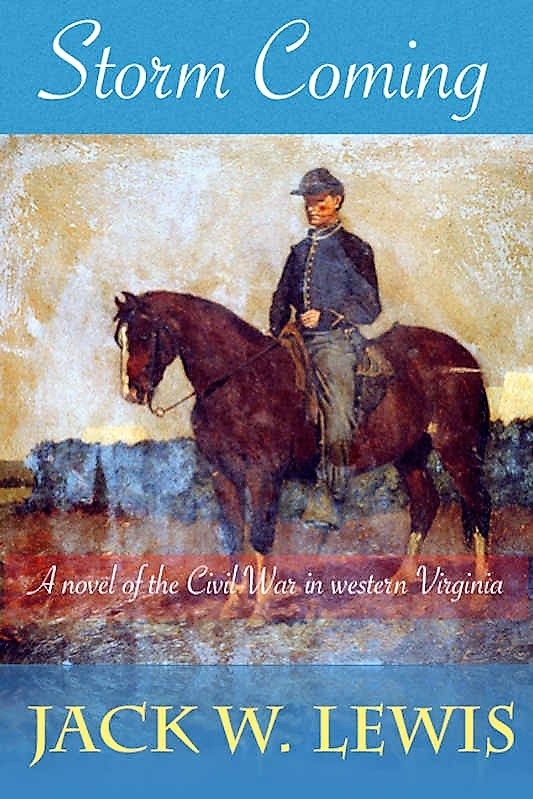
1861: Western Virginia secedes from Virginia. Live the compelling but little-known campaign of western Virginia through the eyes of the military leaders and two young volunteers in the 1st Regiment of Loyal Virginia Volunteer Cavalry. Based on a true story.
PRAISE FROM HISTORIANS: “Storm Coming is a first-rate histori cal novel, well researched and delightfully perceptive. Jack Lewis has crafted an artful account of the earl action in ‘Western’ Virginia—one of the most compelling and overlooked chapters of the Civil War.” —W. HUNTER LESSER,
author of Rebels at the Gate “…a wonderfully detailed book that comes at the twisted, confusing history of western Virginia as a story
teller would, following key historic characters, both Union and Confederate, as they negotiate the politica
More details at Battlefield Guide for Antietam
Reconstruction: A History Southern Reconstruction By Philip Leigh. Illustrations notes, bibliography, index. 28 pp. Westholme Publishin
in 1877 as is commonly taught. This book utilizes factual ana ysis to extend the work of suc pioneers as Kenneth Stampp (Th Era of Reconstruction [1965]) and C. Vann Woodward (Origins of the New South [1951])
show how previous emphasis on racial equality misses the Sou economic descent to become
ruption, Control and Capitalism merely the doormat for Northern capitalism. High tariffs, discriminatory banking laws, injurious monetary policies, excessive t crippling railroad subsidies, gouging by Northern trusts and most importantly political exploitation kept the South in poverty, illiteracy and economic peonage for a century after the Civil War. Racial equality, long the mantra of Radical Republicans, took a back seat to greed, political dominance and punishment. The South was to be nothing more than a subjugated province whose resources were mined for the benefit of the Nor and the dominance of Radical Republicanism. The author forecasts how this exploitation led to the South’s myth of the Lost Cause where the dignity of its past, the val
of its soldiers, and the uplifti of sectional pride was all it ha
left. This is still a battle bei fought today over the preservation of the Confederate past and the fight for a fair share of fe largesse to make up for decades
thus characterized by incompetence and corruption where newly freed slaves, carpetbaggers and
scalawags engaged in an orgy of theft, mismanagement and political skullduggery. The result was a South unable to restart its economy after the war and burdened with increased debt, higher taxes, educational deficiency and the migration of the best and brightest to the North. Ultimately this led to increased racial animosity, a fracturing of the Republican Party, the rise of the solid Democratic South and decades of subsistence living and endemic poverty. World Wars I and II serve as excellent examples of the impact of different reconstruction policies. The crushing debt imposed on Germany after WWI led to a decimated economy (much like the South). The result was the rise of Hitler. Conversely, after WWII Americans assisted Germany and Japan in rebuilding and incubated
vibrant economies and political allies. How different the South
may have developed if Reconstruction would have followed benevolent Lincolnian policy. Perhaps white and black would have coalesced to the benefit of
both and the lingering effects of slavery consigned to history.
The only criticism of the data is the author’s use of vague descriptors, e.g., a Confederate Confederate Heroines The young book cover is two corporals and 120 other military cour quinine, cutt seducing Unio of courage, l Hardcover, Ou Availa “used bu
general or an attorney general, where naming these individuals would clarify the text. Likewise black elected leaders like P.B.S Pinchback are either omitted or again referenced only by positio Regardless, this book would be a welcome addition for researchers of Southern Reconstruction, the rise of the Klu Klux Klan or Southern Democratic politics after the war.
Wayne L. Wolf is Professor Emeritus at South Suburban College of Illinois and Past President of the Lincoln-Davis Civil War Roundtable. He is currently researching newly discovered letters of Bvt. Brig. Gen. Clark Edwards of the 5th Maine Regiment.
Southern woman on the Emma Kline, guarded by of the 5th Iowa Infantry. She women were tried by Union s for acts such as smuggling ng telegraph wires, and soldiers – stirring stories yalty, and endurance. 40 pgs. Fully indexed. of print. le on Amazon,
My first impress is going to be jus ter book! However, pages in I realize the case. Over the there have been se tellings of this s
on was, thi another Cr just a few this was n past decade eral excell ory. Most a
activities leading up to, descriptions of the action and its tragic
aftermath. Most are highly opinionated accounts and virtually all leave out certain aspects of the affair, including participation of African Americans and respon-
sibility for events that happened. That is not the case here. In just 139 pages of text Mr. Levin describes the planning, battle and aftermath in succinct fashion. It is well annotated and has a very pertinent list of references. However, it is not about the battle. There are many other good sources for that; Remembering the Battle of the Crater is about how this event was and is perceived in history. We are given detailed information on the influence of “The Lost Cause” on the memory of the battle, on how difficult it has been over the years to acknowledge AfricanAmerican participation, and on the surprisingly little assistance the Federal government afforded in the creation of a battlefield p that included African Americans. Each chapter deals with a different aspect of “historical
important one is the last chapte It is here that Mr. Levin brings
aspects of the story to fruition this age of political correctnes and controversy over “memorials,” I am sure this book will add fuel to the fire. Yet, in sp
of this, I applaud the author on his courage to deal head-on with the issues presented here. His straightforward, non-opinionated style is refreshing. Overall, it is a well written book. I thoroughly enjoyed it. My disappointments were few. I would have liked to have seen a bit more on the Union leadership’s failure to use the USCT as originally planned, but I guess that is for another book That aside, I highly recommend this book for its unique content and welcome its divergent opinion. It is a bit pricy for a paperback, but worth the cost.
Joseph Truglio is a lifelong student of the American Civil Wa He is currently President of the Phil Kearny Civil War Round Tabl in Wayne, N.J., and is researchi the life of John M. Chivington.
eadlines Advertis or Edito missions 20th of th. Emai ilwarnew