Joseph Medill is in Lincoln circles bring him and his attention of Civil as well. In the mi century Medill was the Chicago Tribun ant Republican new 1861 his brother W in a 3-month caval Chicago; later tha came an officer in Cavalry. This book series of wartime various members of family, although m ters are from Will
glimpse into the e Union soldiers. William and Jose were both strong R
of Journa on Under etters and nd Joseph rgiann s, bibliog 2018. Kent s, kentsta
ll known his book w ily to the r enthusia ineteenth e editor o an importper. In iam enlist unit from ear he bee 8th Illi produces a ters to/fr e Medill of the le to Joseph
Union POW Camp who advocated for the destructi of slavery. Ironically, William also defended Union general George B. McClellan in the early months of 1862, although he would come to loathe “Little Mac” by the end of the year. Hi letters detail interactions wit slaves and white southerners an offer pointed commentary on the landscapes of Virginia. When he visited the site where Georg Washington had courted Martha Custis, he wrote, “Romance is written everywhere, and I wonde not that Washington’s heart was filled with love while stopped the [plantation]. Even I would tempted to make love to a handsome widow if I found one in such a delightful spot.” By the summer of 1862 Willia started to think about resignin his commission. He was “disgusted and disheartened” with the lack of progress by the arm as well as the way that Union soldiers were required to prote Confederate property. “Our generals will never put down this slaveholders’ rebellion by purs ing a proslavery policy,” he wr in June 1862. “We must knock away this great pillar of their ifice, else we shall never succ in putting down the revolt.” William finally tendered his ignation in August but his supe ors refused to accept it. He fo renewed joy in the army, though when his younger brother Samuel joined his regiment in Septembe “His initiation into the regime was on the morning of the great battle of Antietam Creek,” wrot William. “The regiment was moving forward at the time he arrived and in twenty minutes
after I shook hands with him, w were in advance of all the line
perienced.” William watched his little brother withstand “the f first-rate,” remarking, “I don’ think he was frightened much.”
Unfortunately, other health issues caused Samuel to leave the army within a few weeks. William’s correspondence includes personal reflections, accounts of military operations, and astute political observations. Some of the most telling passages offer details about how his regiment worked to free as many slaves as they could, and how William cared for a fourteen-year-old Virginia slave who had lost his family through slave sales. But the most touching part of the book comes at the end. William was mortally wounded on July 6, 1863, a few days after the battle of Gettysburg. Joseph rushed to the hospital to care for his brother and kept a detailed diary over the ensuing ten days, until William finally died on July 16. Joseph’s diary brings readers right to William’s deathbed in a way that few period sources do so vividly. A Family and a Nation Under Fire is an excellent volume that will appeal to readers interested in the military and political history of the Civil War. The book is ably edited and annotated, and the personal correspondence from this family of journalists makes for fascinating reading.
Jonathan W. White is the author or editor of 8 books about the Civil War, including Midnight in America: Darkness, Sleep, and Dreams during the Civil War (2017) and “Our Little Monitor”: The Greatest Invention of the Civil War (2018) with Anna Gibson Holloway.
Vol. 42, No. 3 Battlefield Of Franklin Land Pres By GreGory L. Wade FRANKLIN, Tenn. — What is considered the bloodiest acreage
the Nov. 30, 1864, Battle of Fran is now being reclaimed as part of evolving Carter Hill Battlefield Local preservation leaders recent
from owners Reid and Brenda Lovell after a months-long proces
of coordinating various funding sources for the critical 1.6 acre adjoin the Carter House, a major battle landmark. Details were recently provided a press conference led by Frankli
Charge board member Julian Bibb, who praised the “remarkable transition” of the Franklin battlefie
Franklin’s Charge is a coalition civic and preservation groups who joined together more than ten yea ago to purchase local battlegroun Over 150 years ago the Army of Tennessee stepped off in a series of charges to be virtually destro by Federals under John Schofield hopes of taking Franklin and late Nashville.
was open farmland on the outskirt of what was once a small Middle Tennessee farming community. Over time development covered much of the battlefield with houses, ligh dustry, and small businesses. All that remained of the criti area where the Confederates tem-
porarily broke the Federal line w the small farmhouse and a few acr known as the Carter House farm. The 1.6 acres purchased, which adjoin the southern boundary of t Carter House property, is compris of two lots. Today, they are occu
that were turned over to the City of Franklin Parks Department by Franklin’s Charge and the Battle o
Franklin’s Trust (BOFT), managers of the Carter House the nearby Car ton Plantation. The structures wil removed in coming months, possibly relocated for other use. The purchase is only the latest in a long and arduous effort to re
build the Franklin battlefield. “It had to be a miracle,” quipp Civil War Trust (CWT) President James Lighthizer, referring to the most recent acquisition. Local res ident Michael Grainger, long time
Trust board member and former chairman, said, “Local leadership has been incredible and will conti
ue to be a partner [with the CWT]. In 2005, after years of frustra attempting to preserve Franklin ba tleground, local preservationists cided it would have to be done the hard way, by buying properties, of ten with buildings on them. The largest parcel of land was originally a local golf course sla to be sold to a developer to build
of the Confederate attack north to ward the Federal lines just south the town. It was then that Franklin’s Cha came into existence. Funds have
chase from private donors, the CWT the City of Franklin and others. T
110-acre segment, now fully interpreted and known as the Eastern Flank Battlefield, is what got the preservation ball rolling in Frank Since that time nine other parc in proximity to the Carter House have been purchased and have been, or will be, turned over to the Fra
lin Parks Department, according t Bibb. But it was the land just south Carter House, long considered the
most bloodied ground in Franklin, and some say in America, that was the most coveted. BOFT Chief Executive Officer Eric Jacobson noted, “to not have this ground reclaimed and preserv would be like having Omaha Beach cut out of Normandy.” The most recent acquisition
evolved when Franklin’s Charge an the BOFT began discussions with t Lovells, who have a strong sense the history of the land, having g up in Franklin. “I was born and raised in Fran lin on ground many believe should have been a national park,” said Lovell. He recalled when visitors came to town and had to envision
what happened, not walk on ground where it transpired. “My great-grandfather, who fou here, and my parents would be pro
of what we are doing here today,” said at the press conference. The Franklin Board of Mayor and Aldermen voted unanimously in February to fund part of the
remaining debt on the Lovell property purchase. The previously
paid by the city on a non-interes basis over seven years. These funds will cover the bal now bridged by a local bank and w be derived from the city’s hotel-
tel tax. Local banker Chuck Isaac was instrumental in working out t
by his employer, First Farmers an Merchants Bank.
Confederate Prisoners at Fort Delaware: The Legend of Mistreatment Reexamined. By Joel D. Citron. Photos, endnotes, index, illustrations, ta graphs, bibliography, 238 pp.,
No prisoner-of-war camp is a pleasant place to be. No one would dispute that. However, fo many decades—since 1861 probably—Americans have argued about the relative conditions o Northern and Southern prisons. As important as the conditions themselves is the question of t cause. What led to the inhumane circumstances which created so much suffering? One commonly-held view is that the squali conditions in Confederate priso were due to a lack of resources while Confederate prisoners in the North suffered because of retaliatory measures adopted by the United States government. The late Joel Citron, a chemist
by profession, was a long-time volunteer at Fort Delaware Stat
“The goal of this study,” he writes in the preface, “was to find as many contemporaneous primary sources of information about what happened...and to an alyze what these primary sources reveal.” The author pored through over 20 diaries and the relevant documents in the Offic Records. In addition, Citron
found many unpublished and previously unused documents in the
National Archives that relate t the prison. The research led hi
The work includes a great dea of quantitative analysis related rations, death rates and medical care. It also includes descripti of the prison’s physical plant a Pea Patch Island on which the prison was located; the prison’s administration and the military bureaucracy which oversaw operations; and the daily life of prisoners and their guards. Citron concludes that the pri oners fared reasonably well at Fort Delaware; that the food, shelter and medical care were generally adequate; that camp discipline was not unduly harsh; that the death rates (the proof the pudding, if you will) were lower than at other Northern and Southern prisons. (The adjective and adverbs in the foregoing sen tence, and especially in the las clause, are employed with the understanding that we are talkin about a facility in wartime—and about events that occurred in th mid-19th century, when medical science and understanding of the causes of disease were primitive compared to the present. We must keep in mind that soldiers died of disease every day of the war, whether they were in prison or not.) Citron makes a strong case. However, in one way his methodology—his exclusive reliance on contemporaneous sources—is questionable. There is no doubt that contemporaneous sources are preferable in most circumstances, but should all others b dismissed wholesale? Shouldn’t they be consulted, compared to other sources, assessed and used with care to complete the
picture? One example is a 1905 Confederate Veteran article, wri
appear in Citron’s work. Moffett claimed that hanging prisoners by their thumbs was “a daily occurrence,” while Citron gives ju a few examples of this torture a then changes the subject. Should this allegation of dai torture be ignored? Moffett said that Fort Delaware was “infinite ly worse” than Camp Chase.
While Delaware’s commandant was a “Hessian brute,” the offic
in charge of Chase was “a soldier with gentlemanly instincts.
H POW Camp . . . . . . . . . . from page 41 to Camp Chase? Perhaps the judicious use of sources like this could add to our knowledge. The book is not an easy read. There are some stylistic issues that are distracting and in plac es the writing could be more spirited. These are minor matters, however. The main reason Confederate Prisoners at Fort Delaware is not a page turner is because it is not meant to be. I is a detailed analysis and requi work on the reader’s part. Citron explicitly limits his clusions to Fort Delaware and suggests that studies similar to be undertaken for other Northern prisons. He has already uncovered long-ignored boxes of records. Perhaps another researche could dig through them and see i there is something to learn abou Elmira, Camp Douglas and Point Lookout.
Gould Hagler is a retired lobbyist living in Dunwoody, Ga. He i a past president of the Atlanta Civil War Round Table and the author Georgia’s Confederate Monuments: In Honor of a Fallen Nation, published by Mercer University Press in 2014. Hagler speaks frequently on this topic and others related to different aspects of the Civil War and has been a regular contributor to CW since 2016. He can be reached at
Fresh Look at the Confederate March to Gettysburg
At the Forefront of Lee’s Within ten days and with Brig Invasion: Retribution, Plunder, Gen. Robert Rodes’ brigade in and Clashing Cultures on the lead, Confederate forces Richard S. Ewell’s Road had swept all Union forces from to Gettysburg. By Robert J. western Virginia’s Shenandoah Wynstra. Illustrations, maps, Valley, which included victories notes, bibliography, index, 352 at Berryville and Martinsburg. pp. Kent State University Press, By June 15, Ewell’s lead columns
visit to northern territory. Reviewed by Paul Taylor The Confederacy needed supplies for its depleted ranks. As with the Antietam campaign nine months earlier, one of Lee’s par amount concerns was feeding his always hungry army and perhaps more importantly, gaining diplomatic recognition from England and France. They were confident that one more victory, especiall on northern soil, might bring th recognition. Wynstra amply depicts the tactical maneuvering and the resultant skirmishing with norther militia. Five maps are included illustrating corps and division routes of march through Virginia Maryland and Pennsylvania. However, it is the Confederate supply demands and requisition tactics throughout Maryland and On June 4, 1863, the three Pennsylvania—and the civilians’ corps of General Robert E. Lee’s response to those ultimatums— Army of Northern Virginia began that form this book’s essence. marching northward from their The author describes how Virginia camps to begin what the Confederates’ reception by would become the second inva- Maryland residents was genersion of northern soil. This new ally more welcoming than in the work by Robert Wynstra focuses prior campaign; nevertheless, th on the march of General Richard soldiers’ desire for revenge ran Ewell’s Second Corps, which led deep. Consequently Lee issued the advance. explicit orders forbidding his
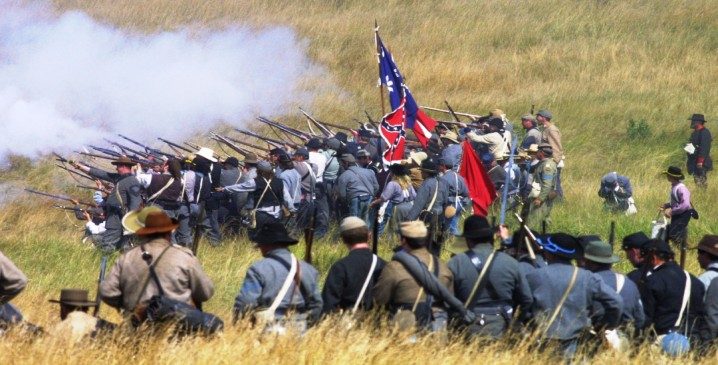
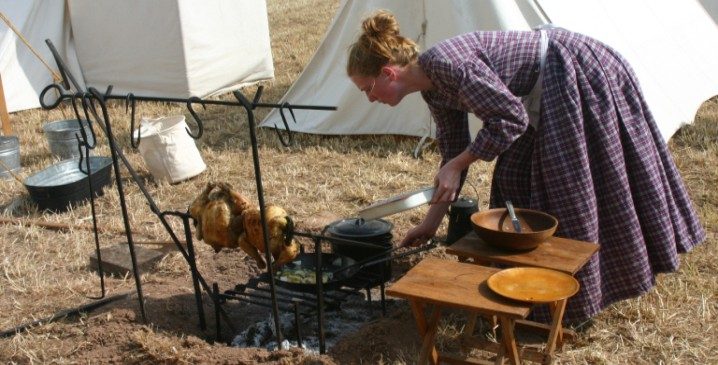
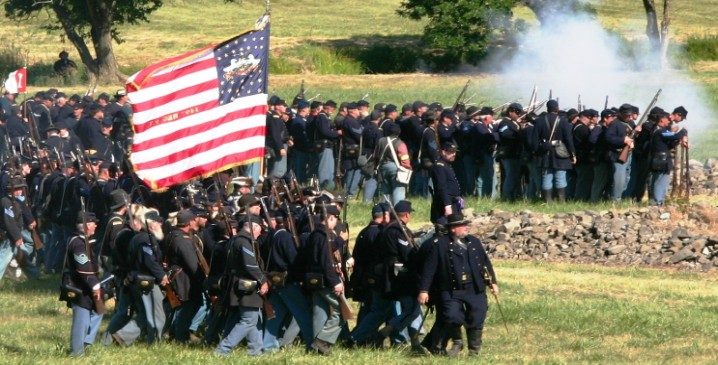
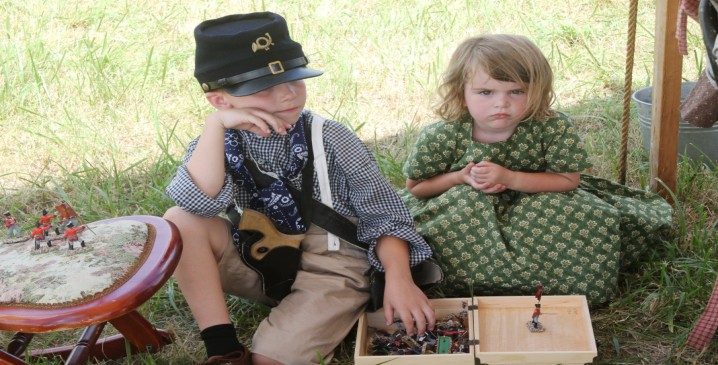
Ta p t o L i v e C i v i l Wa r M u s i Obser ve Medical Demonstrations
Interact in the Living Histor y Village Stroll the Military Camps View Mor tar Fire Demonstrations
Take Part in a Period Worship Service Enjoy the Food/Bevera ge Vendors
men to plunder or take private property of no military value, except by officers so designated to requisition necessary supplies How Lee’s senior officers strove to enforce the general’s edict against the army’s legitimate sup ply needs and some men’s longing for retribution is a core foc in this book. Those officers in charge of ga ering supplies confiscated whatever they needed, “paying” businesses and individuals for their booty in worthless Confederate scrip or receipts. They quickly realized they would be able to comfortably live off the land and off these confiscations while realizing that any local militia re sistance could be easily swatted away. As one Confederate soldier famously asked of the terrified northern civilians, “How do you like this way of our coming back into the Union?” Confederate officers reassured shopkeepers that if the South won the war, the Confederacy would reimburse their losses in gold. I the South lost, however, it would be up to the U.S. Government. In any event, few civilians or business owners ever saw the first nickel in compensation. Wynstra illustrates how the Confederates were well aware of the financial distress their confiscations plac on the northern population and were quite pleased by it. Confederate soldiers did not limit their spoils to foodstuffs, medicines, clothing, livestock, or other supplies of military
value, either. Any blacks they came across—allegedly slave or free—were rounded up to be sent back south into bondage. Such seizures were considered by the Confederates to be no different than confiscating horses or cattle and were carried out with the sanction and knowledge of their commanding officers. Meanwhile, southern slave catchers and owners followed closely behind the army in order to claim their “property.” The author utilized period newspapers as well as dozens upon dozens of manuscript sources from both northern civilians and Confederate soldiers to describe how and to what degree the southern soldiers confiscated what they needed. Many of these men were in awe at the rich bounty of food and supply all around them. Despite that material abundance, however, those same men often had little good to say with in their diaries and letters abou the local people who produced such wealth. This was especially prevalent within the German immigrant communities in south Pennsylvania. Instead, they derisively claimed the hated “Dutch” were merely part of a corrupted culture that placed monetary wealth above social refinement. Wynstra’s excellent book is not the first to cover the Confederat advance into Maryland and Pennsylvania. Jacob Hoke, a Chambersburg eyewitness, first penned The Great Invasion of 1863 in 1887. That was followed by Wilbur Nye’s Here Come the Rebels! over 75 years later in 1965. Both works are considered essential components of a Gettysburg bookshelf. John W. Schildt’s Roads to Gettysburg (1978) and Bradley M Gottfried’s Roads to Gettysburg: Lee’s Invasion of the North, 1863 (2001) are more recent additions to this small canon. Even so, with its rich use of u
common primary sources and insightful analysis, At the Forefro is a worthy successor to these previous volumes that covered the Confederate march to destiny: a four-week campaign that succeeded admirably at refitting and feeding Lee’s legions, but hardly compensated for the forthcoming devastation at Gettysburg. Paul Taylor is an award-winning author of seven books pertaining to the Civil War era. His newest
book is titled “The Most Complete Political Machine Ever Known”: The North’s Union Leagues in the American Civil War, published by Kent State University Press.