. Lundberg ry’s Texas de: Diehar Confedera Louisiana ersity Pre
it interes most famou the Confed rn Virgini te Army of om… guessed i Texas Brig
Lee’s army, has admittedly more chroniclers, from Col. Harold B. Simpson to (more recently) Prof. Susannah Ural of the University of Southern Mississippi. Now, Granbury’s Texas Brigade, of Pat Cleburne’s Division in the army of Braxton Bragg, Joseph E. Johnston, and John B. Hood, has had its story definitively tol in Granbury’s Texas Brigade: Diehard Western Confederates, by Prof. John Lundberg, who teaches in Fort Worth. It is the story, as the author states, of “perhaps the premier brigade in the premier division in the Confederate Army of Tennessee.” In his very first paragraphs, t author poses the key question that he pursues in his narrative of the brigade: “why did Confederate soldiers stay with the cause as long as they did?” The eight regiments that eventually formed the brigade led by Brig. Gen. Hiram Bronson Granbury offer a collective story of patriotism and battle ardor, but also garrison surrender and deadly imprisonment. The cavalry regiments merged into the brigade suffered the indignity of government-ordered dismounting (and subsequent desertion). Long-distance assignment east of the Mississippi led some Texans to drift back so as to fight closer to home. Still, the veterans who stayed in the ranks evidenced a stalwart devotion to the Confederate cause. Dr. Lundberg offers a corollary question: “why in particular did Confederate soldiers in the western theater, deprived of battlefield victories and effectiv army leadership, fight for so long?” Are you hooked yet? I was. Take the 7th Texas Infantry. Organized in September 1861, it was assigned to duty at Fort Donelson and there was surrendered in February 1862. During seven months in captivity, 62 of the 379 prisoners died at Camp Douglas. Of the survivors, Lundberg explains, “the men of the 7th Texas remained more willing than ever to lay down their lives for the Confederacy, a fact that belies the argument that Confederate soldiers lost faith in their cause in the face of adversi ty.” Indeed, the author concludes that “the casualties suffered at Donelson and in prison served to
bind the Texans closer together and strengthened their resolve.” The author also examines desertion by Texas cavalrymen after the government confiscated their horses in the summer of 1862. In the 15th mounted regiment, some 80 men deserted; 140 men deserted in July from the 17th Texas Cavalry. In the 18th Texas Cavalry, 180 slipped away from camp. Altogether the desertions and resignations amounted to sixteen percent of the three regiments’ strength at the time. Here’s the interesting part. Lundberg followed the deserters through the war, and found that “even though these Texans deserted their original regiments, most of them returned home and joined regiments in the TransMississippi Department or in Texas itself.” In other words, “when the Confederate officials decided to dismount the cavalry regiments…in 1862, it did not erase their loyalty to t Confederacy or their desire to d fend the Southern way of life. I merely changed how and where they would fight.” Assignment to Arkansas Post on the Arkansas River, maybe twenty miles from the Mississippi, brought the 6th and 10th Texas Infantry together wit the 15th, 17th, 18th, 24th, and 25th Texas Dismounted Cavalry. The Confederate surrender of the place, in January 1863, sent 3,912 officers and men, in regiments that would eventually form Granbury’s Brigade, to Northern prisons. Before they were exchanged in April ’63, twenty to twenty-five percent died. The su vivors were assigned to Braxton Bragg’s Army of Tennessee the following month. So many had died in prison that Bragg ordered the seven Arkansas Post regiments consolidated into two. The 6th and 10th Infantry joined the 15th
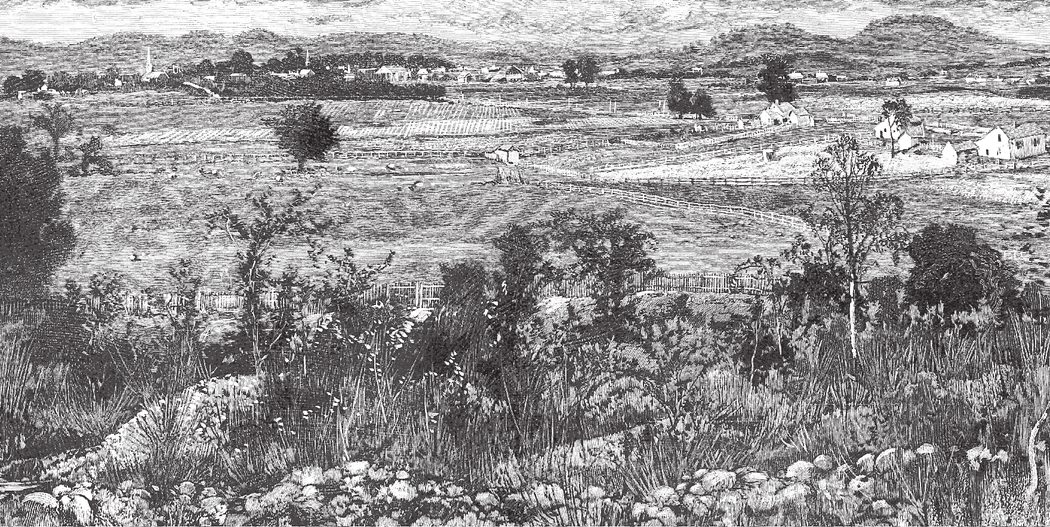
View north from Hood’s headquart Winstead Hill before the Battle
Dismounted; the 17th, 18th, 24th and 25th Dismounted formed a second Texas regiment. These units became part of Brig. Gen. Thomas J. Churchill’s Brigade of Cleburne’s Division. After Churchill requested transfer farther west, the briga came under the command of Brig. Gen. James Deshler in late July 1863. The Texans fought at Chickamauga, where Deshler was killed. Succeeding him was Brigadier James A. Smith, who was wounded at Missionary Ridge. Two weeks previous, the 7th Texas Infantry, Col. Hiram Granbury’s regiment, had been added to the brigade. To replace Smith, Cleburne assigned Granbury, whose promotion to brigadier general followed in March 1864. In the Atlanta Campaign, Granbury’s Brigade shone in the Battle of Pickett’s Mill, fought May 27, twenty-five miles northwest of Atlanta. A few weeks lat er, the 5th Confederate Regiment joined Granbury’s Brigade. But the unit continued to be called the Texas Brigade of the Army of Tennessee. In the battle fought July 22 east of Atlanta, Lundberg states that “the Texans captured fiftee pieces of artillery, two stand o colors, numerous ambulances and a brigade commander,” Col. Robert Scott. “They could also take credit for the demise James McPherson at the hands of the 5th Confederate.” Indeed, history has handed down that it was Capt. Richard Beard of the 5th who fired upon and killed Maj. Gen. McPherson, commander of the Union Army of the Tennessee. “Granbury’s Texas Brigade served as the shock troops, the diehard Confederates of the Confederate Army of Tennessee for roughly a year, from its for mation in November 1863 to
n Winstead Hill. General Hood’s anklin. (engraving from Battles
Stephen Davis’ article, “Simply Criminal,” on the battle of Picke Mill, appears in the May 2019 iss of America’s Civil War. Civil War News of January 2019 also carried Steve’s article about an incident of that battle—how Union soldiers complained that all the bugling from Willich’s brigade alerted Confederates of their march to Pickett’s Mill. He and Bill Hendr are working on a book on the Atlanta Daily intelligencer, lead wartime newspaper in the city.
2019 Chancellorsville t’s May and time to think abou tory. My questions and answers rs’ Chancellorsville (Boston, The Union XI Corps had the ill fortune to be positioned o the right flank of the Federal line in the Wilderness. Who was its commander? Lee wrote President Davis on May 4: “I regret to state that General _____was killed. General Jackson was seriously, and Generals Heth and A. P. Hill slightly wounded.” Which Confederate general was killed at Chancellorsville? (a) Lewis Armistead (b) Isaac Trimble (c) William Pendleton (d) Frank Paxton. “My plans are perfect, and when I start to carry them out, may God have mercy on General Lee, for I will have none.” Who said this? The Confederate infantrymen who fired into Jackson’s and A.P. Hill’s parties on the evening of May 2 were from which state? Commander of the Cavalry Corps, Army of the Potomac, was this general, who set out on April 13 in a diversionary raid against the Richmond, Fredericksburg & Potomac Railroad. Who? Who was the Confederate surgeon who performed the amputation of General Jackson’s left arm? Commander of the Union V Corps at Chancellorsville Deadlines for Advertising Submissions is the 20th of
Publishers: Send your book(s) fo CWN Book Review Edi Stephen Davis 670 Falling Leaf Lane, Cumming
bert E. Lee’s historic e from Stephen W. ). was this major general, who seven weeks later would become commander of the Army of the Potomac. Who? 8. “At Chancellorsville we gained another victory; our people were wild with delight—I, on the contrary, was more depressed than after Fredericksburg; our lo was severe, and again we gained not an inch of ground and the enemy could not be pursued.” Who wrote this? 9. On his way to review the Federal army in early April, this politician heard his dr er cursing at his mules. He asked the driver if he were Episcopalian. No, came the reply; he was a Methodist. “Well, I thought you must be an Episcopalian, because you swear just like Governor Seward, who is a churchwarden.” Who said this? 10. Stonewall Jackson’s cartographer estimated that his march route to get in position for the Confederate fla attack of May 2 was ten to twelve miles. Who was the mapmaker?
Answers found on page 40. Steve Davis is the Civil War New Book Review Editor. He can be contacted by email at: