Mary Lincoln is perhaps the most maligned and misunderstood first lady in history. This is the impression I took away from the opening essay of Jason Emerson’s valuable new book, which is a unique new research tool for all Lincoln scholars. Unless you have more than a curious interest in Mary Lincoln this may not be the book for you. In the relatively short space of 213 pages, the reader can find
used entrenchments, r communications. It was also the first Mathew Brady, Alexand having made iconic ph George N. Barnard des
A civilian photograph take pictures of fort them in and around th 100 Significant Civil War Photographs: Union Maj. Gen. James 1864.
Thus far, no comprehe Atlanta Campaign presents a riveting work. The Library of Congre
Point, New York, has collection of George Barnard’s camera Other repositories, s
For this book we have work. Most of the photographs are from other students may wo
Barnardiana, and that Barnard’s time in Atlanta, mid-September
to mid-November 1864, during the Federal occupation of the city.
With this volume, Stephen Davis advances the scholarly literature of
an War to be exte ner and Timothy O hs in the Civil W o be ranked in th
d by Gen. William ons around Atlant in the fall of 18
virtually everything ever writte about Mary. Presented in chronological or der are histories, newspaper art cles, essays, interviews, dramas poetry, musicals, etc. Also included is an index and note sections. Each entry has a short an ysis included to give the reader an understanding of the gist of that specific presentation. I fo this particularly helpful in sel ing appropriate research items. The opening essay, “Common Canon of Mary Lincoln,” is the author’s opinions on how Mary has been treated over the years by historians. He is critical of some for repeating inaccuracies, like Jean Baker and William Herndon, and praises others like Frank Williams and Michael Burlingame. However, at no time did I feel Mr. Emerson was trying to influence my opinions, bu rather guiding me to seek out ad ditional information. As I have said before, this i valuable tool for serious studen This book presents a road map to learning what Mary Lincoln was really about. It should be on ev eryone’s bookshelf. I highly rec ommend it.
Joseph Truglio, of Manchester, N.J., is a retired Motion Pictur Technician who has a life long in-terest in the Civil War. He i cur-rently President of the Phil Kearny CWRT in Hasbrouck Heights, N.J.
ief engineer to several hundred of ous is the site of
Lincoln’s State Legislative Career Proved Formative Lincoln in the State Legislature. By Ron J. Keller. Notes, index, 176 pp., 2020. Southern Illinois University
On December 5, 1840, Abraham Lincoln leapt from a window. In a convincing display of his physical and political ag ty, the lanky Whig representativ from Sangamon County sought to deny the Illinois General Assembly a quorum. Lincoln successfully escaped the legisla tive body’s temporary chambers, though his daring effort ultimat ly failed to spare the state ban from its Democratic foes. The ep isode supplied plenty of copy fo the contemporary press, but biog raphers and historians have paid
it, and Lincoln’s four terms in Illinois House of Representative
relatively little notice. Such inattention is not exact difficult to explain. Much of th
state legislator was occupied by tedious debates about internal
contends in this deftly argued and well written addition to Southern Illinois University
Press’s Concise Lincoln Library, “through his service in the
Illinois legislature,” Lincoln’s “true calling as a humble servan of the people has unmistakably
emerged” (127). It was during his service in the Illinois Gener Assembly, the author contends, that Lincoln found his political voice and “wrestled with his moral convictions” (127). Keller tracks these developments alongside the struggles Lincoln faced in his personal life, locating bo in the larger narratives of state and national politics. The author excels at contextualizing his story. Lincoln’s tenu as state legislator coincided wit the heyday of a “transportation revolution” that gouged canals into the earth, macadamized a warren of roads, and belted the nation with iron rails. As a Whig Lincoln championed these “internal improvements,” deeming them vital to the state’s future. Neither public opinion, which increasingly turned against the projects, nor the state’s spirali debt could dissuade the so-called “DeWitt Clinton of Illinois.” Lincoln’s time in Vandalia and Springfield likewise coincided with the congealing of a second party system and a new, more boisterous political style. In Keller’s rendering, Lincoln emerges as a clever and sometimes cutthroat politician. The Lincoln here is hardly the folksy prairie statesman of popular memory. As a member of the “Long Nine,” the all-powerful Sangamon County delegation in Vandalia, Lincoln muscled through infrastructure bills, bar gained for votes, and “learned to wield political tools to achieve
larger political aims” (60). He perfected the art of the public l
ter and pseudonymous journalism; the latter almost occasioned
the respect of his peers, who selected him as Whig floor leader. Perhaps the most significant act of his state legislative career was casting one of just five votes against a resolution decrying abolitionists and frowning on “any attempt by Congress to abolish slavery in the District o Columbia without the consent of the people in that district” (74) What was more, Lincoln penned a statement (together with Dan Stone, a colleague who voted against the measure) explaining his position. While expressing no sympathy for abolitionism, Lincoln and Stone identified slav ery as “founded on both injustice and bad policy” (75). If the campaign autobiography he prepared for John Scripps is any index, Lincoln considered his “protest” against the anti-ab olition measure the highlight of his tenure as a state legislator. the time he turned his attention to a burgeoning law practice, the internal improvements bill had been repealed and the state bank’ charter revoked. Yet he had tutored himself in the workings of politics and party loyalty. What was more, Lincoln’s first taste o political influence left him crav ing more. As his later law partner William Herndon aptly put it, Lincoln’s ambition was “a little engine that knew no rest.” Not unlike the one Lincoln leapt from, Keller has provided an accessible window into the future president’s formative years.
Brian Matthew Jordan is Assistant Professor of Civil War History at
Sam Houston State University and author of Marching Home, which was a finalist for the Pulitzer P
in Civil War Women’s History The Women’s Fight: The
Civil War’s Battles for Home, Freedom, and Nation. By Thavolia Glymph. Photos, notes, index, 379 pp., 2020. UNC Press,
In this long awaited contribu tion to the University of North Carolina Press’s Littlefi History of the Civil War Era series, Thavolia Glymph, a professor of history and law at Duke University and a leading authority on slavery and emancipation, offers a stunning reassess ment of how women experienced the nation’s defining conflict. Discarding old paradigms and amplifying new voices, Glymph weaves a more complete, more nuanced, and ultimately more human history of the war. Throughout, she is attentive to the diversity and multivocality women’s experiences. The war brought women together in new combinations, exposing old tensions and hierarchies, but faile to forge a “sisterhood” that cou transcend race, class, politics, section. While historians in recent de cades have produced an impressive body of work illuminating the lives of women and building connections between the war’s military and non-military
a full accounting of women’s participation in the conflict remains elusive. In particular, poor, non-slaveholding white and African American women are neglected in the literature. Rooted in archival spadework and punctuated with keen historiographical insights that will have students of the war nodding and underlining, The Women’s Fight serves up a range of interpretive possibilities. Juxtaposing white and black, rich and poor, norther and southern women, Glymph reveals that the War was not just a contest between men, but “a fight among and between women” as well (15). The book is divided into three sections. The first considers southern women. “The Civil War,” the author writes, “set women across the South in flight” (20). War, occupation, and the collapse of slavery “forced reckonings in the meaning of home that white Southerners had not anticipated” (21). As slaveholding women took to the road and sought refuge from the invading Yankees, they came into close contact with poor women, competing for dwindling food, space, and resources in ways that raised troubling questions about the Confederate experiment. While the war congested the roads with refugees, it nonetheless “enlarge the space for the slaves’ war,” and “opened to wider view existing crevices in Southern slave society” (89-90). Black women “fought, prayed, sacrificed, and died” for the Union (88). The second section turns to th experiences of northern women. Glymph reminds the reader that “the vast majority of white Northern women and men neither began nor ended the war as abolitionists, though their ranks gr and deepened over the course of the war” (158). The author tallie the benevolent and relief work of northern women, but without the usual dose of sentimentalism or celebration. Scholars, she argues have not yet accounted for “the class antagonism and racism that
States Sanitary Commission (150). Such assumptions factor into the next chapter, which considers Northern women who hurried South during the war as missionaries, teachers, and relief workers. Once again, the war brought women together, in this case, black women and white northern abolitionists. Yet they occupied uneven ground. “Refusing a sisterhood of equality with black women,” Glymph concludes, white northern women “helped to refurbish the racial ideology tha had defended slavery and would work to constrain black women’s lives for decades to come” (195). The final section explores how women experienced the “hard hand of war.” Excellent recent books by Stephanie McCurry and Amy Murrell Taylor have tilled some of this ground, but Glymph further dissolves the fictive boundary between the battlefield and home front. In particular, sh reminds us that memories of the American Revolution informed southern women’s experiences of military occupation. A wrenching chapter on slave refugee camps recalls the unique path out of bondage for African American women, a path marked by withheld wages, sexualized violence, and attacks from Confederate guerrillas. The bone-grinding toi of black women on behalf of the Union war effort has remained invisible, but placed emancipation undeniably at the center of the war. The best books raise more ques tions than they answer. By that measure, The Women’s Fight is a triumph. To its agenda for future research, however, I would add a fuller accounting of the lives of young women, soldiers’ mothers, veterans’ wives, and widows. The author has focused our attention on how antebellum experiences informed wartime actions, but we need much more work on how wartime events shaped postwar lives. Serious students o the war and general readers alike will profit from this major work that boldly reimagines Civil War women’s history as something more than sewing circles, bandage rolling, and relief work.
Brian Matthew Jordan teaches Civil War history at Sam Houston State University. His bo Marching Home was a finalist for
“the boys have to keep there gunes and selvs clean I hant saw but one body louse since I left
Weigh 175 pounds” In Their Letters, In Their Words: Illinois Civil War Soldiers Write Home. Edited by Mark Flotow. Maps, photos, endnotes, bibliography, appendices, index, 320 pp., 2019. Southern
Independent researcher Mark Flotow writes in his preface that he once “sought a book like this one, but without success.” He therefore took on the work himself and did a most creditable jo In Their Letters, In Their Words draws on letters written by 165 Illinois soldiers and sail ors, all contained in the Abraham Lincoln Presidential Library. The editor presents relatively brief excerpts from the letters and con nects them with ample editorial notes that provide background and context. He also preserves the letters’ original (mis)spelli and (exceedingly sparse) punctuation. The sentence quoted above, penned by Private John Laingor, tells us something about camp life and something about John as well. Almost all letters are from so diers who served in the Western Theater, but we do sail into Port Royal Sound with a midshipman and ride in Virginia with the 8th Illinois Cavalry. Officers and enlisted men alike share their thoughts with us. The letters are arranged thematically, with each of the elev-
en chapters covering a different aspect of the war and army life.
We learn how the men become soldiers in training camp; we go with them into combat and learn
how they react when they “see the elephant”; we read their de-
in camp and on the march. One chapter deals with stationery, pens, stamps, and the process of getting letters from the military camp to the home front, things to which we give little thought, but matters of importance to the men and their families. In other chapters the soldiers opine about their generals and political leaders; give impressions of Southern people and society; and offer their perspectives on war aims, Copperheads, slavery, and the Emancipation Proclamation. The chapter on prison camps is the only one that relies mostly on postwar accounts rather than contemporary letters. After the soldiers are mustere out in the final chapter, one appendix provides brief biographical sketches of the entire cast a another offers a chronology of the war. A reader wishing to review letters written by any given soldier will find the index very useful. The readers will find differen letters to be of particular inter est. Four especially caught my attention. Col. Elmer Ellsworth wrote a moving letter to his fiancée on May 23, 1861, the day before he met his fate in an Alexandria hotel. A soldier camped near Fredericksburg wrote nine days after the Battle of Chancellorsville and told his correspondent that “we due not know what the actual result was.” There is a similar letter written from Williamsport four days after Antietam. This soldier too was in the dark, admitting to his brothe in-law that “You are better posted with regard to our movements than we are ourselves.” The last of my four was writte by an officer, a letter about another letter received by one of h men, a devastating missive which the editor says “recounted perhaps one of the worst ‘Dear John’ letters ever.”
Gould Hagler is a retired lobbyist living in Dunwoody, Ga. He is a past president of the Atlanta Civil War Round Table and the author of Georgia’s Confederate Monuments: In Honor of a Fallen
Nation, published by Mercer University Press in 2014. Hagler speaks frequently on this topic and others related to different aspects of the Civil War and has
been a regular contributor to CWN since 2016. He can be reached at
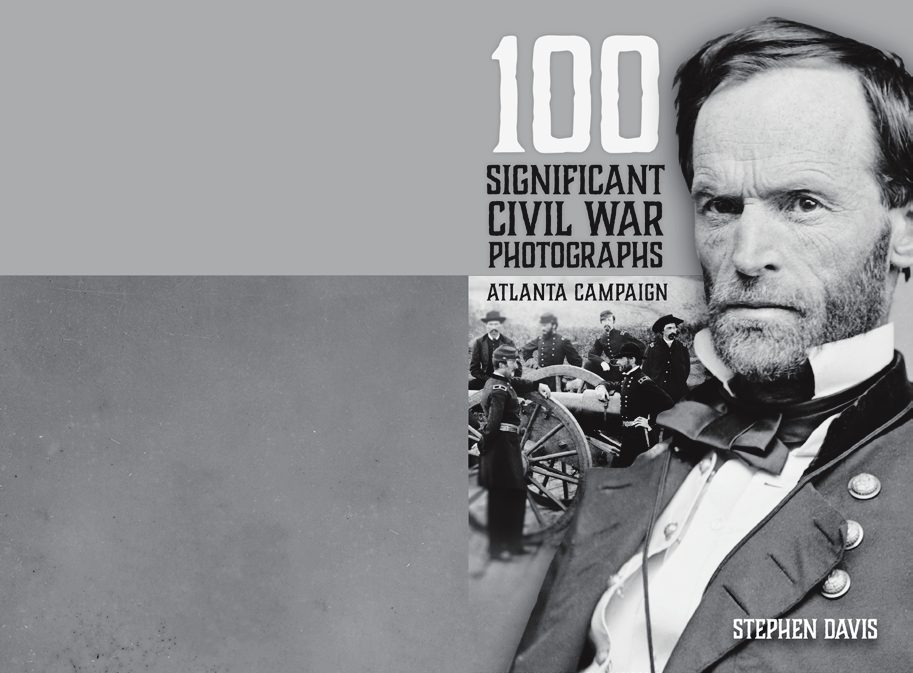
100 Significant Civil War Photographs – Charleston in the War. By Stephen Davis & Jack W. Melton Jr. Maps, photos, illustrations, bibliograph index, 160 pp., 2020. Historica
The Civil War still resonates with so many people because it was the first American war captured by cameras. Photographers using bulky equipment and work-
ing in harsh, often dangerous conditions produced a remarkable visual record that has wit stood the test of time. Not onl did they document all aspects o the war, but they did it in rem ably vivid and dramatic photos
that remain among the most famous and recognizable pictures
about Civil War photographs focuses on the place where the wa started: Charleston, S.C. Edito
sembled an impressive selection of photos taken during the four years the city was under siege. While many photographs are
520 Folly Road, Suite Charleston, SC 29 Email cover image to bookrevi
“alternative” takes made just minutes or hours apart, or in some cases, days or years apart from the better known versions. The book is thematically arranged. The first section is ap priately devoted to the men who took the photographs, most notably George N. Barnard, one of the war’s greatest photojournal ists. While there is a section voted to famous individuals, th bulk of the images are still li of buildings and various areas of Charleston. Many reminded this reviewer of the bombed cit ies of Europe at the end of Wor War II. There are once fine, st ly homes, now pock marked with holes from artillery fire. Sections of the city are burned out. Magnificent ruins of mansions and churches stand next t unharmed shanties, and vice ver sa. Perhaps most compelling is an image of Fort Sumter the day after its initial shelling, rid with holes, but still a three s structure with architectural ae thetics. Below that image is an other taken two years later sho ing the fort reduced to a one s rubble pile. The photographs have been digitally restored and look so
clean and crisp you would have thought they were just recently taken. Even if it is a picture have seen dozens of times before, the odds are good you wil see something you never noticed before. Almost every individu-
al picture is accompanied by an excellent commentary from the
picture’s significance. For anyone interested in the history of Charleston and/
rience in both photography and studying South Carolina in the
The Great Post Civil War Gold Robbery and Treasure Hunt Graball Road: The True Story of the Civil War’s
Greatest Mystery: The Lincoln County Gold Train Robbery of 1865. By Bob Young. Maps, bibliography, 195 pp., 2019, Eagle
A train carrying the Confede Treasury gold and silver reserv left Richmond on the night of April 2, 1865, just before the fell. That train also carried t gold and silver reserves of sev Richmond banks. Accompanying the cargo were clerks from both
the Confederate Treasury and th banks who took great care that the cargoes remain separate. As the Confederacy collapsed behind it, the valuable cargo wound itself further and furthe south, sometimes by train and
sometimes by wagon. It finally reached Washington, Ga., by wag
trip. The Confederate Treasury was dispersed to soldiers and o er members of the Confederate
on April 27, the Richmond banks decided it was safe to return t funds to Richmond. The clerks received travel passes from the Union Army and traveled to Georgia to bring the funds back A few days after the clerks ar-
rived in Washington, the 40 keg of gold and silver coin were lo
ed onto five wagons and left wi a light escort. They headed for Abbeville, S.C., to place the s cie on railroad cars. The first night out, not too
from Washington, the wagon train was robbed by persons un-
known. No shots were fired, and no one was ever apprehended for it. The robbery was something o a makeshift affair with the rob bers placing the gold in saddle bags, feed sacks, and, reported trousers tied at the leg. Not a
in gold coins was found on the ground after the wagon train le to return to Washington the nex morning. Most, if not all, the robber ex-Confederate soldiers, many from Tennessee or Kentucky, who had been paroled and were reluctant to return home due to the uncertainty of their welcom It turned out that many thought the funds were Confederate and didn’t think of it as robbery. On that basis, some loot was returned, eventually amount-
The final results were: 1. The Union Army search for the robbers became something of a reign of ter ror, using torture to obtai information. 2. The Federal treasury placed
ing that it must have been Confederate States money and therefore now belonged to the Union. and 3. A trove of rumors and innuendos about lost Confederat gold buried somewhere in
Lincoln County, Ga., that continue to this day. There
I have not mentioned a chest of jewelry that accompanied the
New 392 page, full-color b Civil War Artillery Projecti
The Half Shell Book. For more information and h to order visit the website w
The author has done an exhaustive search for records pertaining to the treasure and its history, all of which are include in the volume. They range from Union Army passes, statements of the bank clerks, bank official Union officials, statements from locals, as well as 19th-century newspaper articles from papers in Boston, New York, California, and the Atlanta Constitution. Graball Road is a readable look at a minor Civil War legend. It is also an interesting look at the South immediately following the war when there was no local government and lots of transient personnel. This volume is not for everyone but will reward those with a special interest in the su ject or those who want something different in their Civil War stud ies. It is recommended with those caveats.
CAPT Joe Derie is a longtime Civi War buff with a special interest in Civil War naval history and th Civil War in the West. He is a re tired USCG officer and a licensed officer of the Merchant Marine, currently self-employed as a marine surveyor and marine accident investigator in Portland, Oregon.
Vol. 46, No. 1 Remembrance Day, 2019, Get The world will
– Abraham Linco by Joe Bordonaro President Lincoln was wron about the first part, but ve correct about the second par this famous phrase from his
nificent “Gettysburg Address On Nov. 23, 2019, reenactors members of the general publi gathered in Gettysburg, Penn to remember the actions of t soldiers and the President 1
Remembrance Day 2019. Stafford County Science Teacher Don Mullen, portrays President Lincoln. (Garry Adelman, American Battlefield Trust)
Members of the 14th Brooklyn years ago. The Sons of Union
Veterans held their 62nd ann parade, featuring numerous C War reenactors. Members of r enacting groups commemorated the actions of various indiv and units by conducting marc es and visiting monuments. A “Remembrance Illumination” o
Gettysburg National Cemetery graves occurs each year, as Although the numbers of reen tors are down from its 2000 when Wikipedia estimated the were about 50,000 Civil War enactors; a still impressive ber showed up this year and
panying photos highlight som activities that took place. Joe Bordonaro is a USAF vete