analysis of the latest and mo scholarship. Contact email: B
Abraham Among t Yankees: Lincoln’s 1848 Visit to Massachusetts. By William F. Hanna. Illustrated, Notes, Bibliography, Index, 202 Southern Illinois University
In 1848 Abraham Lincoln was a little known junior congres man from Illinois. A staunch Whig, he participated in a so journ of stump speeches in th Bay State to promote Zachary Taylor for President. Taylor was not a popular choice among Whigs. He was a
slave owner and inexperienced as a politician. Because of t
e our readers with timely ificant Civil War research and Re
into the national political scene Lincoln is a novice at “stump speaking.” Little survives about his talks other than comments on his look and style. What we do learn is that he was extremely partisan to the party line. He does not favor Taylor in his talk but rather denigrates Taylor’s op ponents. He fosters the opinion that Taylor is the better choice between Martin Van Buren and Lewis Cass. In the end, Taylor wins but we are left with doubts as to Lincoln’s value in the election. This is a well written account of Lincoln’s foray onto New England political scene. It is we annotated and contains a good bibliography. Unfortunatel there is little information on th speeches. Lincoln garnered little coverage from the press. What it does contain is much insight into the political mind-set of the are and the tremendous growth of the cities. The many illustrations an photos give a strong flavor of th era. Although short in story, it is worth the time to learn about the New England anti-bellum atmosphere and Lincoln’s beginning steps onto the national political scene.
N.J., is a retired Motion Picture Technician who has a lifelong in-
How Republican Junior Officers Wo Army of the Potomac’s Internal Po A Republic in the Ranks:
Loyalty and Dissent in the Army of the Potomac. By Zachary A.
Frey. Photographs, maps, notes, index, 336 pp., The University of
The high command of the Union’s Army of the Potomac (AOP) has long been studied by historians. From William Swinton’s 1866 Campaigns of the Army of the Potomac to Bruce Catton’s majestic 1950s Army of the Potomac trilogy, these scholars utilized a top-down approach that focused on the army’s senior leadership and its various trials and travails. The results reveale a cauldron of political intrigue its attendant military machinations highlighted by a Democratic cabal led by Major Gen. George McClellan battling agai Republican President Abraham Lincoln and his administration. Author Zachery Frey, an assistant professor of military histor at the U.S. Army Command and General Staff College, takes us down a previously underexplored path in his fresh new study of th
army. For this journey, Frey utilizes a bottom-up approach that
ideologues in shoulder straps who sought to “persuade and educate” the Army’s enlisted men as to
Republican message was based on the nature of the rebellion, w
time exigencies, and rallying behind a wartime president. While
that Lincoln had all but shredded the Constitution, Frey writes
that “Republicans and even some War Democrats viewed strict conservative constitutionalism as little better than a mask for Confederate sympathies.” By the war’s midpoint, and despite repeated military defeats, these junior officers’ steady drumbeat for Lincoln’s policies and against Copperhead defeatism provided the AOPs demoralized rank-and-file with a previ-
ously missing sense of purpose. Frey argues that the evidence shows how these Republican junior officers “decisively” won the struggle for the privates’ political allegiance. All of which culminated in Lincoln’s 1864 presidential election victory which included overwhelming support among the AOPs rank and file. The author emphasizes that this is not a book that puts forth a narrative history of the AOPs military exploits in the Eastern Theater. Nor is it another study of the Army’s high command. That ground has been heavily trod elsewhere. Rather, Frey argues that to understand the emergence of a distinct political culture in the army requires a serious study of its junior officer level. This work is divided into six chapters built primarily around the summer of 1862 to late 1864 timeframe. Each chapter examines a different “political crisis point” for the Army, such as those that followed the July 1862 Seven Days and December 1862 Fredericksburg defeats, and the 1864 reenlistment controversies. These significant “down times” typically lasted several weeks between active campaigning. Frey has also added six detailed
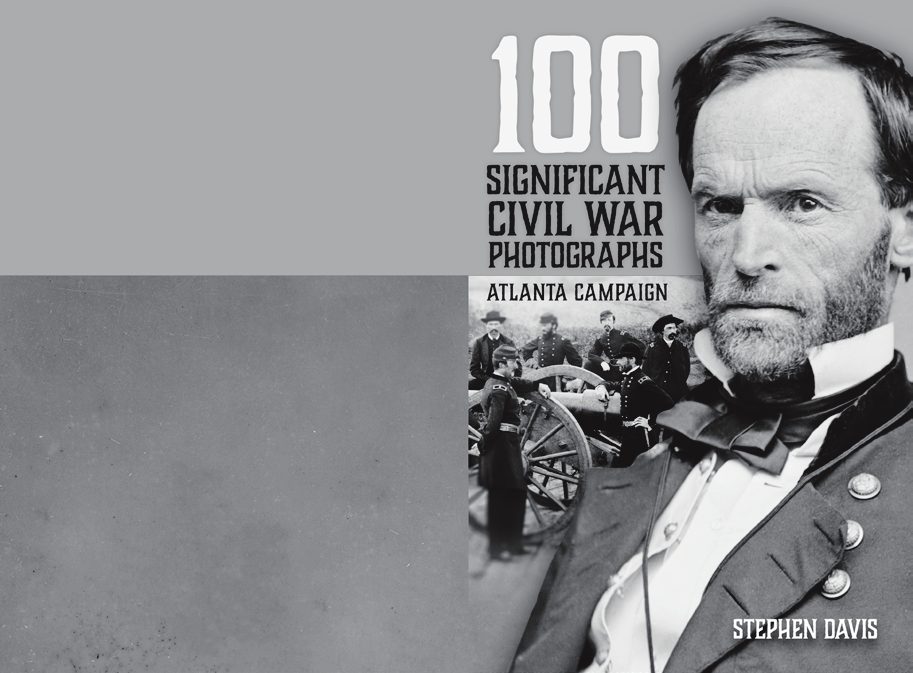
The Atlanta Campaign The American Civil War was the first war in w
used entrenchments, repeating rifles, ironcla communications. It was also the first American War to be exte Mathew Brady, Alexander Gardner and Timothy O having made iconic photographs in the Civil W
George N. Barnard deserves to be ranked in th work in the war’s western theater.
A civilian photographer hired by Gen. William
take pictures of fortifications around Atlant them in and around the city in the fall of 18 100 Significant Civil War Photographs: Union Maj. Gen. James B. McPherson’s death in 1864. Thus far, no comprehensive, definitive listin Atlanta Campaign presents a riveting work. The Library of Congress has 130 images; the U Point, New York, has at least 98 photographs, collection of George Barnard’s camera Other repositories, such as the Gilder Lehrma New York City, have smaller collections.
For this book we have chosen a hundred images work. Most of the photographs are from other students may wonder at some of our sele
We hope that this work will stimulate further
Barnardiana, and that other scholarly volumes Barnard’s time in Atlanta, mid-September
Federal occupation of the city. 128 pages, photographs,
With this volume, Stephen Davis advances the scholarly literature of
clude a remarkable bibliography of unit (mostly company and
regimental) political resolution from spring and autumn 1863, another that analyzes the 1864 reenlistment rates for Union reg ments, and a third illustrating number of officers in each regiment who attended the officer candidate school in Philadelphia known as the Free Military School. Appendices four through
six analyze unit voting returns for the 1863 elections, the 1864 Pennsylvania congressional election, and the 1864 presidential election, respectively. Zachery Frey is to be commended for this thoughtful and deeply-researched work. He illustrates that, despite the well known and oft-examined high level discord between Lincoln and his Democratic generals, it was the Republican junior officers toiling in the field who were the crucial lynchpin in delivering the 1864 soldier vote t Lincoln. As Frey explains, their wartime political education made post-war loyalty the “touchstone of manhood;” an unconditional loyalty to a republic free an everlasting in Abraham Lincoln’s image.
Paul Taylor is an award-winning author of seven books pertaining to the Civil War era. His upcoming book is titled “My Dear Nell The Selected Civil War Letters o General Orlando M. Poe to His Wi Eleanor, and will be published b Kent State University Press in f 2020.
The Civil War not only changed the political and milita makeup of America, it also altered the landscape, agriculture social practices, and even how Americans took care of natural resources after the war. The war was not just a series of militar actions but a biotic or biologic event, one that had lasting consequences for the environment, both North and South, as well as the people of both regions. This book is a refreshing look at the war through the eyes of a milita historian and an environmental scientist. Together they have pr duced a valuable examination of the effects of crowded camp conditions, the lack of experience with cleanliness and food preparation, the role water played in military strategy, and how commanders were forced to make decisions in the ever-changing fusion of human and non-human actors and activities. Two-thirds of the over 750,000 Civil War soldier deaths were caused by disease. Many of these deaths were caused by the lack of knowledge regarding disease causation, the Northern blockade which kept medicine and supplies out of the South, and the spread of microbes in camps devoid of proper sanitary controls. Added to these were the triple threats bad weather, lost slave labor in the South and skilled farm hands in the North, and diminishing productive agricultural land due to battle devastation and enemy conquest. Troops ate every scrap
the Momentous Day of nd Inaugural Address of food they could gather and lef behind an ecological wasteland for area residents. For example, disease (particularly glanders) killed over 248,000 Union horses in two years. The Southern loss was even greater with 75% of all horses dying every year from disease, exhaustion, or lack of food Additionally, horses were impressed from local farmers hindering their ability to plant and harvest crops. Hog cholera killed hundreds of thousands of pigs, costing the Confederacy a major source of food. Over four million trees were felled in support of fortifications, housing, and rail road construction. Diseases like syphilis and gonorrhea accounted for 200,000 disabled soldiers and even caused the death of onethird of soldiers in post war retirement homes. These examples clearly illustrate how, while command decisions mattered, the physical changes in the environment dictated both strategy, the place ch sen to fight, and even the pace of fighting, many times at odds with sound military judgment. For instance, would the Battle of the Wilderness have turned out differently if visibility had bee clearer? Would Gettysburg not have occurred if the South was not in desperate need of shoes and food? Would Shiloh have turned in to a Confederate victory if rains did not delay the attack on the second day allowing Union Gen. Buell to arrive? These examples could go on and on to illustrate how it is imposs ble to divorce military acts from the natural environment in which they occurred. This book is highly recommended as a treatment of how geography, nature, disease, topogra phy, and the environment affected Civil War military maneuvering. It is thoroughly researched, meticulously documented, and eminently readable. Every Civil War historian would benefit by adding it to their bookshelves.
Wayne L. Wolf is Professor Emeritus at South Suburban College and Past President of the Lincoln-Davis Civil War Roundtable. He is the author of numerous books and articles on the Civil War including Soldiers, Sailors and Scoundrels of the Civ War and The Last Confederate Scout.
Every Drop of Blood: The Momentous Second Inauguration of Abraham Lincoln. By Edward Achorn. Appendix, Notes, Bibliography, and Index, 414 pp., 2020. Atlant Monthly Press, groveatlantic.
By March 4, 1865, the four years of conflict was coming to an end with the result leaving over seven hundred thousand American soldiers dead, the Union preserved and the United States changed forever with an end of slavery. Tens of thousands packed Washington, DC’s, Capitol grounds to witness Abraham Lincoln take the oath of office for his second term as President. Edward Achorn tells a moving story about Washington’s divided groups of power, the intrigue during the short time aft the second inaugural address and the difficulties Abraham Lincoln had in ending the war and healin the country. There have many books written on the life of Abraham Lincoln, his presidency and involvement in the Civil War but few have pr vided so much detail and new information concerning his Second Inaugural speech. This outstanding narrative reads like a fastpaced novel but provides such vivid descriptions of what went on before this important moment in United States history on March 4,1865, events surrounding the day of, the time after a the effects of his message, and assassination had on the country and many groups of people. This story is told from the perspective of not only Abraham Lincoln but many soldiers such as Union General’s Ulysses S. Grant, and William Sherman, statesman and Supreme Court Justice Salmon Chase, politicians such former
Tennessee’s military governor and new Vice President, Andrew Johnson, Nurses such as Clara Barton, newspaper person-poet Walt Whitman, former enslaved person and Civil Rights activist, Frederick Douglass, family members such as Mary Lincoln, Lincoln, assassin John Wilkes Booth, and many other politicians and ordinary citizens. Edward Achorn examines Washington, D.C.’s important individuals who played a key role in ending the Civil War, and influenced the direction of the U.S. following the great conflict. Every Drop of Blood’s epilogue; The Stuff to Carry Them Through, provides an excellent understanding of what happened following the second inauguration. Many radical Republicans such as Ohio senator Benjamin Wade and Michigan senator Zachary Chandler were very hostile toward Lincoln’s plan of mollification and it many ways the author shows how several were not unhappy with his assassination. One of the arguments Edward Achorn makes is that the Sixteenth Presidents righteousness toward the defeated South did not necessarily protect forme slaves from Southern discrimination nor the domination of reconstruction by Radical Republicans. Edward Achorn also provides an important comparison of two contrasting men, Frederick Douglass and John Wilkes Booth that offers important analysis of their actions, thoughts, and meaning to what transpired on March 4th and on April 14th. Douglass stated to Lincoln on March 4th at the White House that he liked his speech. On the other hand, Booth who had contemplated kidnapping the President, was preparing to kill him. In his mind he was a hero, who “struck boldly and the country was not what it was.” This excellent historian shows that many people regard Booth as a coward and that his actions did a terrible disservice to the reconciliation of the U.S. and civil rights for African Americans. While the words and message of President Abraham Lincoln’s Second Inaugural speech offering reconciliation with the South was not initially admired or supporte by all Democrats, Republicans, Northerners, and Southerners. In time it would be viewed as one of the most important speeches in American History and critical to the country moving forward as one nation. This speech and Lincoln’s Gettysburg Address
today can be found on two separate walls on the Lincoln Memorial that generations of people can read and allow these words to resonate. Achorn provides the historical context and importance of Lincoln’s final sentence in his 2nd Inaugural speech, with malice toward none; with charity for all… in 1865 as well as since and today. This book’s clarity of organization and accuracy of description, coupled with interpretive insights, enable the reader to grasp both details and the larger picture of The momentous Second Inauguration of Abraham Lincoln. Achorn makes a substantial contribution to scholars and students on writing this important monograph on the last important words and life of our 16th President by providing fresh insight that helps readers understand the motivation, strategies, tensions, controversies, and triumphs that have characterized the life of Lincoln and people in volved in the work. Atlantic Press has provided en thusiasts with 41 helpful images as well as an extensive bibliography with a deeply researched bibliography of various sources, notes and index. Achorn has delivered a readable study that breaks new ground, is lively, con tains interesting engaging prose, ably illuminates the topic, and makes the subject accessible to anyone who seeks to understand. This reviewer highly recommends this new study.
David Marshall is a high school American history teacher in the Miami-Dade School district for the past thirty-three years. A li long Civil War enthusiast, David is president of the Miami Civil War Round Table Book Club. In addition to numerous reviews in tions, he has given presentations to Civil War Round Tables on Joshua Chamberlain, Ulysses S. Grant, Abraham Lincoln, the Battl of Gettysburg, and the Common Soldier.
Missouri and on the Great Plains Bluecoat and Pioneer: The Recollections of John Benton Hart, 1864–1868. By John Benton Hart, Edited by John Hart. Photographs, maps, notes, index, 240 pp., The University o
John Benton Hart was twentyyears-old when he enlisted in th Eleventh Kansas Infantry during the fall of 1862. Only a few months later, the reality of war struck Hart hard when he was “wounded at the Dec. 7 Battle of Prairie Grove, Ark. During his convalescence, Hart’s regiment was reorganized as cavalry. When Confederate General Sterling Price invaded Missouri in September 1864, Hart was back in the saddle with the Eleventh Kansas Cavalry, part of the Union forces opposing Price. Hart and his troopers saw action at the Oct. 23 Battle of Westport as well as other smalle engagements during Price’s 1864 Missouri Expedition. Hart was apparently quite the raconteur and it is his rollicki and extensive recollection of th campaign that forms the first of three distinct reminiscences in this memoir. It is also the only one pertaining to the Civil War. His memoir picks up just afte
City Can Be l Richmond: Life and those who bro the war ended, when Hart and his regiment were sent west where he took part battling the Plains Indians. The book’s remaining war-related focus includes the Battle of Platte Bridge on July 26 1865, and the Hayfield Fight near Fort C.F. Smith in the Montana Territory on August 1, 1867. With down-home folksiness, much of which the editor verified from other sources, Hart relays his time spent on the Plains working as a “bullwhacker,” aka an ox wrangler. He also recounts his time carrying mail between forts on the Wyoming/Montana Bozeman Trail, the only known account of its kind. How Hart’s 1864–1868 memoir came into being is a story in itself. Fifty years later, in 1918 Hart was repeatedly urged by his son Harry to recount his youthful reminiscences. Harry was an aspiring writer who quickly began dutifully recording his father’s words in what became several manuscripts totaling over 100,000 words. Hart’s manuscripts remained undisturbed for close to a century until historian John Hart, John Benton Hart’s great-grandson, edited and annotated his ancestor’s manuscript into this cohesive, engaging, and exceptional tale from the “wild west.” The book represents approximately one-third of Hart’s total manuscript. Chapter Two’s account of the battle of Platte Bridge is the only one reproduced in full while the 1864 Missouri campaign memoir utilizes approximately one-half of Hart’s corresponding Civil War manuscript. While there are timeline errors within Hart’s recollections, not uncommon for memoirs written a half century after the fact, its value lies in the author’s spot-on accounts of the day to day life of an ordinary soldier toiling on the Great Plains. Editor Hart contributes an excellent introduction along with extensive biographical, historical, and explanatory notes that link the narrative’s three section into a seamless whole. Thirty-two illustrations and six maps supplement an excellent work that will surely appeal to students of the post-Civil War American west.
Paul Taylor is an award-winning author of seven books pertaining to the Civil War era. His next boo
is “My Dear Nelly”: The Selected Civil War Letters of General Orlando M. Poe to Eleanor Brent Poe, and will be published by Kent State University Press.
Victim of Wa meat and pro- forerunners of Reco Death in the Confederate Capital. By Stephen V. Ash. University of North Carolina Press, uncpress.org. 296 pp.
A famous April 1865 photograph of Richmond shows the city as a skeletal ruin. As unique as the image is, it could be mistaken for New York City, London, Dresden, Hiroshima, Sarajevo, or any other city that has had the misfortune to find itself a center of destruction in violent times. Rebel Richmond: Life and Death in the Confederate Capital by Stephen Ash traces the history of Richmond, Virginia, during the time it was the capital of the Confederacy, a time when it was also a center of destruction. Megan Kate Nelson’s Ruin Nation outlines how war destroys a city. She refers to them as “architectural ruins.” Ash, in his nicely nuanced Rebel Richmond, takes the art of destruction sever al steps further. His definition o a city includes the citizens as we as the buildings. Ash examines the change in the citizenry first. With a population of nearly 38,000, Richmond was only of moderate size in 1860. With the coming of the war, Richmond’s population boomed to as many as 150,000 by 1865. Ash uses newspaper accounts, letters, anecdotal evidence, and memoirs to create a book in which the reader feels the strain of this influx. One eas ily imagines the formerly pretty houses and streets becoming dingy, rutted, and unclean. The city gasworks, which failed due to equipment shortages, was unable to keep the streets lighted a
night. The citizens of Richmond failed as well; as the war continued; fashionable clothing became patched, mended, and turned inside out. Animals, especially
ction’s duce to market, began to look skeletal. After a year or so of deprivation, so did the people. Newcomers were stuffed into boarding houses and piled into hotels. At first, soldiers were e erywhere, but at least they were healthy. Then came measles, typhoid, battles, and soon the hous es of elite southern citizens became impromptu hospitals. Food was scarce, workers were limited, and money became worthless. White women were forced into employment to help their families meet basic needs. This situation was a considerable disruption to the southern lifestyle which proclaimed that women, at least proper ones, did not work outside the home. Author Ash has an entire chapter on just that situation; how women dealt with breaking of one of the promises around which their lives rotated. For a southern woman to give up her right to property, education, movement, legal acts, etc. she expect ed a return, lifelong protection and care. Even poor women felt they were entitled to care in exchange for their labors and sacrifice. The Civil War turned this entire concept on its head. The men were gone, the money was no good, and, after 1865, there were no enslaved workers to do the marketing or fix the broken gate. Relatives from outside the city arrived, hoping to be able t live with other family members. Strangers descended on the city, especially women, hoping the Confederate government would feed them. Women had given up all, even their men, and there must be recompense! Except there was none, and despair set in citywide. The Richmond Bread Riot was not a singular event. In meat stalls, empty vegetable markets, and small stores all over Richmond, women protested their situation with anger and violence. Promises were, indeed, broken. Government employees, convalescent soldiers, young boys, and older fellows identified the large population o Africans as a comfortable place to put the blame. Free or formerly enslaved, black Richmond felt the blame for anything of which white Richmond wanted to accuse them. The black population endured legal restraints, th
Black Laws, put upon them to prevent black people from asserting any social equality with whites. Unknown to most white citizens, black people resisted in strong but subtle ways. Rebel Richmond’s last chapter deals with death. From First Bull Run to Appomattox, Richmond was a geographic destination for the wounded, the ill, and those who died. Chimborazo, the South’s most successful pavilion hospital, was just outside the city limits. Existing cemeteries like Hollywood and Oakwood were quickly overwhelmed. As mass graves sufficed for the thousands of unknown soldiers, the Lost Cause was born from all the death and suffering. One of the fi nal scenes in the book is the burn ing of Richmond at the hands of the Confederate government. Author Ash uses the diary of War Department clerk John Jones to paint the picture. He saw: a dark volume of smoke ris[ing] from the southeastern section of the city, and spread[ing] like a pall over the zenith. It proceed from the tobacco warehouse, ignited [by retreating troops], I suppose, hours ago, and now just bursting forth. (226) Rebel Richmond helps readers understand that the capital city of the Confederacy met the same fate that other cities caught in war’s inexorable path have met. Stephen Ash has expanded the definition of “city” to include it people, its infrastructure, and it cemeteries. He has written an excellent, poignant book within the topic of urban studies, one that demands further investigation.
Meg Groeling received h Master’s Degree in Military Histor with a Civil War emphasis, in 2016 from American Public University. Savas Beatie published her first book, The Aftermath of Battle: The Burial of the Civil War Dead, in the fall of 2015. Her biography First Fallen: The Life of Colonel Elmer Ellsworth, the North’s First Civil War Hero. It will be publish by Savas Beatie in 2020. She is a book reviewer for LSU, Civil War News, and a regular contributor to the blog Emerging Civil War. She lives in Hollister, California, in 1928 bungalow with her husband, her cats, and a lot of books and roses.
Politician in Uniform: General Lew Wallace and the Civil War. By Christopher R. Mortenson. Photos, notes, index, bibliography, 283 pp., 2019. Norman, The University of
Henry David Thoreau wrote: “The mass of men lead lives of quiet desperation,” but not Lew Wallace. Reading Christopher Mortenson’s excellent treatise on Wallace’s army career during the Civil War, brought to mind a cliché. That is not to say that Mortenson’s narrative is cliché ridden. On the contrary, it is a example of taut, economical clarity of language. No, the worn out thought in reading Wallace’s “arc of history” brings to mind the obvious: “he was his own worst enemy.” The author employ this phrase only once in the conclusio (page 191). The most glaring, and in some respects, comical example was immediately after Shiloh, with his division still on the fi in late April. He was visited by “three well-dressed officers” who he didn’t know (his first mistake He offered them his hospitality o “biscuits, whiskey and cigars.” During the conversation, he managed to disparage Henry Halleck and then discovered as the officers left to return to their command, that they were members of Halleck’s staff. Wallace had ridi culed Halleck’s “plans of operations” and he realized much to hi
regret and much later, that was n different than mocking the man. “…and that is just what I did,” h later wrote (page 73). He not only disparaged Halleck, but practically everyone up and down the command chain, Grant, Sherman, Brigadier General Charles F. Smith, Don Carlos Buell, Secretary of War Stanton, and Indiana governor Oliver P. Morton. He aimed most of his vitriol at West Pointers. When he testified before the congressional Joint Committee on the Conduct of the War, he criticized both Grant and Halleck for lack of energy and inept communications in the western theater (page 80). Although he was indeed a Politician in Uniform, his utterances were impolitic. Still, Mortenson more than adequately reveals Wallace’s innermost political skills and attributes t served him well in his multidimensional life time, and particularly during his army career. He performed admirably as commander of the Middle Department (Maryland primarily); played a role in the battles of Forts Henr and Donelson; saved Washington in 1864 by delaying Jubal Early’s troops at the battle of Monocacy; sat on the court which tried the Lincoln assassination conspirators; headed the court that tried and executed Andersonville’s Henry Wirz, attempted to influence the Mexican/French entanglement, dealt with Billy the Kid after the war in the Arizona terr tory, and then authored Ben Hur. As tempting as it is to wander, Mortenson sticks to Wallace’s career during the war. Of course the centerpiece is Shiloh. Grant, according to some accounts, had been surprised by Albert Sidney Johnston’s and P. G. T. Beauregard’s attack on the morning of April 6, 1862. Grant had ordered Wallace to bring his division down to Pittsburg Landing from Crump’s Landing. Grant wanted him to take the River Road, closest to the Mississippi and land in the middle of the Union line so that his troops cou be deployed left or right or stay put in the center. Wallace, alway
the contrarian, took the Shunpike, farther west and by the time he reached the lines, he found himself on the union far right almost behind the Confederate left. Therein lay the problem that vexed our hero the rest of his lif Did he misread Grant’s orders or did he willfully disregard them? At every opportunity, Wallace persisted in explaining, describing, interpreting, depicting, and otherwise portraying his actions at Shiloh. That is the beginning of the Wallace story and the central thesis of Mortenson’s argument, namely Wallace’s search for manly, military glory; a goal that eluded him during his Civil War career. When he was sent back to Indiana after Shiloh, the governor ordered, by asking him nicely, to travel the state recrui ing, which he reluctantly did. He was sent to Cincinnati when Morgan’s raiders threatened the city and nothing happened, and then there was his tour of duty with the Middle Department in Baltimore. He craved action on the field and wanted command. Instead his political skills lande him desk jobs. Even his attempt to claim some notoriety in the Mexican affair and his hope to broker a deal to end the war in th West fell through. His delaying action in the loss at Monocacy brought him nothing but grief until it didn’t. Belatedly, Grant, Stanton, and Lincoln realized that Early was really a threat to the capital and that Wallace’s fight at Monocacy allowed Grant time to move VI Corps from the siege lines at Petersburg to reinforce the home guard at Washington. Mortenson has done an admirable job in sticking to the subject This is not a biography, it is exa ly what the title indicates; a pol itician in uniform, Lew Wallace in the Civil War. Writers would do well to emulate Mortenson’s focus, exposition, clarity, and un derstanding of this complicated man. The chapters are few, ten; only 198 pages of text including his conclusion, brings it all together nicely. This slim volume is a welcome addition to the volunteer/politician/soldier literature of the Civil War. Salvatore Cilella is retired after 43 years in the museum field. He is the author of Upton’s Regulars, University of Kansas Press, 2009, and editor of The Selected Correspondence of General Emory Upton, 2017, (2 vols). University Tennessee Press and Till Death Do Us Part: the Letters of Emory and Emily Upton, 1868–1870. University of Oklahoma Press, 2020.
The Better Angels Five Women Who Changed Civil War America. By Robert C. Plumb, illustrations, index, en notes and bibliography. 251 pp. 2020. Potomac Books, an Imprint of the University of Nebraska
Robert C. Plumb was a marketing executive for two Fortun 500 companies. He frequently writes for the Washington Post and Washington Post Magazine. Plumb’s latest work focuses on the noteworthy contributions of Julia Ward Howe, Harriet Tubman, Clara Barton, Sarah Josepha Hale, and Harriet Beecher Stowe. The catchy title references portion of President Lincoln’s first Inaugural Address. This speech, directed primarily to Southern citizens, was an appea to Southerners to maintain national unity in a time of great Lincoln made no specific mention that the “Better Angels” w all women. Plumb does not explain why he limited his work t women only. Nor does he provide specific reasons why the women selected were better than other women who also made significant contributions to the natio during this time. He does mention these women were among his favorites. Also, the inside dust cover relates facts regard
distinct social classes and race r lations as probable criteria used for selecting these women. The specific goal of this work, telling these ladies’ stories to adults rather than featuring them as mythical figures in children’s books, is not clearly disclosed until the last third of the book. Plumb’s work relies heavily on secondary sources. Many sources are twenty or more years old. The age of these sources demonstrates a lack of substantial new data for analysis. This is validat ed by the fact that a plethora of information is available online for each of these women. While none of these observations are showstoppers, the reader is left with two questions: 1) what made the contributions of these women more significant than other men and women of the same time period; and 2) why women only. Plumb’s writing style is easy t follow. His storytelling is unique He provides chapters that give biographies of each of these women and additional chapters with overlapping coverage by specific topics for all five. This approach allows the reader to see how contributions made by one woman had a ripple effect impact. This perspective is important, because it is something some historians still often neglect to consider or include in their work. The information provided on each of these women is concise and well organized. The illustrations of each woman at various stages of life provide the reader a touch of realism. Readers with a specific interest in these five women will find Plumb’s work rewarding and informative.
Richard J. Blumberg has reviewed eighteen years. Currently, He is awaiting the publication of an article on the influence of music in the Civil War. He has also begun a series of articles emphasizing the contributions made during the Civil War to modern logistical operations.