analysis of the latest and most scholarship. Contact email: Boo
Lincoln and the American Founding. By Lucas E. Morel. Notes, bibliography, index, Southern Illinois University
This book, one of the Concise Lincoln Library Series, analyze Lincoln’s reliance on his inter pretation the nation’s Founding Fathers’ intent to shape his op position to slavery and its expansion. Energized by the 1854 Kansas-Nebraska Act, Abraham Lincoln, the silent abolitionis jumped back into politics to force America to accept the pri ciples of human equality and in dividual rights that he believe would provide common ground for diverse people to live together in harmony. Additionally safeguarding the right of peopl to self-government was the key to preserving democracy, not only for the United States but
a model for the whole world. Beginning in the late 1850s,
Lincoln’s speeches were aimed at convincing the Civil War gen eration to appreciate what the foundation documents, the
and the Constitution, meant and how they could be interpreted to secure liberty and equali ty for all. These two documents
formed the sine qua non of Lincoln’s political thought. He never strayed from his interpretation of what the Founding Fathers desired, contending that they supported the eventual elimination of slavery, accepting it initially only as a necessa evil to unite the colonies. To Lincoln then, human equality was to be the driving force of the Republican Party’s national public policy. By standing up for equality and individual rights of Black Americans, White Americans could be taught how to defend their own rights. While over 16,000 books have been written about Abraham Lincoln, Lucas Morel has found a niche that exhaustively chronicles the shaping of Lincoln’s political views on slavery. Lincoln’ political growth has been covered in numerous other vol-
umes, e.g. Michael Burlingame’s Abraham Lincoln: A Life and Kenneth Winkle’s The Young Eagle: The Rise of Abraham Lincoln, Morel limits his concise analysis to how Lincoln used the Declaration of Independence to refute his critics on the slavery question and establish an unbending path toward emancipation and full equality. This book is well researched, makes ample use of primary sources, and is well written and academic in its presentation. My only criticism is the frequent repetition of material that needlessly elongates the text. For most Lincoln scholars, much of this material has already been read, leaving a recommendation
for purchase to those scholars who wish to narrowly address
Wayne L. Wolf is Professor Emeritus at South Suburban College, past President of
Roundtable, and the author of numerous books and articles on the Civil War, including Two Years Before the Paddlewheel and The
Two Bloody Weeks in May 1864 ions at The Wilderness
sylvania Court House: teen Critical Decisions
tions, diagrams, bibliogndnotes, appendices, 2020. The University of
Decisions at The Wilderness and Spotsylvania Court House, authored by retired engineer Dave Townsend, is the seventh in a series of books published by UT Press that analyze critical decisions made by Federal and Confederate command-
ers and the impact those decisions had on the course of
the fighting. Previous books in the series cover four battle (Stones River, Second Manassas, Chickamauga, Chattanoog and two campaigns (Atlanta and the 1862 invasion of Kentucky). Townsend dissects decisions that defined the opening battles of the Overland Campaign. Some of the analysis relates to very large issues, Lincoln’s se tion of Grant as general-in-chi being the biggest of them all, decision that defined the campaign as a nonstop slugfest fro May 1864 until Lee’s surrender nine months later. In other cas es, the author drills down to r atively minor tactical matters, such as Fitzhugh Lee’s decision to defend the Brock Road north
of Spotsylvania by mounting a fighting, step-by-step retreat.
For each of the 18 key decisions Townsend starts with a
tions available, then expounds on the one chosen, and next proceeds with analyzing the de-
also discusses alternate scenar ios, what could have happened had another choice been made, but the discussion is confined
into “what if” history. In the preface, the author
states that the book’s “fundamental premise is that the read-
er is somewhat familiar with what happened during the battles.” There is, consequently somewhat less focus on what happened and more on why events happened. Still, considerable space is devoted to an account of the course of the two battles, a narration that wi be helpful for readers not thoroughly familiar with all the details. For most readers, I belie Townsend has struck the proper balance. Townsend relies mainly on primary sources, weighing their reliability carefully and giving more credence to orders and correspondence contemporaneous with the battle. He points out that after action reports were often written after considerable time had lapsed and that the writers of memoirs can have faulty recollections and agendas other than historical accuracy. Minor mistakes, and I spotted a few typos and noticed that Shelby Foote’s famous work is cited as having four volumes, not three, are not numerous or serious enough to distract or detract. More significant is the overall plan by which the book
prise 166 pages containing the analysis of the commanders’ options and decisions. These chapters naturally contain the battle narrative referred to above.
520 Folly Road, Suite 25 P Charleston, SC 29412
guide, is 127 pages. Much of this long appendix is devoted t
additional battle narrative. Th result is a disjointed and some
times repetitive account. The format is somewhat inconvenient and may cause confusion for the reader, but this far from a fatal flaw. The narr tion, though split up, is writt clearly. The maps—essential for the reader following these complex operations—are also well done. Appendices II and III provid the Union and Confederate orders of battle. You can’t tell players without a program, and in this campaign there were lot of players, big players making the decisions being analyzed and the lesser lights trying to carry them out.
Gould Hagler is a retired lobby ist living in Dunwoody, Ga. He a past president of the Atlanta Civil War Round Table and the author of Georgia’s Confederate Monuments: In Honor of a Fallen Nation, published by Mercer University Press in 2014. Hagle speaks frequently on this topic and others related to different aspects of the Civil War and ha
Hellmira: The Union’s Most Infamous Civil War Prison Ca Elmira, NY, is a compelling that fills gaps in Civil War
Cecilia Lawton’s life was plantation owner, she was later, she found herself f brutal campaign in Georgia story of Cecilia Lawton, a
dersonville of the North Comes Alive become very popular in recent commanders, surgeons, staff challenges of war and prison years. In this thoughtful account officers, and other important camp. He uses quotes from parand compelling analysis of the Union authorities such as Edwin ticipants judiciously. The anecchallenges those in charge of Stanton. dotes spur the reader’s interest prisoner of war camps, Derek After setting the scene and and whet the appetites of prisMaxfield does a nice job in ex- spending time analyzing con- on camp enthusiasts. Maxfield plaining the difficulties camp troversial decisions made by makes an important point in administrators faced in several individuals such as Lt. Col. Seth his fascinating epilogue chapNorthern and all Southern POW Eastman, Benjamin Tracy, Lt. ter on “The Melancholy Debate” camps, and how they succeed- Col. Stephen Moore, Maj. Henry that the humanitarian tragedies ed or failed to overcome them. Colt, and Dr. Eugene Sangers, produced by the POW camps “Hellmira” is a solid introduction the bulk of the text describes is- stained the meaning of the U.S. to prisoner of war camp history; sues that worsened throughout flag. it is an outstanding addition to the camps existence. Maxfield This outstanding title pubthe Emerging Civil War Series. blends Union and Confederate lished by Savas Beatie, includes “Hellmira” actually covers sev- accounts with a solid depth and a very useful driving tour that eral Civil War prison camps but balance. cludes ten important stops with the volume’s focus deals with The main text of the book is their GPS coordinates as well as the prison camp at Elmira. The approachable. Although the au- directions and an explanation of book expands its breadth by thor only briefly discusses some each tour stop. A tour guide and incorporating topics either ig- topics such as the creation of introductory book on any subnored or lightly touched on in long term POW camps during ject must be clear and precise i other Civil War histories. the conflict, withholding food its directions, which this guide Maxfield tells the story of the due prisoners, the lack of shel- does well. The detail provided “Andersonville of the North” ters, limited clothing especial- at each stop is well-written and from the summer of 1864 to July ly during the cold winters, the not overwhelming. For casual 1865, doing a solid job of elu- failed exchange of prisoners, the visitors this guide should be a cidating why it was important evolution of Camp Elmira, and welcome companion during a and also symbolic of the hor- the inhumane treatment of the visit to the Elmira Prison Camp. rendous treatment of captured prisoners, Maxfield presents the An important addition conConfederate soldiers during the prisoners’ human experience. tained in this balanced work is conflict. Maxfield has included a wealth the seven appendices includdy ison Like many historians, Maxfield places blame, and a little credof first-hand accounts and anecdotes by officers and common ing “How Elmira Gave the World Mark Twain” as well as sug-
it, on the Elmira Prison Camp soldiers who experienced the gested reading, maps, and an
In Volume One, Texas Brigadier To The Fall oF aTlanTa (Dec 2019), Stephen Davis traced Hood’s rise from lieuten Virginia to commanding general of the Army of Tennessee. Here in Volume Two, inTo Tennessee and Failure, Davis September–October 1864, tracing Hood and his army into North Georgia and Alabama, then on to Tennessee in late Spring Hill and Franklin.Then to the battle of Nashville on December 15-16, where the Army of Tennessee was rou the time it ended its retreat in North Mississippi, Confederate authorities were ready to relieve Hood from com the general offered his resignation in January 1865. Davis’s theme in Volume One was the ambition that drove Ho and higher rank. Here, while recognizing Hood’s loyalty to the Confederate cause, he discerns Hood’s unflatteri courage of his men, bickering with other generals, and concealing from his superiors the extent of his disaster s INCIDENTS IN THE LIFE OF CECILIA LAWTON TION LIFE, WAR, AND RECONSTRUCTION IN GEORGIA AND SOUTH CAROLINA
nged forever when the bloodiest war in American history began in 1861. The daughter of a wealthy Georgia ried at the age of sixteen and went to live at her husband’s plantation in South Carolina, but a few months ing from the army of General William T. Sherman as it ravaged the state. She observed the aftermath of this d South Carolina, writing of what she saw in vivid, horrific detail. Told in her own words, this is the true ung woman who faced incredible challenges with determination and courage. ON RISING GROUND THE LIFE AND CIVIL WAR LETTERS OF JOHN M. DOUTHIT, 52ND GEORGIA VOLUNTEER INFANTRY REGIMENT
When John M. Douthit enlisted as a private in Fannin County’s 52nd Volunteer Infantry Regiment in 1862 and marched to train at Camp McDonald, he left behind a pregnant wife, an eighteen-month-old daughter, and a small farm. A precious cache of family
Vicksburg, where five North Georgia regiments solidified into what became known as the Barton-Stovall Brigade. The author, John’s great-great granddaughter includes family 866stories and her own mother’s memories of John’s wife Martha.
abundance of helpful images. The text is well written, clear, formative, and easy to read. The result is both an excellent guid book and a history lesson at an attractive price. Overall, Hellmira is long-needed addition to the story of this prison camp, and i will make a fine addition to the reading list of any serious student looking at POW camps, including those already well-read or those just beginning their journey. Serious Civil War buffs will find the narrative has much to offer; novices should enjoy the introductory story and battlefield trampers will love the well-planned tour route.
David Marshall is a high school American history teacher in the Miami-Dade School district for the past thirty-four years. A li long Civil War enthusiast, David is president of the Miami Civil War Round Table Book Club. In addition to numerous reviews in tions, he has given presentation
cavalry in up the story in er at om the field. By Seeing it coming, seek higher its: questioning the nnessee.
They Left Us Here To Die Andersonville: An American unt Tragedy. By William Baird. Illustrated, bibliography, Willi Baird Publishing, 2020, 188 pp.,
In this self-published work o the tragedy on Andersonville, William Baird has crafted a stor of the prisoners, guards, doctor and clergy who ministered to the thousands of Union soldiers imprisoned on land farmed by Benjamin Dykes. Over 13,000 Union troops died at Ft. Sumter (Andersonville) in little over a year beginning in February 1864. What caused this massive loss of life was analyzed and fi overriding factors were deemed responsible. The first of these factors wa the performance of Gen. John H. Winder. Overall commander of Confederate prisons, Winder’s inability to get the needed supplies of food, lumber, and medicine to the improperly housed prisoners left Andersonville pri oners to starve, live in vermin fested “shebangs,” and die from lack of medicine or proper hospital shelter. Secondly, the murk Confederate chain of command not only hampered General Winder but made the work of post commander Henry Wirz and medical doctors, impossibly hard to procure materials. Added to these two causes was the local populace’s opposition to the impressment of food supplies they themselves needed for survival, the increasing manpower needs of the Army of Northern Virginia that left only
Deadlines for Advertising Submissions is the 20th of
Illumina local militia to guard War Hist the prison, and the deteriorating condition of Southern railroads that hindered the supply chain to the prison. Accompanying the logistical challenges noted above, the author weaves in the personal stories of men connected with the prison. For example, Dorence Atwater, who kept a secret dead list of prisoners at the fort, J McElroy who published his personal story as a prisoner in 187 Fr. Peter Whelan, the Catholic priest who sacrificed his own health to minister to the religious needs of the prisoners, and Captain Henry Wirz, who became the only Confederate executed for war crimes, give faces to the tragic number of dead and dying men of Andersonville. Additional events of courage and generosity add a sense of self-sacrifice to the men of Ft. Sumter. For example, Fr. Whelan took out a personal loan to provide 16,000 loaves of bread to prisoners; the discovery of an unpolluted spring gave fresh water that saved lives; Capt. Wirz’s parole of prisoners who traveled to Washington to beg President Lincoln to resume prisoner exchanges (he never met with them), and the tireless work of Clara Barton to get word of prisoner’s fate to their wait ing families, all shine as people helping people in a time of great need. Two historical errors appear in this novel. Camp Chase was located in Ohio not Chicago; Jefferson Davis died in 1889 not 1869. Additionally, an editor might have eliminated a number of grammatical, punctuation, type setting, and spelling errors. Nevertheless, this book is recommended for the novice historian who wants a quick overview of Andersonville prison. More comprehensive analyses can be found in Ovid Futch’s History of Andersonville Prison Revised Edition or William Marvel’s Andersonville: The Last Depot.
Wayne L. Wolf is Past President of the Lincoln-Davis Civil War Roundtable and the author of numerous books and articles on the Civil War including The Last Confederate Scout and Two
f Vital, Yet Often Overlooked, C ong the Rio Grande Valley
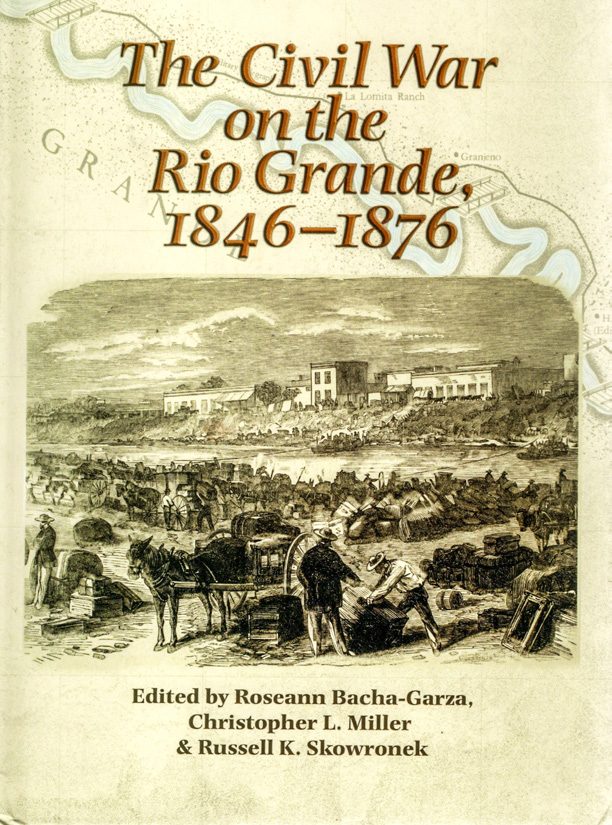
The Civil War on the Rio Grande, 1846–1876. BachaGarza, Roseann, Christopher L. Miller, and Russell K. Skowronek eds. College Station: Texas A&M University Press, 2019. 326 pages, photos, maps, bibliography, index, preface, and endnotes by chapter, with foreword by Gary
If asked when the war started, many Civil War buffs would say with the firing on Fort Sumter in April 1861, and if asked when the war ended, some Civil War buffs might answer Appomattox Courthouse with the surrender of Robert E. Lee’s Army of Northern Virginia, others might say Bennett Place where Joseph E. Johnson’s remnants of the Army of Tennessee surrendered. Some might even propose Citronelle, Ala., or Galveston, Texas. Of course there is room for many other answers depending on how we determine the start or end of the conflict so with this in mind The Civil War on the Rio Grande 1846 to 1876 supplies food for thought. The book is a collection of 11 essays dealing with various aspects of the war, and, in partic lar, how to redefine the chronol ogy and location based on an interpretation that the first US troops entered the area in 1846 and the war really didn’t end until military Reconstruction stopped in 1876. The Rio Grande Valley is described as a coastal plain from Laredo to the Gulf of Mexico. It is postulated in the book that “The intersections of races, cultures, economic forces historical dynamics, and individ
ual destinies that made up the unique world of the Rio Grande
Valley are the same as those tha made the contemporary United States and the increasingly in-
in which we live in now.” A prelude that defines the mindset of the authors is followed by an outstanding narrative of the early Rio Grande se tlement written by Christopher L. Miller. This is an absolute must read because it sets the stage for everything else in th book, and also helps the reader understand the modern Rio Grande Valley because many of the same families who initially settled the region are still th powerbrokers. Author Douglas Murphy’s second chapter deals with the connection between the Mexican War and the Civil War, plus goes a long way toward explaining the reasoning behind book’s title. Chapter 3, by M.M. McAllen, is concerned with life along th lower Rio Grande Valley during the Civil War, adding insights into topics not usually covered Roseann Bacha-Garza handles race and ethnicity along the an tebellum Rio Grande along with the emancipation of slaves and mixed race colonies in Chapter 4. Irving W. Levinson covers th separate wars and shared destiny of Mexico and the United States in Chapter 5. Readers should keep in mind that Mexico was engaged in its own civil war between conservatives supported by the French vs. liberals favored by the Lincoln administration. While evading the naval blockade strangling the Confederacy, the Confederates often allied themselves with the more conservative French supported government of Emperor Maximilian to obtain much-needed military supplies and sell valuable cotton to anxious buyers from around the world. This chapter delves into complex economic, military, political, and so issues, and will probably be a great history lesson for those unfamiliar with the impact of, and on, Mexico. In Chapter 6, Jerry Thompson discusses the conflict between troops led by Confederate José de los Santos Benavides and his nemesis Juan Cortina. It’s an oversimplification to say th was a family feud that lasted generations, but not far off, s
the chapter is extremely interesting to read and enlighten-
ing. In Chapter 7 Karen and Tom Fort examine the impact of cotton, the lifeblood for the regi
and the reason for existence of the Mexican town of Baghdad.
McBride covers the US Colored Troops, largely from Kentucky, who occupied the valley from 1865 to 1867. That chapter is fo lowed by the African-American military experience along the Rio Grande by James Lieker. There are some nice photos of existing buildings created by these African-American troops with compelling new information well worth getting the book. Rolando Garza, a veteran National Park Service battlefiel archaeologist, does a superb job of providing archaeological insights into the site of th Civil War’s last battle (Palmito Ranch May 12-12, 1865). Russell Skowronek puts the icing on the cake for this book with his chap ter on the Rio Grande area as a forgotten front of paramount importance. Having all this material available in a quick refe ence makes the book a must for those interested in this ove looked facet of the war. For those who find this regio especially interesting, a more detailed narrative history can be found in Michael L. Collins, A Crooked River: Rustlers, Rangers, and Regulars on the Lower Rio Grande, 1861–1877 (2018). For those who want to read a great military history de voted to the battles at Palmito Ranch, Ginn and McWhorter’s Palmito Ranch: From Civil War Battlefield to National Historic Landmark (2018) is more highly recommended because it will provide specifics related to the military tactics and the regional strategy from a combat arms perspective.
William J. Bozic Jr. is the former National President of the Descendants of Mexican War
school teacher, he is a Park Gui at Jean Lafitte National Histori Park & Preserve in Lafayette and
jela. He travels frequently to S Texas and is currently working on the final stages of Indianola Incidents, a book concerning the 1863-4 Federal occupation of the Texas port city. He has also gai much practical, hands-on experience participating in numerous
By March 4, 1865, the four years of conflict were coming an end leaving over seven hun dred thousand American soldiers dead, the Union preserv and the United States changed forever with the end of slavery. Tens of thousands packed the capitol grounds to witnes Abraham Lincoln take the oath of office for his second term as President. Edward Achorn tells a moving story about Washington’s divided power groups, the intrigues after t second inaugural address, and the difficulties Abraham Linc had in ending the war and hea ing the country. There have many books written on the life of Abraham
Lincoln, his presidency, and volvement in the Civil War bu few provide so much detail an new information concerning hi Second Inaugural speech. This
outstanding narrative reads li a fast-paced novel but provide vivid descriptions of what wen on before March 4, 1865, event surrounding that day, the period following, and the effect his message and assassination had on the country. This story is told from the perspective o not only Abraham Lincoln but many soldiers such as Union General’s Ulysses S. Grant and William Sherman, statesman and Supreme Court Justice Salmon Chase, politicians such new Vice President Andrew Johnson, Clara Barton, poet Wa Whitman, Frederick Douglass, family members such as Mary Lincoln, and assassin John Wilkes Booth. Edward Achorn examines Washington’s important individuals who played key roles ending the Civil War and influencing the direction of t U.S. following the great confl and historic speech. Every Drop of Blood’s epilogue; The Stuff to Carry Them Through, provides an excellent understanding of what happened following the Second Inauguration. Many radical Republicans such as Ohio senator Benjamin Wade and Michigan senator Zachary Chandler were very hostile toward Lincoln’s plan of reconstruction and, in many ways, the author shows how several were not unhappy with his assassination. One argument Achorn makes is that the Sixteenth President’s righteousness toward the defeated South did not necessarily protect former slaves from Southern discrimination nor th dominating control of reconstruction by radical Republica Additionally, Edward Achorn provides an important comparison of two contrasting men, Frederick Douglass and John
Wilkes Booth, that offers an i portant analysis of their acti thoughts, and meaning about what transpired on March 4 and April 14. Douglass stated
Lincoln that he liked his speec on the other hand; Booth was preparing to kill him. This exc lent historian shows that many people regard Booth as a coward and his actions did a terri disservice to U.S. reconciliati and civil rights for blacks. The words and message of President Abraham Lincoln’s 2nd Inaugural Speech offering reconciliation with the South were not initially admired nor supported by all Democrats, Republicans, Northerners and Southerners. In time it would b viewed as one of the most important speeches in American history and critical to the cou try moving forward as one nation. This speech and Lincoln’s Gettysburg Address are today on two walls of the Lincoln Memorial where future generations can read and allow these words to resonate for generations. Achorn provides the historical context and importance of Lincoln’s final sentence in his 2nd Inaugural speech, “with malice toward none; with charity for all…,” in 1865 as well since and today. This book’s organizational clarity and descriptive description, coupled with the author’s interpretive insights, e able the reader to grasp both details and the larger picture of The Momentous Second Inauguration of Abrah Lincoln. Achorn makes a substantial contribution to scholars and students with this important monograph on the last important words of our 16th President by providing fresh in sight that helps readers understand the motivation, strategie tensions, controversies, and tr umphs that characterized the life of Lincoln and Atlantic Pr provided readers with 41 helpfu
images as well as an extensive bibliography, notes, and index. Achorn has delivered a readable study that breaks new ground, is lively, contains interesting gaging prose, ably illuminates the topic, and makes the subjec
accessible to anyone. This reviewer highly recommends this
David Marshall is a high school American history teacher in the Miami-Dade School district for
Vignettes of Coastal North Carolina’s Civil War Gunboats, Muskets, and Torpedoes Coastal North Carolina 1861–1865. By Michael G. Laramie. Photographs, maps, notes, Glossary, index, 347 pp. Westholme Publishing, Yardley, PA.
This new book is a beginner’s overview of the Civil War on North Carolina’s coast. In 21 chapters that are basically snapshots of the two initial campaigns and the continuing efforts by both sides to take, or keep, control of the sounds and coastal waters. It follows the footsteps of John Barrett’s The Civil War in North Carolina (1963) but limits its scope to coast where it goes into more detail but does not compare in either accuracy or detail with R. Thomas Campbell’s Storm over Carolina The Confederate Navy’s Struggles for Eastern North Carolina (2005) or Willia R. Trotter’s Ironclads and Columbiads (1989). The general impression is th this effort is directed at read starting from a basic, rudiment ry knowledge of what happened
as Confederates mismanaged and lost key positions and then tried to both protect their int rior rail lines and take back w they had lost. The text reads w and is easily understood; even the midst of the flow, his incl
ing specific participant accoun does not distract the reader. T
of historical maps. The epilogu is a very useful summary of wha happened and why; it could
glaring is his constant, except for one example, use of the word pound to describe cannon. He cannot really believe a siege and garrison cannon weighed only 32 pounds; the weight of its solid shot, hence 32-pounder. His misuse of cheval de frise when slashing or abatis is meant goes along with “mini” balls, bursting solid sho and “twenty-round cartridge boxes,” suggesting he gets the overview but not the details. This reviewer understands what the author meant but found the terminology jarring and indicative of a lack of knowledgeable editorial oversight. Many secondary sources are outdated but there are some surprising current materials including fairly recent archaeolog ical studies not generally found in more popular historical writing. All in all, Laramie has put gether a good starting point for anyone wanting to look deeper at the War beyond the Armies of Tennessee and Northern Virginia.
Larry Babits has been reenacting since 1960. He served in the U.S Army’s B Company, 21st Infantry (Gimlets) during 1963–1966. Babi earned degrees at Maryland and Brown leading to a career teachi archaeology and military history Washington and Lee, Armstrong State, and East Carolina. A reti rugby player, Larry is now working on the sequel to his studies the 1781 battles of Cowpens and Guilford Courthouse although he admits to taking breaks from cor na self isolation to practice bl powder marksmanship, getting
Vol. 46, No. 1 Remembrance Day, 2019, Ge The world will
– Abraham Linc by Joe Bordonaro President Lincoln was wro about the first part, but v correct about the second pa this famous phrase from his
nificent “Gettysburg Addres On Nov. 23, 2019, reenactor members of the general publ gathered in Gettysburg, Pen to remember the actions of soldiers and the President
Remembrance Day 2019. Stafford County Science Teacher Don Mullen, portray President Lincoln. (Garry Adelman, American Battlefield Trust)
Members of the 14th Brooklyn years ago. The Sons of Union
Veterans held their 62nd ann parade, featuring numerous C War reenactors. Members of r enacting groups commemorated the actions of various indiv and units by conducting marc es and visiting monuments. A “Remembrance Illumination” o
Gettysburg National Cemetery graves occurs each year, as Although the numbers of reen tors are down from its 2000 when Wikipedia estimated the were about 50,000 Civil War enactors; a still impressive ber showed up this year and
panying photos highlight som activities that took place. Joe Bordonaro is a USAF vete