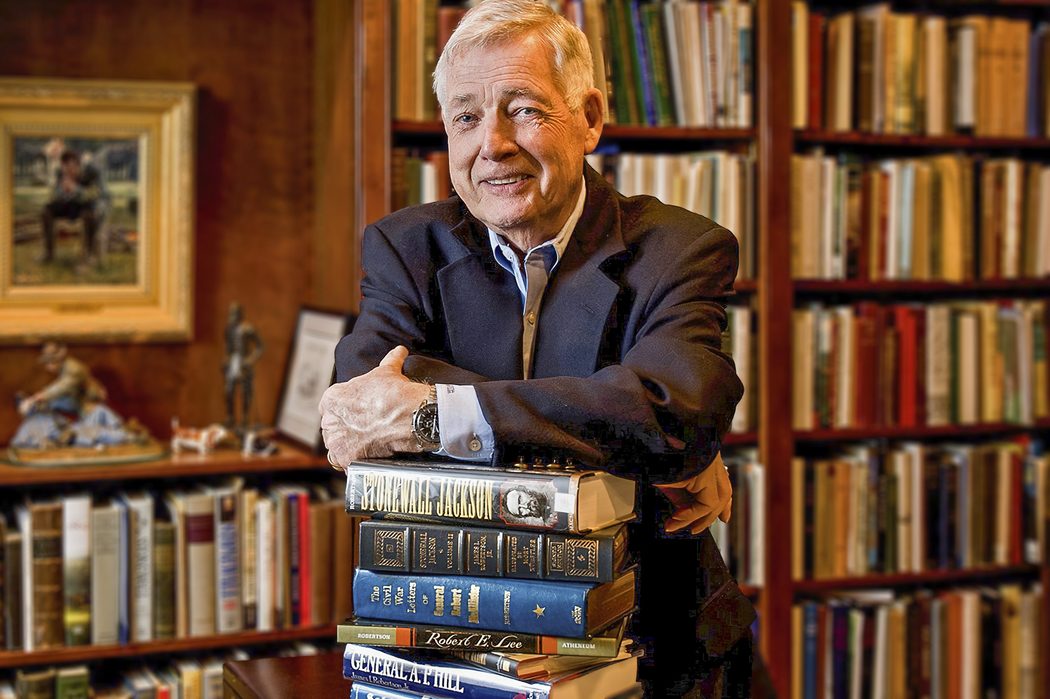
James I. Robertso by Stephen Davis James Irvin “Bud” Robertson (1930-–2019) was known across the land to Civil War enthusiasts in the same league as Ed Bearss and maybe a few other stars. Born in Danville, Virginia, after college at Randolph-Macon he took his Master’s and Ph.D. degrees at Emory in the late ‘50s. In 1957 Congress created the U.S. Civil War Centennial Commission; already people were foreseeing that the hundredyear war anniversary would be a big deal. In December 1961 “History is the greatest te ever have.” – James I. “Bud” the commission elected Dr. Robertson as executive director. At the time he was teaching at the University of Iowa and serving as editor of Civil War History, the scholarly journal just getting started. Robertson’s first book, The Stonewall Brigade (1963) stemmed from his doctoral dissertation written at Emory under Prof. Bell Wiley’s direction With Wiley and Allan Nevins he co-authored Civil War Books: A Critical Bibliography (1967, 1969). I bought my two-volume set from Dr. Wiley himself, for al
More of Robertson’s works followed: a biography of Powell
Hill, a study of Civil War soldier (following in Wiley’s footsteps), and his crowning achievement, Stonewall Jackson (1997). In April 1972, Robertson began writing a regular feature for Civi War Times Illustrated. Editor Jack Davis announced that for it, “Dr.
Robertson will review a selected work from the mountain of words
on this most written-about of conflicts.” Bud chose for his firs “War in Words,” appropriately enough, the Official Records. By my count, 127 “War in Words’ columns followed in CWTI, petering out in December 1987 (Kate Cumming’s A Journal
of Hospital Life). His selections were deliciously varied: Heros von Borcke’s Memoirs, John Billings’ Hardtack and Coffee,
20– American Battlefield Trust 38 – Book Reviews 36 – Central Virginia Battlefield
America’s Monthly Newspaper For Civil War “The War in Words” Nat Hughes’ biography of Hardee. Some of Robertson’s pieces clumped works together, as in biographies of Jefferson Davis (August 1972), the works of Thomas Robson Hay, the writing of Mary Elizabeth Massey. Back when I was at Emory, Dr. Wiley handed out to us in his Civil War class long typed lists of recommended books. I was building my library, so I took Wiley’s lists to the second-hand bookstores I frequented. In truth, Bud Robertson’s “The War in Words” often highlights r you will ertson Jr. books that are today expensive or hard-to-find. Still, if you’re building a discriminating Civil War library, keeping an eye on “The War in Words” can be a smart thing to do. Perhaps it’s best just to list the subjects he James I. “Bud” Rob chose to write about in Civil War Virginia Center fo Times Illustrated:
1865 June 1975. The works of Thomas Robson Hay July 1975. Joseph Cullen’s work on Chimborazo Hospital
30 – Critic’s Corner 34 32 – Emerging Civil War 28 st 45 – Events 22
shown in his study, was the founding director of the Studies. (Courtesy Virginia Tech)
surgeons November 1976. Randolph Harrison McKim December 1976. The battle of Harris’ Farm, Va., May 1 January 1977. Benjamin F. Butler, Autobiography and Personal Reminiscences April 1977. Daniel Ellis, Thrilling Adventures (1867) May 1977. Harry Gilmor, Four Years in the Saddle (186 July 1977 Augustus C. Buell, The Cannoneer: Recollect
biography August 1978 Civil War atrocities H Robertson . . . . . . . . . . . ic War 24– This And That e 16 – The Unfinished Fight he Lens