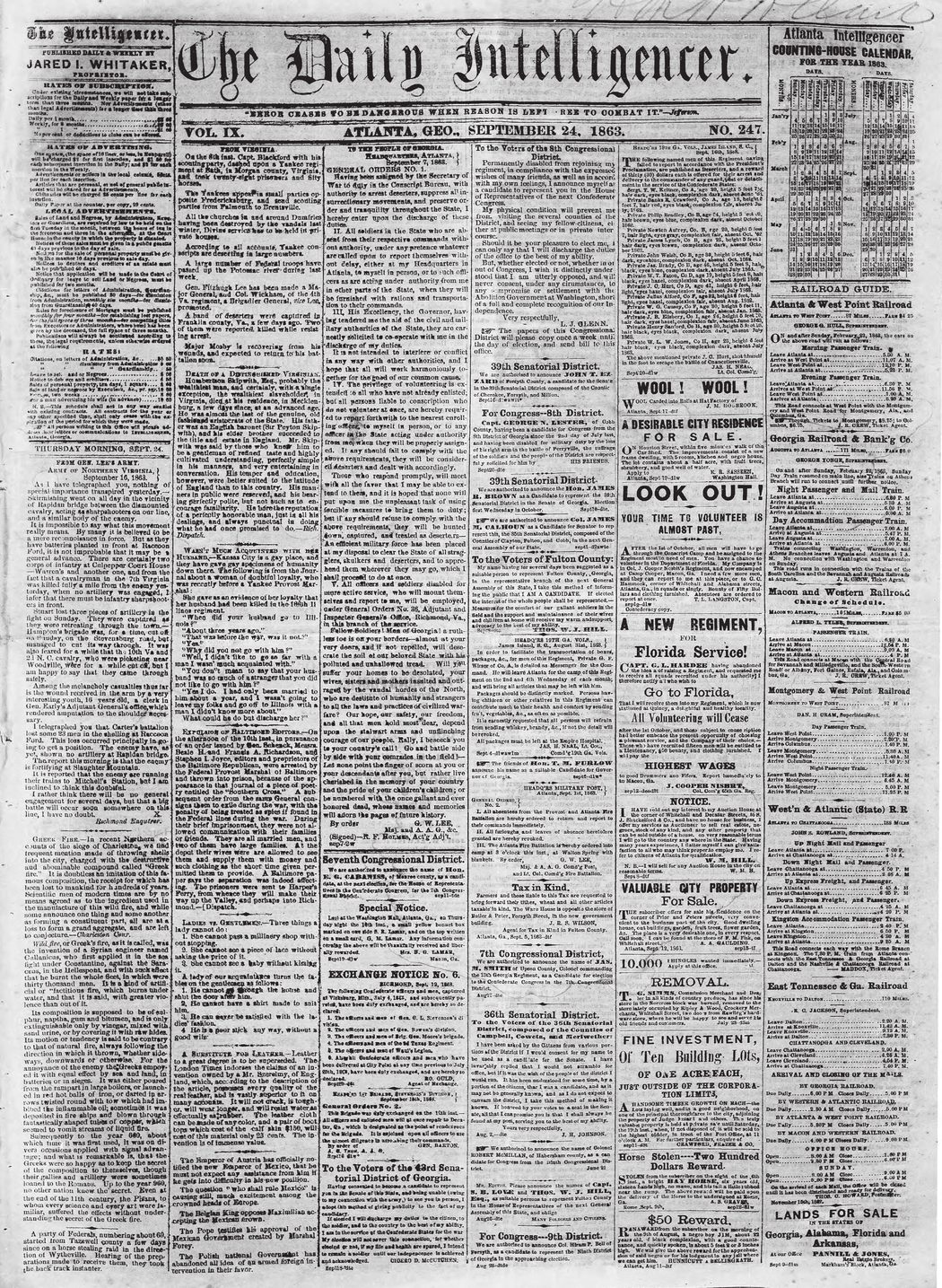
He and Pilgrim got a small hand-press and each afternoon composed columns, set type, and each day produced frontback, single-sheet copies of the Memphis Appeal “Extra.” Copies of the Extra are rare today, but the time, again put on the train Macon and other Southern cities, the Appeal was reprinted widely, even in the New York Times. Thus we can read it today. To round out the story of Atlanta’s Confederate journalism is also to include reporters fro other papers who stayed in the city, enduring Sherman’s bombardment and filing reports for printing in their papers. Su a star correspondent was Henry Watterson, who wrote for several Southern papers under such pennames as “Shadow” and “Grape.” Watterson’s Confedera patriotism was on full display when he turned to William
T. Sherman in his column for the Augusta Constitutionalist of August 28, 1864. “Of all the Yankee Generals he is the poorest, the vainest, the meanest,” Watterson wrote, “a paltry villain, a currish knave,” in a style that only Confederates could have appreciated. Indeed, to Watterson, Sherman was “an ill-begotten, ill-bred and destin caterpillar, clinging only to slo and mildew, climbing no higher than the scum of a rank and putri atmosphere.”
Oh! That we could get away with that stuff now!
Endnotes: 1. Herb Bridges, The Filming Gone with the Wind (Macon: Mercer University Press, 1 88-91; Steve Wilson, The M of Gone With the Wind (Aus University of Texas Press,
154-57. Michael Rose, Atlanta: A Portr of the Civil War (Charleston: Arcadia Publishing, 1999), 111 Keith F. Davis, George N. Barnard: Photographer Sherman’s Campaign (Kansas City MO: Hallmark Cards, 1990), 86. Franklin M. Garrett, Atlanta and Environs: A Chronicle of Its People and Events, 2 vols. (Athens: University of Georgia Press, 1969 [1954]), vol. 1, 2 “C.R.H.” [Cornelius Hanleiter], “A History of Newspaper Enterprises Atlanta,” Atlanta Sout Confederacy, July 14, 1861; Garrett, A & E, vol. 1, 279; H T. Malone, “Atlanta Journalism During the Confederac Georgia Historical Quarterly, vol. 37, no. 3 (September 1953 211. Williams’ Atlanta Directory, City Guide, and Business Mirro (Atlanta: M. Lynch, 1859), 28.
Malone, “Atlanta Journalism,” 211-12. Garrett, A & E, vol. 1, 573; “ Newspaper Changes,” Atlanta Daily Intelligencer, Aug. 12, 1863. Stephen Davis, What the Yankees Did to Us: Sherman’s Bombardment and Wrecking of Atlanta (Macon: Mercer University Press, 2012), 83; “Colonel Geo. W. Adair Is Paralyzed Today,” Atl Journal, Sept. 27, 1899; “J. Henly Smith Taken by Death,” Atlanta Constitution, Feb. 26, 1907. B. Kimball Baker, “ Memphis Appeal,” Civil War Times Illustrated, vol. 18, no (July 1979), 34-35. “Knoxville Register,” Atlanta Daily Intelligencer, Sept. 15, 1863. “The Atlanta Register,” August Constitutionalist, Aug. 30, 18 Ron Soodalter, “News on the Run: J. R. McClanahan and ‘The April 2022
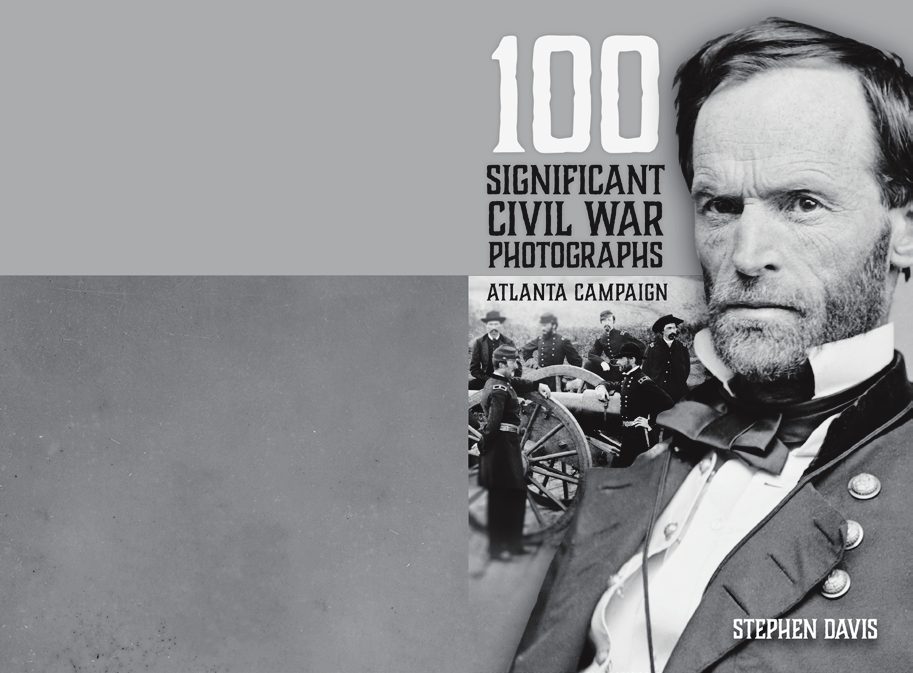
The Atlanta Campaign The American Civil War was the first war in which both sides widely used entrenchments, repeating rifles, ironclad warships, and telegraphed communications. It was also the first American War to be extensively photographed. Mathew Brady, Alexander Gardner and Timothy O’Sullivan are famous for having made iconic photographs in the Civil War’s eastern theater. George N. Barnard deserves to be ranked in this top tier for his photographic work in the war’s western theater. A civilian photographer hired by Gen. William T. Sherman’s chief engineer to take pictures of fortifications around Atlanta, Barnard took several hundred of them in and around the city in the fall of 1864. His most famous is the site of 100 Significant Civil War Photographs: Union Maj. Gen. James B. McPherson’s death in the battle of Atlanta, July 22, 1864. Thus far, no comprehensive, definitive listing has been made of the photographer’s Atlanta Campaign presents a riveting work. The Library of Congress has 130 images; the U. S. Military Academy at West Point, New York, has at least 98 photographs, donated by Captain Poe’s widow. collection of George Barnard’s camera Other repositories, such as the Gilder Lehrman Institute of American History in New York City, have smaller collections. For this book we have chosen a hundred images we deem “significant,” though work. Most of the photographs are from other students may wonder at some of our selections. ISBN 978-1-61850-151-6
We hope that this work will stimulate further interest in Barnardiana, and that other scholarly volumes are yet to come. Barnard’s time in Atlanta, mid-September 9 781618 501516
Federal occupation of the city. 128 pages, photographs,
advances the scholarly literature of ISBN: 978-1-61850-151-6.