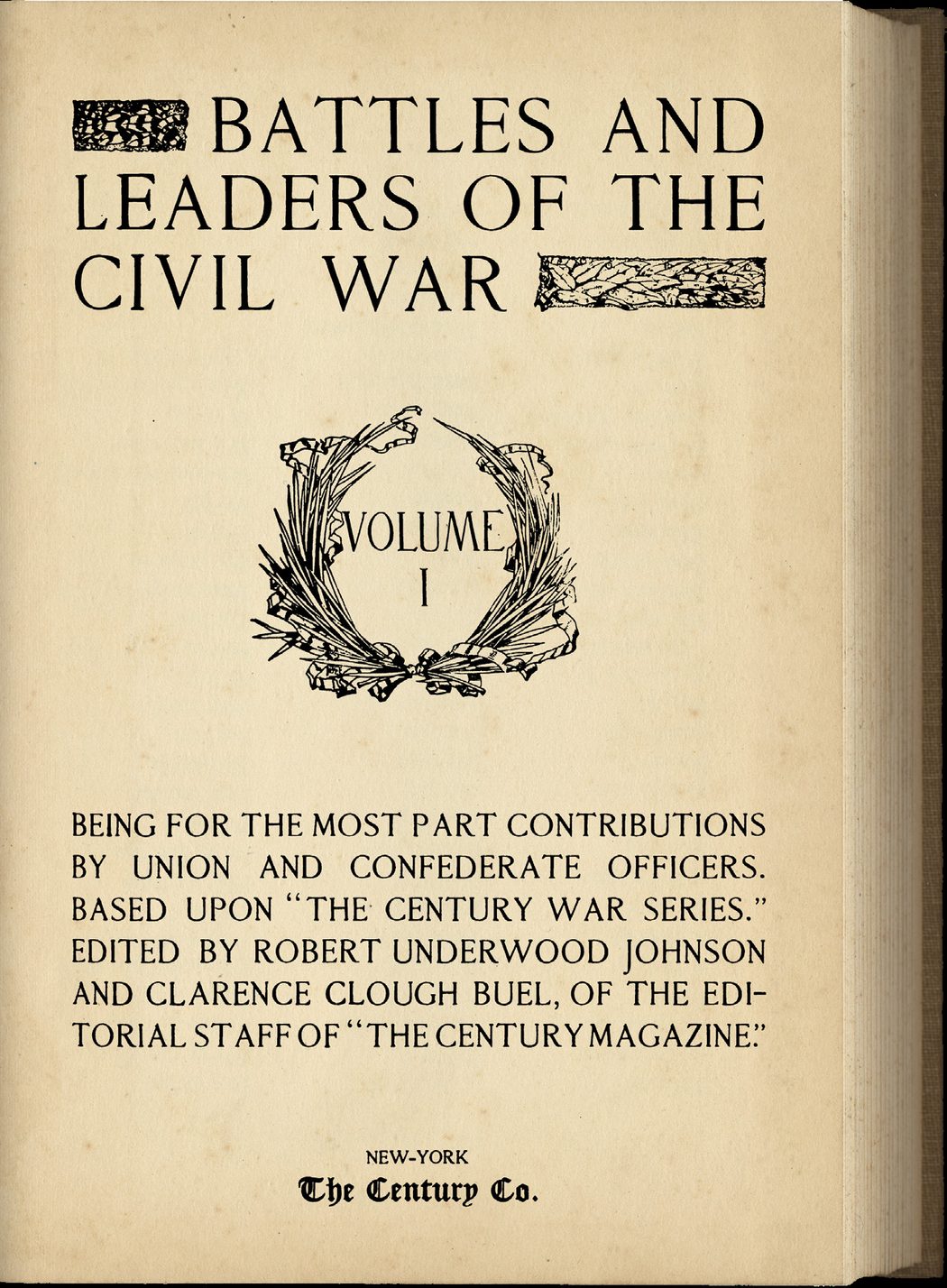
for CWTI in February 1970, James I. Robertson remarked that so many Civil War books were coming out that the next one would be titled “Lincoln’ Wife’s Doctor’s Dog”—but amid the bibliographic bustle was careful to mention it.4 M recently (1995), Gary Gallagh listed it among 100 essential titles.5 Bibliographer David Eicher included it in “Findin Civil War in Books” for North South (April 1998).6 He based list of 125 titles on his The War in Books: An Analytical Bibliography (1997), in which is #743 of 1,099 works cited. We’re speaking, of course, about Battles and Leaders of the Civil War, the four-volum work that ranks as probably t most important compilation of writings by major Civil War figures, both Union and Confederate. First published 1888, the series was reissued a single-volume Century War Book: People’s Pictorial Edit in 1894.8 Three subsequent editions have appeared, inclu that published in 1956 by Tho Yoseloff.9
The “Battles and Leaders” series was conceived by Clarence Clough Buel, assistant editor for Century magazine. In early 1883 Buel thought of pairing an articl on John Brown’s raid at Harpers Ferry written by a Virginian, with a “Comment by a Radical Abolitionist.” The piec published that June, aroused considerable interest. Soon Buel outlined a more ambitious project using the same format: a series o eight or ten articles on decisive battles of the Civil War, written generals who had commanded the opposing armies. Buel proposed his idea to the associate editor, Robert Underwood Johnson. Both Johnson and the Century editor-in-chief, Richard Watson Gilder, liked the plan. Gilder pu Johnson in charge of it, with Bue assisting. The most important task, the lining up of contributors, was begun in the spring of 1884. In the early days of “general catching” (Gilder’s phrase), the editors met with setbacks. Ulysses S. Grant, the first offic to be contacted, declined to writ because his biographer, Adam Badeau, had said it all. William Sherman said the proposed series would fail. G. T. Beauregard said he was too busy. Some officers refused because they would have to criticize their dead comrades; others held back because of the living (Johnson termed this dilemma “Scylla and Charybdis”). But the editors worked their prospects energetically. They persuaded Beauregard by using as intermediary his friend George Washington Cable, whose fiction Gilder had published. Grant, attracted by the editors’ promise
after his banking house had failed, and he in turn helped convince Sherman to write an essay. Eventually Joseph E. Johnston, David D. Porter, James Longstreet and many other important military leaders agreed to help.10 Despite their array contributors, the editors regrett
the refusal of some notables to cooperate. Johnson could not persuade generals Winfield S. Hancock, Nathaniel P. Banks, Simon B. Buckner, or Benjamin F. Butler to participate in the series. Philip H. Sheridan wanted to save his commentary for a book; Jubal A. Early claimed that he opposed writing history for money. Neither Robert E. Lee’s son, George Washington Custis Lee, nor Lee’s chief of staff, Col. Charles Marshall, could be induced to contribute a piece on the great Virginian. With these exceptions, though, most of the war’s major figures
participated, and the series progressed. From the start, the editors emphasized an interesting colorful format. Johnso admonished his contributors to avoid the style of official reports and tell of their battles as they would an after-dinner chat, preferably with personal incidents and even secrets. But many contributors submitted articles that were too long and sometimes so colorless that they were returned or discreetly set aside. General Grant, considered the biggest “catch,” was one such case. Having received his article on Shiloh in early July, Johnson was dismayed to find the general’s writing too much like an official report. On his next visit, Johnson induced Grant to talk offhand about the battle, then informed him that this was the style which the editors were seeking. “He seemed astonished at this,” Johnson recalled, but t general eagerly applied himself to revision. Before long he had completed a more lively piece, as well as three others on different battles.11 Plentiful illustrations by suc staff artists as Walton Taber and Allen C. Redwood (himself a Confederate veteran) would accompany the articles. To balance the generals’ factual narratives, lighter pieces were also commissioned. In December 1885, for instance, there appeared a witty piece by Mark Twain, “The Private History of a Campaign That Failed,” relating in a highly imaginative way the celebrated author’s brief stint in the Confederate service. At the same time, the editors planned to continue their policy of publishing Southern fiction by Joel Chandler Harris and others, long a trademark of
The Atlanta Daily Intelligencer Covers the Civil War Stephen Davis and Bill Hendrick Order online UTPress.org or call
the magazine provided its basis. In all, 226 writers contributed four hundred articles in the fou volumes. As much an anthology
of participants’ narratives, B & also gave officers on both sides a forum for airing complaints
argued about Shiloh; Longstreet was attacked for his role at
pages, in fact, were devoted to the Pennsylvania battle. Meade
was defended against charges of slow pursuit; Mosby spoke up for Stuart. Johnson and Buel gave space to Sickles’ argument that
his corps’ placement had saved the army and the battle. Buel and Johnson sought new material for the books.
Significantly, and a point overlooked by many students, is that only a fourth of the books’ articles had appeared in some form as part of the original “Battles and Leaders” series of the Century. There were some
deletions, too. Many of the ligh pieces, such as Twain’s “Private Campaign,” didn’t make their way into the final volumes.
controversy, but they also worked hard to vouch for the
historical reliability of their contributors’ writings. Their efforts paid off; the Century’s circulation doubled, allowing it to surpass Harper’s, the topselling magazine in the United States. The books sold well, too some 75,000 sets were purchased before the pictorial edition of 1894. Johnson estimated that the entire project netted the Centur
Company a million dollars.12 As the largest and most scrupulously edited compilation of war-related articles by major
military figures of the Civil Wa Battles and Leaders remains
an indispensable source for historians and general readers alike.
Endnotes: “A Confederate Book Shelf” i Douglas Southall Freeman, The South to Posterity: An Introdu
to the Writing of Confederate History (New York: Charles Scribner’s Sons, 1939), 217.
Ralph G. Newman and E. B. Long, “A Basic Civil War
Library,” Illinois State Histo Society Journal, vol. 56 (1963
392. Reprinted with additional listings as “The War in Books: A Basic Civil War Library” in Newman and Long, The Civil
War Digest (New York: Grosset Dunlop, 1960), 392. Ralph G. Newman, ed., “For Collectors Only,” Civil War History, vol.1, no. 1 (March 1 July 2022
James I. Robertson, Jr., “Th Battle of the Books,” Civil War Times Illustrated, vol. 8., no. (February 1970), 47. Gary W. Gallagher, “The Civi
War 100: Civil War Magazine’s Essential Titles on Military Campaigns and Personalities,”
South, Issue #44 (April 1998), David J. Eicher, The Civil Wa
Books: An Analytical Bibliograp (Urbana: University of Illinois Press, 1997), 260-61. Michael K. Shaffer, “Battles Leaders of the Civil War,” Civi War News, vol. 42, no. 9 (Octob 2016), 6. Roy F. Nichols, “Introductio to New Edition” in Robert Underwood Johnson and Clarence Clough Buel, eds., Battles and Leaders of the Civil War, 4 vol (New York: Thomas Yoseloff, 1956 [1888]), vol. 1, iii. Stephen Davis, “’A Matter o Sensational Interest’: The Cent ‘Battles and Leaders’ Series,”
Civil War History, vol. 27, no. (December 1981), 340-41.
Davis, “’A Matter of Sensati Interest,’” 341. Stephen Davis and J. Tracy Power, “Battles and Leaders of the Civil War” in Clyde N. Wils ed., American Historians, 1866– 1912 (Detroit: Gale Research Company, 1986), 373-76.
aders of the Civil War is onlin https://ehistory.osu.edu/books ttles.
cades ago Steve Davis spent afternoon in the New York blic Library perusing the bert Underwood Johnson
pers. He then wrote an article Battles and Leaders that
peared in Civil War History, cember 1981. He has drawn it for this piece in our wspaper.
From the Editor May offers a wealth of riches for any student of the Civil War The weather finally got good enough for campaigning, which unfortunately meant new seasons of slaughter. In 1863 and 1864, in particular, there was so much action going on east and west th it can be hard to keep track of. In my own front yard, Chancellorsville erupted on May 1, 1863. Along the Mississippi River, meanwhile, Ulysses S. Grant crossed to the east bank a began his overland campaign for Vicksburg. Confederate President Jefferson Davis, while worried about events in his home state, was too distracted by the urgent nearby events in Virginia to give the situation in Mississipp the attention it needed. Modern students of the war often find their own attention split and ho to pay attention to both. Then a the events of early May 1864. Grant launched anoth overland campaign, this one
Confederate General Joseph E. Jo action, but few victories, in Ma
through Virginia that became intense enough to earn its own capital letters: The Overland Campaign. He marched into the same Wilderness, the “dark, clos wood,” where Chancellorsville had taken place the year before; this time the fighting and maneuvering lasted for six straight weeks. Meanwhile, out west, William T. Sherman began
maneuvering against Joseph E. Johnston to open the Atlanta Campaign. Farther west, there is the Trans-Mississippi’s tail end of the Red River Campaign. That is a tremendous amount of activity to study, east and west and that’s not even considering the many smaller actions all across the map. Nor does it include the many compelling stories found on the homefront. If we rewind back to May 1862, we get the battle of Williamsbur on the James Peninsula. On May 8, Stonewall Jackson begins zipping around the Shenandoah Valley with the battle of McDowell. In Charleston Harbor, Robert Smalls and a crew of escaping slaves stole The Plante on May 13. We get Seven Pines/ Fair Oaks at the end of the mont Most Civil War buffs know all this, but I call it out as a way invite you to really think about how much material we really have to study and learn and understand, even in just this sh span of the calendar, because, a the end of May, we’re called to commemorate the losses from this and other wars. When you pay your respects at Memorial Day, I hope you call to mind these “seasons of slaughter” and
appreciate what they meant. — Chris Mackowski, Ph.D. Editor-in-Chief
Can Help ECW Each Monday mornin we feature a Question of the Week. We’d love to have your participation in that weekly conversation. Make a point to check in on Mondays and add your thoughts, either as a repl the question or as a reply to t answers others provide. (And, o course, as always, help us keep the conversation civil!)
We have only a handful of tickets left for the Seventh Annual Emerging Civil War Symposium at Stevenson Ridge, which will be held August 5-7, 2022, in Spotsylvania, Virginia Our theme this year matches up with our newest book release, Great What Ifs of the American Civil War. Join keynote speaker Garry Adelman for “The What Ifs of Gettysburg.” We’ll also hear fr Gordon Rhea and Brian Matthew Jordan, plus ECW’s Sarah Kay Bierle, Neil Chatelain, Sean Michael Chick, Phill Greenwalt, Kevin Pawlak, Jon Tracey, and Kris White. We’ll have panel discussions on “The What Ifs of the Antietam Campaign” and “Favorite What Ifs of the War.” We’ll also have a Sunday mornin tour of the Slaughter Pen Farm Fredericksburg. Tickets for all three days
information or to order, visit h t t p s : / / e m e r g i n g com/2022-symposium.
Chris Mackowski (left) and Kris company of legendary football c his wife, Barbara, on a bus tou
The forty-third book in the Emerging Civil War Series is no available: Dreams of Victory: General P.G.T. Beauregard in the Civil War by Sean Michael Chick. Beauregard was one of th most controversial Confederate generals and he remains so to this day. Sean’s biography looks at the pros and cons of t Creole general and offers new insights for readers to conside Signed copies are available from publisher Savas Beatie:
dreams-of-victory-general-p-g-t beauregard-in-the-civil-war.
The Midwest Book Review included a nice review of The Great What Ifs of the American Civil War. “Far from presenting alternative or counterfactual history, the volume examines some of the key pivotal moments of the Civil War and analyzes their importance,” explained reviewer Robin Friedma Although cast in terms of “what if's" most of the book is squar within the responsible practice of history. . . . Each of these essays encourages the reader to look closely at the complexity of determining what happened before speculating on what migh have happened.” You can read the full review here: http://ww
may_22.htm#robinfriedman The American Battlefield Tru featured a slew of ECW talent at its early May conference in Chantilly, Va. Sarah Kay Bierle Dan Davis, Phill Greenwalt, Chris Mackowski, Mark Maloy, Rob Orrison, and Kris White all assisted with various programs and tours. Steve Davis has not one, not two, but three pieces in the Ju
Civil War and Revolutionary War sites, and went to his first hor race! Chris Kolakowski will be the keynote speaker for the rededication of the Hans Heg monument in Madison on May 29. (The original was destroyed by vandals in June 2020.) On June 8, just after the 80th anniversary, Chris is lecturing about the Battle of Midway online for the Commemorative Air Force. Details are at: https
org/events. Jon Tracey recently delivered a program on the 130th Pennsylvania Infantry as a part of a lecture series by the Cedar Creek Battlefield Foundation that supports restoration of an historic structure. He will also be attending the Society of Civi War Historians conference from June 2-4. He'll be presenting some of his research on wounded Civil War veterans as a part of panel titled “Civil War Bodies, Past and Future.” Dan Welch is heading back to Gettysburg as a seasonal Park Ranger beginning Memorial Day weekend. If you're in Gettysburg over the summer stop in and say hi! ECW was pleased in May to welcome new regular contributor Max Longley. “The Civil War is like a real-life Iliad,” he s “a source of life-or-death drama that authors can recur to again and again while still uncovering new information and new perspectives.” Based in North Carolina, Max loves to focus on lesser-known personalities of th Civil War, and he likes to write about the intersection between the war and religion. Max is available for roundtable talks o the following topics: • The Reaper Man – Cyrus McCormick and the Civil War • Conscientious objectors in the Civil War • Was Lincoln right about the July 2022
• North Carolina’s Northern “governors” on p Cape Hatteras and the coa
• The death throes of the Fugitive Slave Act in the
Civil War North • J. Williams Thorne: An antislavery Quaker wartime Pennsylvan and Reconstruction North Carolina
with Steve Davis For our “Five Questions” feature, we’re focusing on the work being done by some of our stalwart ECW “staff.” We have an outstanding cadre of contributors at ECW, but many of them go above and beyond their writing duties to help
run the organization. We’re an all-volunteer crew, so we’re spotlighting some of those gre folks. ECW wouldn’t be possibl without them. This month, we’re talking with Steve Davis, ECW’s book review editor. You can read Steve’s full ECW bio here:
author-biographies/editors/ steve-davis. You’ve been a book review
ECW Book Review Editor Steve Davis loves to stay
editor in various capacities for a few decades now. Can you please outline that histor July 2022
for us? Dave Roth got Blue & Gray going in 1984, I think. His first BRE was Rowena Reed (Combined Operations, 1978). When she quit in 1985, Dave called me and asked if I'd take the “job.” Of course I agreed. I served in that capacity for twen years, retiring in 2005. Then ea last year, when the ECW Board wanted to ramp up ECW’s book reviews, I accepted the invitati to step in. How did you become interested in serving as a book review editor as opposed to just
a book reviewer? I get to keep up with the major publishers
and their releases. It's a way o staying informed on what's of current interest in the Civil Wa
the book review editor for ECW? I try to send out a book, on average, a week. We don't impose deadlines on our readers so I pretty much have to rely on them to finish up and either pos their reviews or to send 'em to me. Then I ask Chris or Sarah to
post them. What’s your favorite part of the job? Working with enthusiastic, talented reviewers like, just to name one, Meg Groeling. Why do you think book reviews are such an important part of the Civil War culture? I used to work for
medical organizations, and saw that the physicians were very proud of their commitment to continuing medical education; a.k.a. “keeping up in the field” and a lifetime of learning. We Civil Warriors can take even more pride in keeping up with the literature. It's our passion not our profession. So staying informed on what's out there is a proud trademark of Civil War enthusiasts’ identity. ECW Multimedia
On the Emerging Civil War Podcast in May: Chris Mackowski and Dan Welch, co-editors of Grant
Anniversary Series, talked about the book in conjunction with
the launch of the 1864 Overland Campaign We also spoke with Darren Rawlings of American Civil War & UK History and Gina Denham’ of the Monuments for UK Veterans of the American Civil War Association an initiative
underway to honor Civil War veterans who died in Great
Britain by providing them with new headstones. Check out the Emerging Civil War podcast on places like Apple
r podcast through Patreon, ere we are now also offering clusive bonus content for bscribers. Along with episodes our podcast, in May we also fered: • An interview with Ben Kemp of Grant Cottage for the U.S. Grant Bicentennial • An interview with ECW’s Phill Greenwalt about his trip earlier this year to
visit sites in the far Trans Mississippi Theater
• An original Edward Alexander map, “Capture of The Planter, May 13,
oceeds go toward defraying the oduction costs of the podcast.
Meanwhile, on our YouTube annel, we offered” • A Red Badge of Courage battlefield tour o
Chancellorsville from Chris Mackowski • An overview of earthworks around Dalton, Georgia, with historian Bob Jenkins • Recaps of the action at Rocky Face Ridge and Resaca with ECW Chief Historian Kris White • An overview of Dug Gap
with ECW’s David Powell • An exploration of the
Middle Tenn Civil War Show Decemb MK Shows presents the 35th ann Civil War Show and Sale at the
artifacts and memorabilia from around the country and encompa history from the Revolutionary Appraisers are always on hand value your military collectibl on Sat., 9-3 on Sun. Free Park adults and children under 12 a
implications of McPherson’s cau Snake Creek Gap A roundtable ta Chatelain, the Arteries of The Mississippi Squadron”
don’t forget to l ibe! You can also Facebook and Twitt
we’re saluting our to active military Explore SC’s milit exhibits at RelicR
rs and collectors eras of military gh World War II. u identify and ost. Hours are 9-5