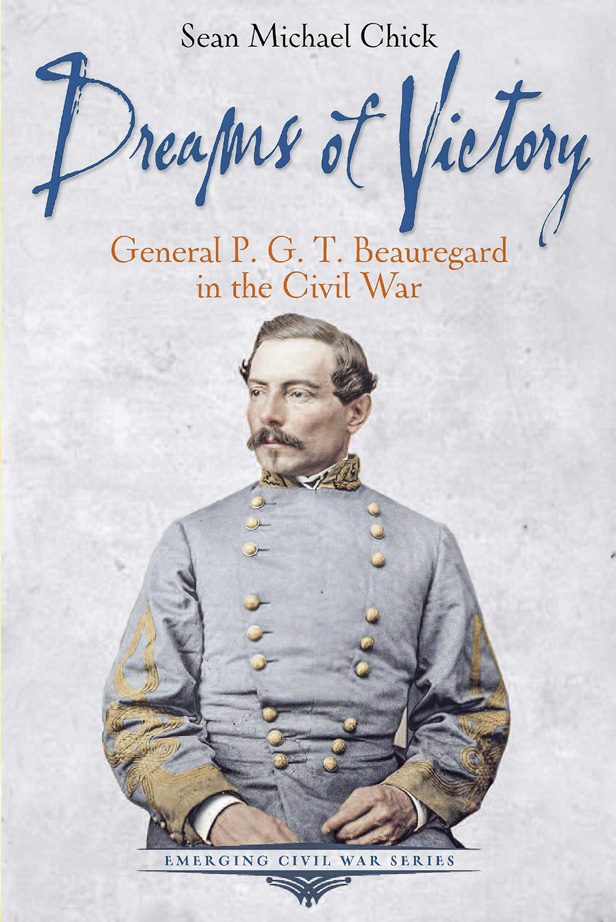
Dreams of Victory. General P.G.T. Beauregard in the Civi War. By Sean Michael Chick. Index, Appendices, photos, Illustrations, Savas Beatie,
In all my years of studying the Civil War I know little of Beauregard. A “Fop,” the loser of Shiloh, an enemy of Jefferson Davis, and various other short comings. So, when the opportunity arose to read book, I jumped at the chance. Beauregard was born in 1818 to an Italian mother and a fa of French/Creole heritages. They were a prominent family
in New Orleans. He attended West Point, became an enginee of note, rose to be Commandan
resigning when Loui seceded. He was in command of troops at First Manassas, and
very successful in orchestrat the Confederate victory. His prickly personality put in bad stead with Jefferson D
This animosity lasted till Da death. It diminished his care
throughout the War. He never got due credit for his action result of this animosity.
blamed him for the loss at Shiloh, an unfair assessment. His excellent engineeri skills saved Charleston and contributed to the repulse of Grant and Butler at Petersburg. These accomplishments were never recognized nor rewarded. Beauregard wanted field command of an army, but Davis denied him. R.E. Lee recommended him for command of the Army of Tennessee, but Davis gave it to John Bell Hood. This was one of Davis’ biggest mistakes as we all know how that turned out. Davis was a proponen of the ‘crony’ system. Beauregard does well in the post war era, but because of several decisions and beliefs he went unheralded. He was not a proponent of ‘The Lost Cause,’ believed in equal rights for African Americans, and did not believe in the canonization of Lee. Although he got along with Lee, I believe he was a bit jealous of his fame. Perhaps his biggest mistake was joining the board of the Louisiana Lottery, thoroughly corrupt enterprise. I made him financially secure but left a bitter taste in the mouth of the Southern people. He never left his beloved New Orleans and died there in February 1893. This is an excellent biograph
filled with information, a short reading list, and notes. In read
it I tried to compare him to a Union general of similar traits. I failed. Beauregard is unique.
of Beauregard since T. Harry Williams wrote “Napoleon in Gray” back in 1955. Perhaps Mr.
Chick will take up that task in near future. I certainly hope so
Joseph Truglio, of Manchester, N.J., is a retired Motion Pictur
interest in the Civil War. He is past President of the Phil Kearn
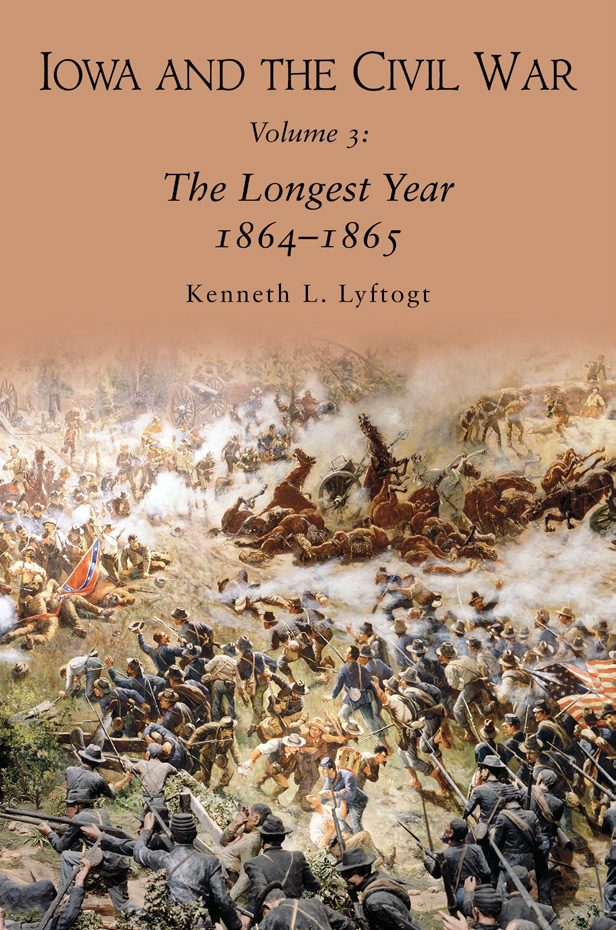
First hand Accounts of Iowa S Iowa and the Civil War; Volume 3: The Longest Year 1864–1865 by Kenneth L. Lyftogt. 2022, Camp Pope
This is the final volume in Lyftogt’s trilogy of Iowa in American Civil War. Volume 1 covered the period 1850–1862; Volume 2 examined the years 1862–1864. During the course of the Civil War Iowa, provid the Federal government with 4 infantry regiments, nine cava regiments, and 4 artillery ba Iowans would fight in the Tra Mississippi, the Eastern, and Western Theaters. The highest commanding officer from Iowa was Major General Grenville Dodge who commanded XVI
memorial transcri upon the informat and the them. Th eloquent nation’s soldiers
Corps. The author skillfully weaves the story of Iowa’s involvement in the various theaters into a comprehensive narrative. He details Iowa’s involvement in General William Sherman’s campaign that led to capturing Atlanta, the efforts to bring
following the capture of Atlant the march to the sea, taking Savannah, and the final battles in South Carolina and North
Carolina. During this period, Iowa soldiers also participated in the Battles of Franklin and Nashville, took part in the cap of Mobile, the defeat of Genera Jubal Early in the Shenandoah Valley, rode with General Wilso during his raid into Alabama an Georgia, foiled General Sterlin Price’s invasion of Missouri, a fought various guerrilla groups on the Western Frontier. The book’s story of Iowa in the Civil War is enhanced by th author adding first-hand accoun of events under discussion into the text. The contemporary accounts provide the reader wit a feel of the emotions generate within individuals, families, a communities by the political turmoil and battlefield casualt taking place around them. Chapter Eight details the 186 Presidential election and is a must read. Many forget that in 1864 the American people were not only deciding who would be President of the United States for the next four years but whether the war would continue
ue work contains a complete hic record of Georgia’s
to the Confederacy, a full tion of the words engraved , and carefully-researched on about the monuments rganizations which built se works of art and their inscriptions express a profound grief, praise the bravery and patriotism, and
and slavery be ended. Also, the people would be electing a new Congress whose new members might finally approve placing the 14th Amendment before the states. This chapter provides a clear summary of the emotional issues that tugged at Iowa voters The Republican Party itself
finding them too lenient and some too demonic. How this all played
out in Iowa is a fascinating stor I personally found the last th
chapters of great interest. Here, the author looked at the effect the assassination of President Lincoln had on Iowa’s soldiers and the state’s home front. Plus, he delves into post war Iowa. Hopefully this examination of post war Iowa will become an additional book in this series on Iowa in the Civil War. The author touches upon the fact that the fighting war did no end with the surrender of Robert E. Lee’s Army of Northern Virginia. The war continued for some time in the TransMississippi Theater; the effects would continue to plague and shape the social and political patterns of Iowa long after fighting ended. I was amazed that some post-Civil War political and social problems that plagued my home state of Kentucky, a border state, also played out in Iowa. I found this book to be a fascinating read, and I have ordered volumes 1 and 2 of the series. The author provides a thoughtful insight into why Iowa believed it needed to support the Union cause both politically and militarily. I only wish the autho had covered Iowa’s involvement in the the purchasing of Federal revenue bonds that were issued to fiancé the war. All in all, this is a great addition to the histor accounts of the American Civil War.
Charles H. Bogart has a BA from Thomas More University and an MCP from Ohio State University. He is employed as a tour guide at the Fort Boone Civil War Battle
Site in Frankfort, Ky., serves as President of the Frankfort Civil War Roundtable, and is a board member of the Kentucky Civil
War Roundtable. He has written several books and articles on military and naval history.
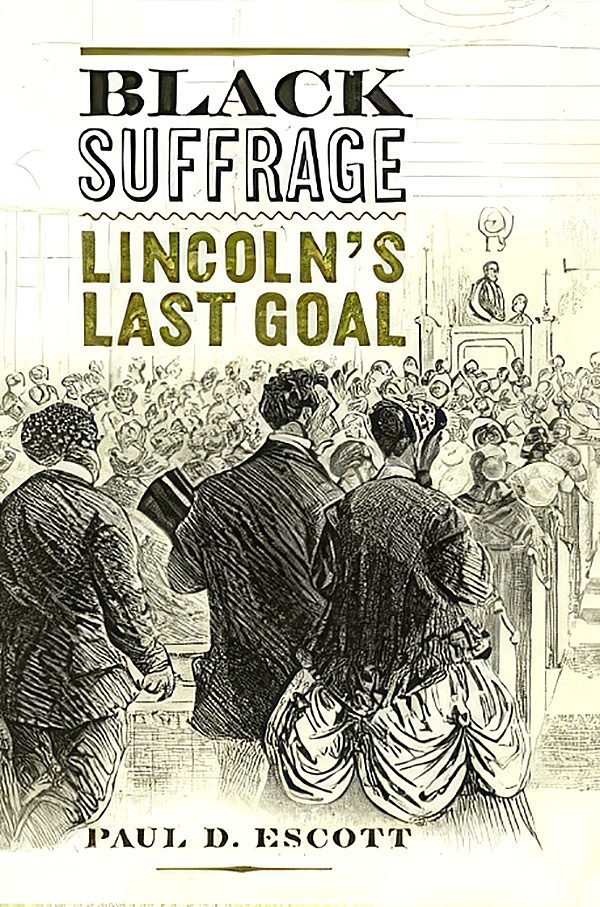
Black Suffrage: Lincoln’s Last Goal. By Paul D. Escott. Photos, notes, index, 288 pp., 2022. University of Virginia
Although victory in the spring of 1865 restored the Union and seemed to settle important Constitutional issues, the succe of United States forces raised various questions about the republic’s future, perhaps most notably whether the nation was ready to grant African Americans the right to vote? In this deepl researched and elega crafted volume historian Paul Escott, among the nation’s most distinguished historians, explor the complexities of the struggle black suffrage in the Civil War’ immediate wake and reveals the multifaceted perspectives northerners possessed about race in the months following the War’ conclusion. Central to Escott’s cogently crafted history is an analysis of the ways in which Northern Republicans advocated black suffrage and the rhetoric Democrats utilized to suppress such support. Largely relying on contemporary newspapers, magazines, and address Escott vividly recreates the war of words between both groups. Unsurprisingly, Escott reveals Republicans argued that suffrage in keeping with Lincoln’s perspective in the spring of 186 should be extended to all blacks who served the Union war effort. Additionally, other Republicans who favored suffrage reasoned that extending voting rights to African Americans proved the only viable means to protect the legacy of Union victory and March 2023
punish the former Confederacy. Conversely, Esc demonstrates, north Democrats opposed granting the right to vote to even a portion of African Americans because they surmised it would lead to racial amalgamation, violence, and the “inevitable degradation of society.” The author reveals ways in which Democrats used the words of Union veterans, including prominent generals such as William T. Sherman, to express the importance of maintaining white supremacy in elections and all levels of government. While Escott lays some familiar argument one paramount value of this well-reasoned history is the author’s stunning ability to present a nuanced analysis of not only differences between Republicans and Democrats but analyze northern Republicans’ complicated racial perspectives. While Republicans supported slavery’s end, not all favored extending the right to vote. Whi Lincoln hoped reconciliation and suffrage could be simultaneously realized, Escott reveals that some Republicans thought it impossible. Granting voting rights to African Americans, some Republicans argu proved a significant obstacle to peaceful reunification. Others decried suffrage due to various factors including the belief tha voting rights could only be granted by individual states, la of education among potential black voters, or fear that black voters in the former Confederacy would be swayed at the ballot box by former enslavers intent on undermining the national government. Beyond Escott’s detai examination of divisions among various groups throughout the North, the author also devotes considerable attention to how Republicans who supported suffrage attempted to allay concerns. History, Escott shows, proved a great ally. Leaning on the limited suffrage that a contingent of freedmen exercised in Tennessee, Maryland, North Carolina, and Pennsylvania, in the republic’s early decades, Republican supporters hoped to show that suffrage could be extended to black people without fear of political and social chaos. Democrats, the author lucidly reveals, also leaned on past and current events beyond
America’s borders, including Jamaica’s autumn 1865 Morant Bay Rebellion, to illustrate why suffrage should not be endorsed. Escott’s powerful study also examines the critical roles Afri Americans played in the struggle for voting rights throughout the remaining months of 1865. From organizing chapters of the National Equal Rights League, maintaining the American AntiSlavery Society, or organizing protests, Escott underscores the importance of African Americans to the movement’s momentum. While much has been written about the circumstanc surrounding passage of the 15th Amendment, which officially granted voting rights after ratification in 1870, no histori prior to Escott has delved into such detail, nuance, and complexity about north attitudes toward suffrage in 186 This magnificent volume, an exemplar of the finest scholarsh is essential for anyone seeking deeper knowledge of the struggle for black suffrage and the role that African Americans played in it in the wake of Union triumph. Furthermore, those desiring a thorough, thoughtful, and balanced analysis of the complexities of Northern racial attitudes will find Escott’s his revealing and compelling. This book, like others penned by Escott, is destined to be a clas and is deserving of much praise and a broad readership.
Jonathan A. Noyalas is director of Shenandoah Universit McCormick Civil War Institute in Winchester, Virginia, a professo in Civil War Era Studies at Shenandoah University, and founding editor of Journal of the Shenandoah Valley During the Civil War Era. He is the author or editor of fifteen book including most recently Slavery and Freedom in the Shenandoah Valley during the Civil War Era, published by the University Press of Florida.
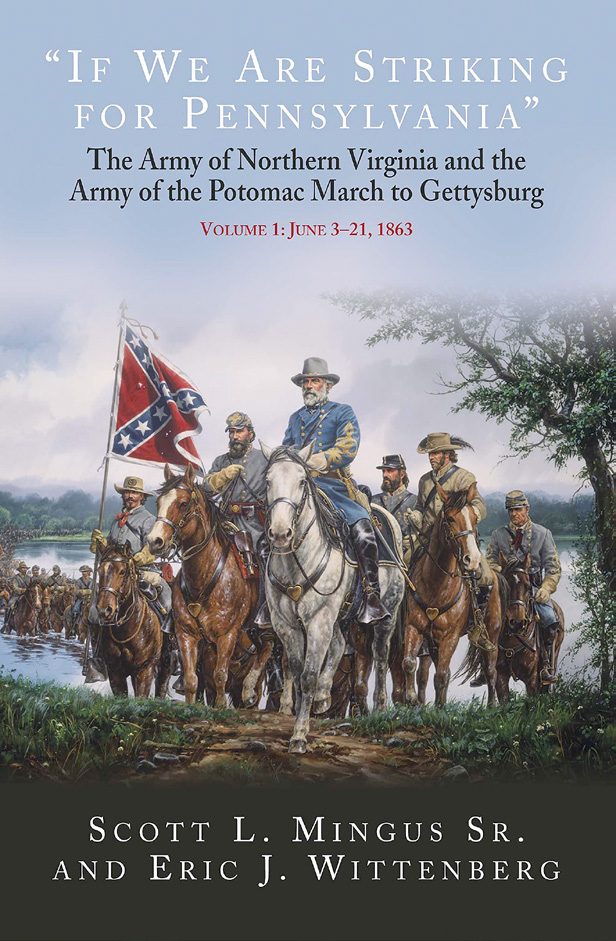
Prelude to Gettysburg “If We Are Striking For Pennsylvania”: The Army of Northern Virginia and the
Army of the Potomac March to Gettysburg: Volume 1, June 3-21, 1863. By Scott L. Mingus Sr. and Eric J. Wittenberg. Appendix, index, illustrated, Savas Beatie Publishing, 2022,
Two gifted modern historians Scott Mingus and Eric Wittenbe have written a meticulous acco of the 18 days that followed G Robert E. Lee’s 1863 decision invade the North. Lee believed an attack on Northern soil wou allow Virginia to buy time to recover from recent Yankee devastation, supply his army w much needed food and forage, and perhaps force Gen. Ulysses Grant to pull troops away from Vicksburg to bolster the Army the Potomac. Each chapter cove one day of Lee’s journey North and Gen. Hooker’s movements in response. As Gen. Lee began stealthily moving North, Gen. Hooker, commanding the Army of the Potomac, was tasked with tryin to ascertain if Lee was going attack Baltimore, Washington City, or Pennsylvania. Hooker’ intelligence personnel spent weeks trying to determine Lee’s intentions as encounters
were fought at Brandy Station, Winchester, Aldie, Martinsburg, Berryville, Upperville, Carter’s Woods, as well as sever smaller outposts. Conflicting reports, unreliable rumors, and lack of consensus on Confederate objectives plagued Hooker. Simultaneously, rumors of an imminent attack aroused Southern Pennsylvanians sending many into a frenzy to hide valuables, livestock, flee safer areas, and await possible Confederate retaliation for the devastation rained on Southern town. In response to the rumors, Pennsylvania civilians joined militia units to protect their capitol. Gov. Curtin called for every able citizen to take up arms, even asking the governors of New Jersey and New York for assistance from their militias. The North was in a panic. While Northern civilians and soldiers struggled to find out what Lee was up to, Jeb Stuart’s cavalry was fighting to keep Northern troops out of the mountain gaps and away from Lee’s main forces, compounding the inability of Hooker to determine Lee’s true objectives. In this first volume of a twovolume series, the authors use extensive primary source material to bring out the actual emotions of the soldiers and civilians who were impacted during these trying weeks. These letters and diaries add the huma element to military reports and make the story of these 18 days come to life. Reading this volum makes one feel as if they were there, witnessing history, with all the angst, drudgery, danger, and sacrifice that attended the impending Battle of Gettysburg. This volume is superbly written, historically sound, ric imbued with primary sources, and indispensable for a true understanding of the Battle of Gettysburg. It should be on the shelf of every Gettysburg histor and is highly recommended. The future Volume 2 is eagerly awaited to finish one’s journey Gettysburg.
Dr. Wayne L. Wolf is Professor Emeritus at South Suburban College, past president of the Lincoln-Davis Civil War Roundtable, and the author of numerous Civil War books and articles including Two Years Before the Paddlewood and the Last Confederate Scout. He is a frequent speaker on the lecture circuit.
The Nashville and Decatur Railroad in the Civil War: History of an Embattled Railroad. By Walter R. Green, Jr. Endnotes, bibliography, ind appendices, tables, illustratio photographs, maps. 256 pp., 2022. McFarland & Co., Inc.
Walter Green is a civil and structural engineer (retired) w lives in Franklin, Tenn. During
the Civil War an important rail line ran from Nashville through the author’s hometown and southward to the north Alabama town of Decatur, where it joine the Memphis and Charleston. The story of the Nashville a Decatur is interesting and one that Mr. Green tells capably. T line was finished soon before t war and was operated by three cooperating railroad companies. The N&D, like other railroads, was “both a tool and a target,” the author phrases it. Dependin on where the armies were as they advanced and retreated, the railroad was a vital asset to be used or an enemy target to be destroyed. As the armies
moved frequently, there was lot of construction, destruction, r
construction, and re-destructio The Confederates wrecked the line as they moved south after
evacuating Nashville in early 1862. Thereafter, it was mostly
the Federals who were using the line and working to keep it in repair, while the Confederates
its use to the enemy. The book tells the story of t war in this theater and connects it to the broader conflict, with focus remaining on the railroad itself. There are lessons on how to build and defend a railroad and how best to tear it up. The engineer/author instructs the reader about bridges and trestle (there is a difference) and also about blockhouses and stockades (again, there is a difference). reader learns about the troops who manned the defensive works and the men who put the pieces back together after raids led by Earl Van Dorn and Nathan Bedford Forrest. One of the most interesting parts of the book is the chapter on John Bell Hood’s retreat afte the disastrous Battle of Nashvil What was left of the Army of Tennessee scrambled to get acros numerous rivers and creeks and just barely managed to say ahead
of the pursuing Federals. Here Mr. Green offers lessons in how to build pontoon bridges and use
fords to cross flowing streams, as the railroad itself was out o commission at this time.
The appendices provide much information to supplement the main narrative; the maps by Hal Jesperson are excellent; and thr tables offer minute details abou all the structures used to cross the streams and the defenses to protect them. Readers will notice a few minor errors and some will from time to time think “Too Much Information.” However, Mr. Green has provided a valuable focus on an aspect of the Civil War that is often covered only cursorily.
Gould Hagler is a retired lobbyi living in Dunwoody, Ga. He is a past president of the Atlanta
Civil War Round Table and the author of Georgia’s Confederate
Monuments: In Honor of a Fallen Nation, published by Mercer University Press in 2014. Hagler
speaks frequently on this topic and others related to different
aspects of the Civil War and has been a regular contributor to CWN\ since 2016. His email is
Erin Irish American Civil War Songs- Identity, Loyalty and
Nationhood. By Catherine V. Bateson. Photos, Illustrations, Bibliography, Endnotes, Index.
“American” folk music can be traced back to Ireland and are actually Americanized versions of Irish folk music. This was v true of many of the songs Civil
War soldiers sang while they marched or civilians heard at patriotic rallies. A good example is The Bonnie Blue Flag, one of the most popu songs of the Confederacy, whose music comes from The Irish Jaunting Car. (The music was also used for another Confedera tune The Homespun Dress) Dr. Catherine V. Bateson, an Associate Lecturer in American history at England’s University of Kent, has analyzed close to 150 songs and lyric sheets devoted to the Irish-American military experience during the American Civil War. In doing so she examines not only their wartime experience but also the
immigrant experience. In the years leading up to
the Civil War, the sheet music publishing industry saw a giant boom, which led to Irish themed
songs or songs that “borrowed” Irish music, to become very
popular. The major publishers of the Irish themed songs, located
primarily in New York, Boston and Philadelphia, were not of Irish descent nor had any direct ties to their local Iris communities. Likewise many of the writers of these songs, wer not Irish themselves either. Fo them, publishing and selling th
songs was simply good business, and business was good.
The book focuses mostly on songs about New York Irish units, most notably the famed 69th New York and the Irish Brigade as well as their commander, Generals Thomas Meaghers and Michael Corcoran. To be fair, the author admits that this is due in part to the large quantity of songs written and published about them, and that very few Irish themed Confederate Civil War songs survive. The song subjects varied, from the heroinism of a particular unit or individual, flags or just plain patriotism. Besides helping to build morale for the war effort, this music helped close the cultural gap between IrishAmericans and the rest of the U.S. population and helped ease prejudices against Irish Catholics. The book would have been
Publishers/Authors Send your book(s) for review to:
Including WWI & II 30th Annual Artiller Military Material From 1775
Saturday May 6th – Sunday May 7th 2023 Sat. 9:00 – 5:00 | Sun. 9:00 – Richland County Fairgrounds, M Location: US-30 and Trim 800 Tables of Military Items, Boo For Buy, Sell, Trade &
~ SPECIAL FEATURES ~ Cannon Firing & Infantry Dem Civil War & WWII Encampments • Period WWII 801st Med Air Evac Educational Pres Camp Chase Fife & Drum & 73 OVI Reg rd Gettysburg Address Presented by Pr Marlboro Volunteers Traveling Museum & ~~~~~
improved if the author had included more song lyrics and presented original Irish version of the songs and their Civil War counterparts. It would also be useful to have had a website whe readers could go to hear some of the songs mentioned in the book, though this reviewer was able to find some on YouTube. The role of the Irish in the American Civil War is a subject that has yet to be fully explore Dr. Bateson has done a very fine job of bringing to light an important part of Irish-American culture and history.
Tom Elmore is the South Carolina State Historian for the Ancient Order of Hibernians and the descendant of an IrishAmerican Civil War officer. His latest Book “Celtic Columbia” looks at the history of the Iris his hometown of Columbia, S.C.
3:00 nsfield, Ohio le Road s, Prints and More Display
nstrations hurch Service ntation • Sutler’s Row mental Band
Gettysburg’s Southern Front: Opportunity and Failure at Richmond. By Hampton Newsome. Photos, maps, notes, index, 424 pp., 2022. University Press of
One of my favorite wartime images depicts an unidentified Union soldier wearing a four button fatigue blouse and fora cap holding a crudely drawn map of Virginia in his left ha and pointing to Richmond with his right index finger. T photograph, one I oftentimes use in the classroom, conveys simple message: take Richmond and the Union will be preserve Since the Civil War’s end much has been written about efforts to seize Richmond at various points in the conflict, partic the failed 1862 campaigns and in the war’s final year. Scant attention has been given to General John A Dix’s operation to threaten Richmond during the summer of 1863 while the Army of the Potomac chased the Army of Northern Virginia into Pennsylvania. Fortunately Hampton Newsome’s latest volume resurrects the story of Dix’s failed effort in this splendidly written and exhaustively researched histor The brainchild of Generalin-Chief Henry Halleck, the “Blackberry Raid,” sometimes
referred to as “Dix’s Peninsula Campaign,” as Newsome cogently argues, “presented a tremendous chance to strike hard at Richmond while Lee’s army was away threatening Pennsylvania.” Throughout the book’s twentytwo chapters Newsome explores debates among war planners in Washington about the merits of launching such a campaign, efforts of Confederate authoriti in Richmond to cobble together a force substantial enough to thwart a Union attack, the capture of Rooney Lee, clashes over how the campaign should be remembered, and effectively describes engagements at such places as Aylett’s Foundry, Crump’s Crossroads, and the bridge that carried the Richmond Fredericksburg, and Potomac Railroad over the South Anna River. While Newsome’s first-rate history describes movements and engagements with astounding detail, this book offers much more than a recounting of an oft forgotten campaign. Newsome’s study offers important insight into General Dix’s prejudice against African American and the United States Colored Troops. Additionally, this volum provides valuable analysis of the important supportive roles enslaved people played in the operation. Throughout campaign, as the author clearly demonstrates, even although Dix’s effort failed, enslaved people who sought refuge with Dix’s troops provided “crucial intelligence” to Union troops. Additionally, Newsome’s finel crafted history, in keeping with the current historiographic tren to illustrate the environment’s impact on military operations, provides a critical analysis of role weather conditions played. Stifling heat and oppressive humidity, coupled with the reali that the majority of troops task with carrying out the campaign, the Union IV and VII Corps, were unaccustomed to hard campaigning, proved disastrous. While Newsome freely admits that “the precise number of men afflicted by the heat is
not known,” the author makes good use of existing evidence to illustrate the toll the excrucia heat had on Union troops and ways in which they attempted to cope with it. Newsome’s history offers a useful reminder that an engagement’s popularity or statistical toll ought not to be the only factors by which a fight’s impact is assessed. For instance, in the author’s excellent discussion of the figh at Crump’s Crossroads on July 2, 1863, Newsome effectively uses primary material to not onl recount the clash between Union troops commanded by General Erasmus Keys and Confederates from General D.H. Hill’s command but to demonstrate combat’s ferocity regardless of the number of men involved. To the troops engaged, particularly the wounded or to families who lost a loved one, the clash at Crump’s Crossroads, as the author rightfully claims, “was a harrowing as any other.” This study’s value extends beyond its important connections to the Gettysburg Campaign. While those seeking a broader understanding of the Army of Northern Virginia’s invasion into Pennsylvania and the Union efforts to stop it will fi Newsome’s smartly crafted book essential, anyone desirous of deepening their knowledge about the roles African Americans played in Civil War operations, interactions between civilians a the military, or the environment impact on troops will find Newsome’s study of great worth.
Jonathan A. Noyalas is director of Shenandoah Universit McCormick Civil War Institute in Winchester, Virginia, a professo in Civil War Era Studies at Shenandoah University, and founding editor of Journal of the Shenandoah Valley During the Civil War Era. He is the author or editor of fifteen book including most recently Slavery and Freedom in the Shenandoah Valley during the Civil War Era, published by the University Press of Florida.
A Small Fight and Quickly Forgotten Six Miles from Charleston, Five Minutes from Hell: The
Battle of Secessionville, June 16, 1862. By James A. Morgan. Maps, photographs, appendices, 192 pp., 2022. Savas Beatie,
Savas Beatie has published over 60 books in its Emerging Civil War Series. More are to b released this year, which marks series’ tenth anniversary. Unde series editor Chris Mackowski, these works are advertised as offering “compelling, easy-toread overviews of some of the Civil War’s most important battles and stories.” In the book under review, aut James Morgan tells the story of the 1862 Battle of Secessionvil on James Island, just across th Ashley River from Charleston. Morgan tells us that the fight was small, and soon forgotten, but that doesn’t mean the story unimportant or uninteresting. James Island was, or could have been, the back door to the well-defended South Carolina port. The Federals tried and fa to drive the Confederates from the island and gain a favorable position across the river from Charleston. The Federals had a larger infantry force than their foe and better artillery. addition, with naval superiorit the Federals could place their land forces where they wanted, when they wanted, and back them up with the ships’ big gun One may think that this capabil would give the Yankees a big advantage, if not an insuperabl one. However, the army commanders did not get along
with their naval counterparts o with each other. The department
commander, Brig. Gen. David Hunter, was oddly uninterested
in the campaign and left almost everything to Brig. Gen. Henry Benham, an officer of uncertain abilities. The Confederates also had some leadership issues. Among other problems, Maj. Gen. John Pemberton was distrusted by civilian leaders and his subordinate commanders. In addition, Pemberton was ordered to transfer a significant part of his force to Virginia, where the Federals were threatening the Confederate capital. The author does a good job explaining the military situation in 1862 and describing the action in the runup to the June 16 assault. Although eight maps help the reader understand the terrain and follow the action, the level of detail will still be challenge for some. There are modern photographs of various sites on James Island, but these contribute little to the reader’s understanding. Morgan includes a paragraph or two on many officers involved, useful especially for the lesserknown figures. Some readers will have trouble keeping up with the many minor characters who pop into and out of the story especially as the book has no index. The author relies on and quotes a number of primary and secondary sources but there are no citations and no bibliography. Appendices contain a battlefield guide and the story of two brothers who fought on opposite sides. Notwithstanding the problems at the command level, when the attack came the soldiers on both sides fought with skill and determination. Morgan’s description of the June 16 action excellent. It was a close run thi but the Confederates repelled three assaults against their key position, the Tower Battery. The Federals were forced to withdraw, suffering 683 total casualties ou of about 3,400 engaged. The Confederate defenders lost 204 of approximately 1,275.
Gould Hagler is a retired lobbyis living in Dunwoody, Ga. He is a past president of the Atlanta Civ War Round Table and the author of Georgia’s Confederate Monuments: In Honor of a Fallen Na published by Mercer Univer
Press in 2014. Hagler sp frequently on this topic and othe
related to different aspects of t Civil War and has been a regular
es & Belts fied Relic & Document & Head Gea & Currency Flags
ar Show rgia Trade Ingle Park GA 30720 & 5, 2023