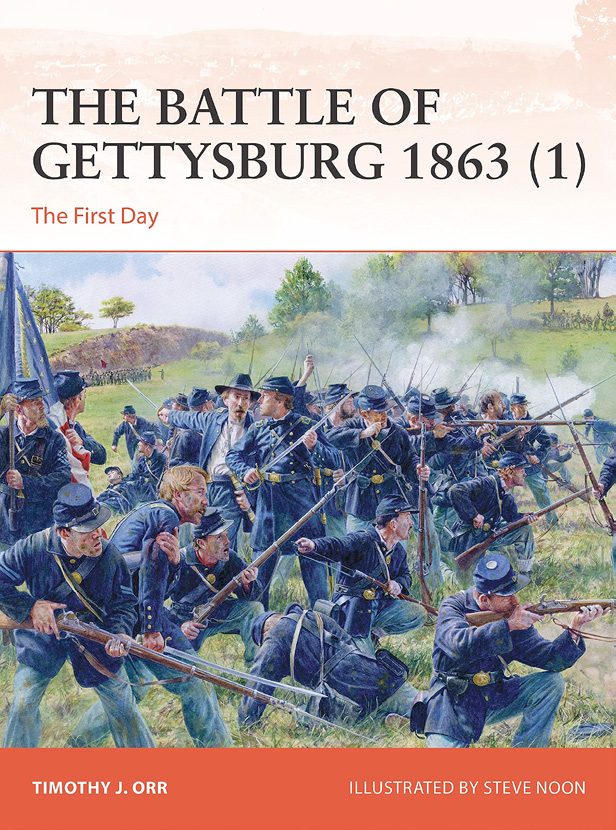
The Battle of Gettysburg 1863 (1), The First Day. By Timothy J. Orr. Illustrated, bibliograp index, Osprey Publishing, 2022,
This first of a planned three volume set telling the story of Battle of Gettysburg using batt reports, 3-dimensional views, maps, and first- hand accounts. It begins with Gen. Robert E. Lee’s strategic planning to relieve Virginia and its plunde resources, stoke negative polit consequences for President Lincoln’s reelection, perhaps siphon off troops from besieged Vicksburg. With these objectives in mind, the Army of Northern Virginia marched down the Shenandoah Valley into Maryland and Pennsylvania with a clear terminal objective not yet determined. Before long circumstances brought on the initial confrontations a Brandy Station, Winchester, and Stephenson’s Depot. When Lee’s army finally reached Pennsylvania, an early morning cavalry skirmish at Wisler’s Ridge began the fateful events July 1, 1863. What followed w Confederate advances Gen. Heth’s Division at Herr
Ridge against Gen. Buford’s cavalry. The engagements then proceeded through locations
frequently overlooked from text on Gettysburg, Marsh Creek,
Herbst Woods, Willoughby Run, Blocher’s Knoll, and Rock Creek The fighting gained momentum as it moved to the more familia locations on Seminary Ridge, Cemetery Hill, McPherson’s Ridge, and the Chambersburg Pike. Each skirmish is detailed thoroughly and highlighted by insights into the commanders, their decisions, and the casual reports that infused the chapte with a human element. Included in this volume is a complete Order of Battle for bo
the Army of Northern Virginia and the Army of the Potomac, with all corps, brigades, and
divisions represented. Photos o officers and enlisted men help to bring to life the sacrifices
all participants. The accounts stress how the North was fighting to preserve the Union and Southerners were fighting to retain their culture. This f volume concludes with the rout of the XI Corps, the final determined stand of the I Corps at Seminary Ridge, and the nighttime planning of Generals Lee and Meade for the next day. This planning ensured neither side would withdraw and day two would bring additional death an misery. This book is historically accurate, well written, and provides a good primer for any student of Gettysburg. The only suggestion for improvement would be to enlarge the battle scene photos as they are too small to fully appreciate their contribution to the reader’s understanding of the battle. Th following two planned volumes should form a complete, well presented, understanding of thi pivotal battle.
Dr. Wayne L. Wolf is Professor Emeritus at South Suburban College and Past President of the Lincoln-Davis Civil War
Roundtable. He is the author of numerous books and articles on the Civil War including The Las
Confederate Scout and Heroes and Rogues of the Civil War.
A Modern Strategic Look at America’s Major Wars Since 1861 Modern History for the Modern Strategist: America’s Major Wars Since 1861. Michael O. Hanlon. Preface, notes, index, maps. 416 pp., 20 Brookings Institution Press,
Modern History for the Modern Strategist: America’s Major Wars Since 1861 was written
by a senior fellow and director of research in Foreign Policy a the Brookings Institution, wher he specializes in U.S. defense strategy, the use of military f and American national security policy. In this book the author “addresses profound questions. How successful has the United States been when it waged these wars? Were the wars avoidable? Did America’s leaders know what they were getting into whe they committed to war? And what lessons does history offer for future leaders contemplatin war?—Including the prospects for avoiding war in the first place.” The book’s first five chapter cover the American Civil War, World War I, World War II, Kore and Vietnam, America’s Wars in the Middle East since 1990, and concludes with a chapter entitl “Three Lessons.” The five chapters have sections covering the paths to war, weapons and technology, a very good general history of the war or wars, followed by a concluding sectio entitled “Mistakes Made and Lessons Learned.” The “Mistakes Made and Lessons Learned”
sections are excellent and wort reading as a standalone on thei own by anyone familiar with the
conflicts involved. The Three Lessons discussed
in the concluding chapter are “Outcomes in Wars Are Not Preordained;” War is Usually Harder and Bloodier Than Expected;” and “America’s Grand Strategy is Strong Enough
the final section has some interesting comments. The author feels that the United States’ strengths (economic, political, geographical) and alliances have prevented a great power war. His summary is that: “The paradox of American power is that while we may not be that good at wielding it tactically and operationally, system of alliances and global leadership itself is so strong at its core that it appears capable of absorbing a number of blows
FOUR INCREDIBL The Artilleryman is a quarterly and mortars pri Now expanded and full The Artil 520 Folly Road, Suite 25 PMB 3
without crumbling.” Modern History for the Modern Strategist is heavily researched and documented and is an interesting reappraisal o the conduct and outcomes of
strategy, decision making at hi levels of authority and uninten consequences.
Capt. Joe Derie is a longtime Civil War buff with a special interest in Civil War naval his and the Civil War in the West. is a retired USCG officer and a licensed officer of the Merchan Marine, currently self-employed as a marine surveyor and marine accident investigator in Portland, Ore.
979 for enthusiasts who collect tionary War, Civil War to World color throughout the entire mag
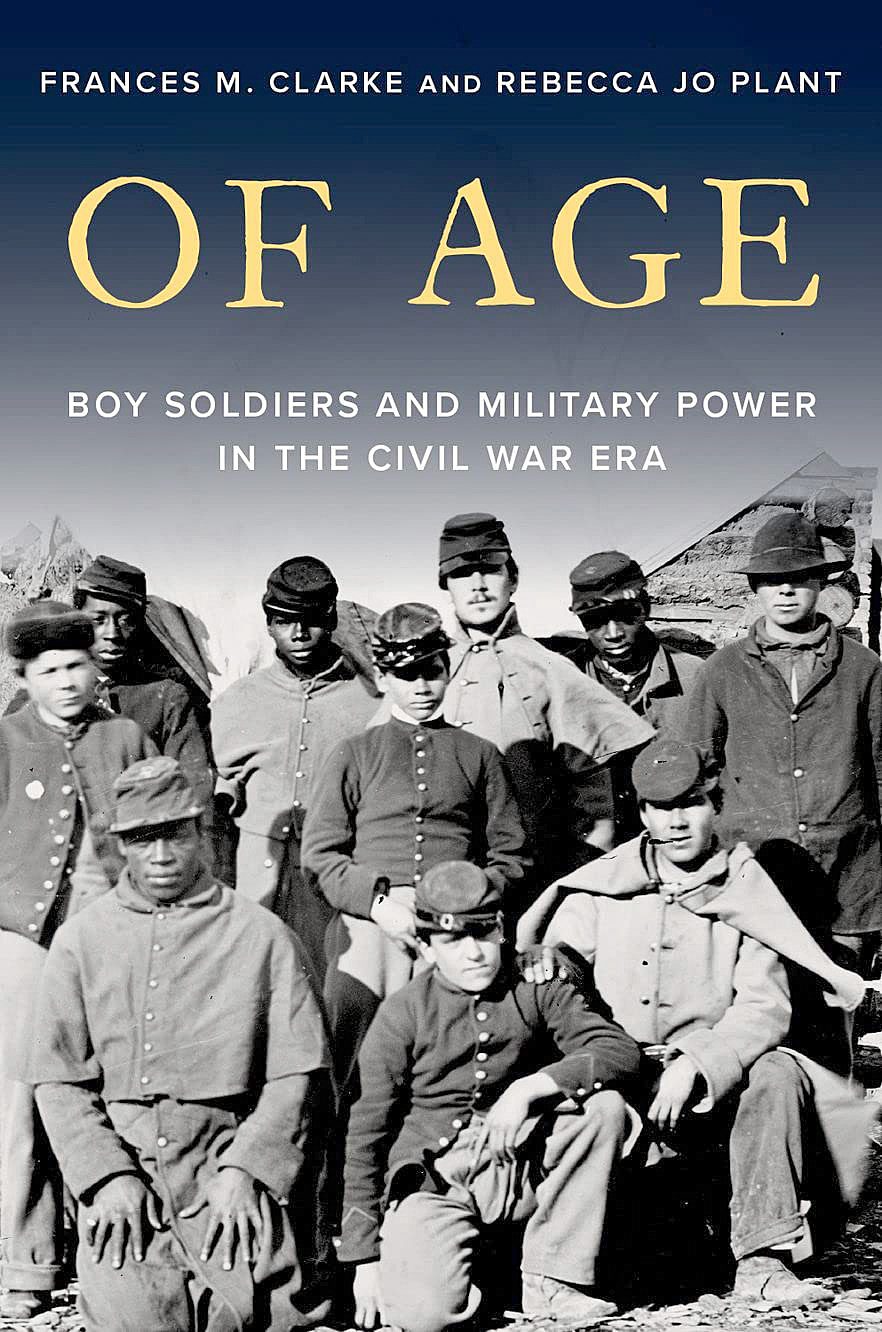
This book traces the history of the economic, legal, social, political and cultural perspecti which formed the basis for the world’s view of what was a child who owned the labor and body of a child until the age of adultho and how did the military reconcile the legal definition of filial obedience to the needs of a war machine. During the Civil War, approximately 10% of both Union and Confederate forces were under the age of
18. Whether these recruits were scammed into enlisting, ran away from home, lied about their ages, or were literally kidnapped, they set in motion a legal process whereby their parents or guardians attempted to retrieve their children. This created a situation where state courts, mainly through writs of habeas corpus, were petitioned to release these children from military service. In opposition, federal authorities, desperate f manpower, generally considered
the enlistment contract to be binding and having emancipated
the youth from parental control. Within this context, the autho attempt to clarify four aspects underage soldiering during the Civil War: (1) How a youngster’s removal from the home affected a family’s labor requirements and, in many cases, survival; (2) How expectations of young males affected enlistments; (3) By the war’s end how the traffic in underage boys became a profitable business; and, (4) Ho August 2023
idealization of Confederate yout helped shape the Lost Cause mythology. These objectives were shaped further by studies of human growth in the 19th Century that concentrated on the effect of war and its horrors on physical and mental development of youth. Children were seen as having to conquer their fears and develop the manly traits and vigor to deal with the world the lived in. Thus, male youths were seen as benefiting from exposure to conflict so they would remember the sacrifices that others endured to keep them free in a world of competitiveness. I the North youths were thus seen as symbols of the national self and a virtuous Union cause. In the South, they were lauded as proof of Confederate unity and righteousness. The Civil War thus became the final stage of a process of politicization and militarizatio that had begun decades before. Neither parental resistance nor legal restrictions could check war fever and the freedom youths could experience away from home in the companionship of other me of all ages. As a resul the federal government became the largest single employer of child labor during the Civil War Likewise, until the turn of the 20th Century, the bravery of the young soldiers, drummer boys, and musicians was seen as vitall important to justify the Union cause in the North and cement th
sacrifices endured in the South. This book is well written and
researched, historically sound, and commendable for exploring the multifaceted aspects of underage service in the Civil Wa Youthful service becomes a lens through which history can view changing perceptions of what a child is and how should children be raised to succeed in society. This has been a neglected topic most Civil War literature and th book fills a vital niche to bett
understand society’s changing views of childhood and how the Civil War transformed American
Dr. Wayne L. Wolf is Professor Emeritus at South Suburban College and the author of numerous books on the Civil War including Heroes and Rogues of the Civil War, Two Years Before the Paddlewheel, and The Last Confederate Scout. He is past president of the LincolnDavis Civil War Roundtable and a frequent lecturer on the roundtable circuit.
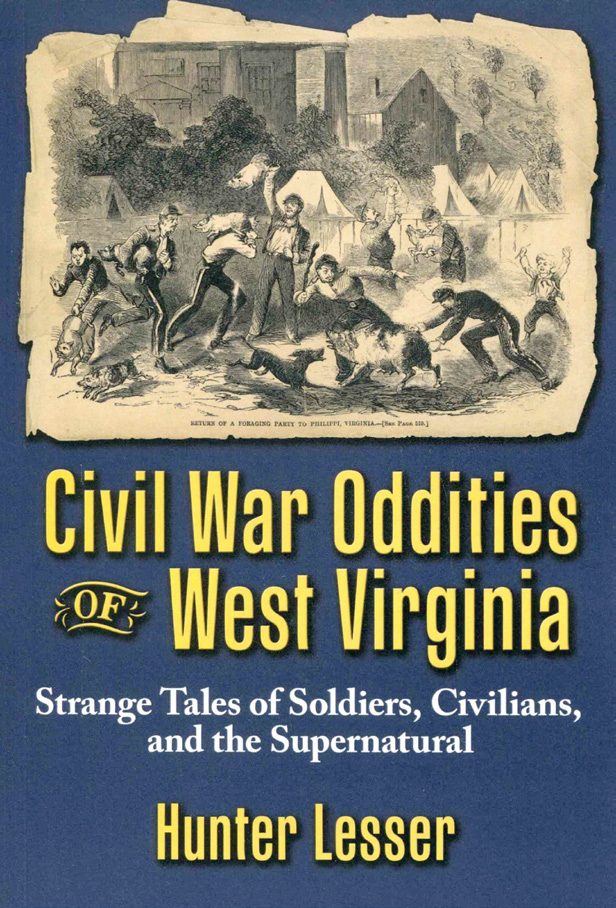
The Oddity of O Civil War Oddities of West Virginia: Strange Tales of Soldiers, Civilians, and the Supernatural. By Hunter Lesser, Quarrier Press, Charleston, WV.
This book has a title that is entirely accurate. There are fe “strange tales” within its cove and very little of the supernat There are, however, many short anecdotes concerning W Virginia soldiers in the Americ Civil War. The book is arranged by year, 1861 to 1865, and each account has its own endnote, 286 of them, at the back of the book. A substantial biography also contains books, periodical newspapers, manuscripts, and websites. Readers may find the
bibliography as compelling as the book itself. Several anecdot are enjoyable, such as the 1862 ride of Jane Snyder. Her West Virginia neighborhood was in danger of being attacked by some partisan rangers under Col. John Imboden. Young Miss Jane was the daughter of a Unionist. Her father was the leader of some Union Home Guards. When she learned of the coming incursion, she leaped (of course she did!) the back of a fleet horse. She r through the night to alert her f and a nearby Union garrison near present-day Parsons. “Her Paul Revere-like ride saved the Union garrison and spread an alarm tha foiled Imboden.” (45-46) Author Lesson claims that, in 1861, General R. E. Lee’s famous mount Traveller was a West Virginia-bred horse purchased for two hundred dollars. He also tells readers of various newspap editorials mocking General Lee and his less-than-effective defe of what would soon become West Virginia. (26-27) Many anecdotes fea enslaved persons. One, from 1864, claims that a man wearing Confederate uniform was captured by Generals Crook and Averell and deposited in the Athenaeum prison at Wheeling, W.Va. The prisoner claimed he was trying to get through Confederate lines when captured and impressed into southern service. The Confederat claimed he was one of theirs, so
s) for review to: e 4 PMB 304, Blue Ridge, GA 3051
remained imprisoned. (85) I had never heard or even considered one particular anecdot It concerns the famous Thomas Jonathan “Stonewall” Jackson’s sister. Her name was Laura Jackson Arnold. She was close to her brother until the beginning o the war, but just as he went Sout she remained a staunch Unionist. Miss Laura became a nurse in Beverly, W.V., and pledged to “take care of the wounded Federal as fast as brother Thomas could wound them.” Laura Arnold is one of those “B List” characters whos life deserves more investigation. (3-4) Civil War Oddities of West Virginia is easy to read, mildly interesting, and contains some laughs. This little book is one possible answer for readers tired of five-hundred-page treatises on strategy and tactics or who simpl want a break.
Meg Groeling received her Master’ degree in Military History, with Civil War emphasis, in 2016, from American Public University. Savas Beatie published her first book, Aftermath of Battle: The Burial o Civil War Dead, 2015, and she has written First Fallen: the Life of Elmer Ellsworth, also published by Savas Beatie. She is a regular contributor to the blog Emerging Civil War. She and her husband li with three cats, in a 1927 Califo bungalow covered with roses on th outside and books on the inside.
Union General: Samuel Ryan Curtis and Victory in the West. By William L. Shea. photographs, index, endnotes, and bibliography. 346 pp. Potomac Books, An Imprint of the University of Nebraska Pres
Grant, Sherman, Sheridan, and Chamberlain are well known Union generals. Each commanded units serving primarily east of the Mississippi River. Their fame was not only derived from military leadership, but also t proximity to major governmental industrial, and financial cente where media coverage was strong. Unfortunately, many fin generals who served west of the Mississippi River are still lar ignored. General Samuel Ryan Curtis is one of them. William Shea remedies that problem in his latest work, Union General: Samuel Ryan Curtis and Victory in the West. Shea provides a comprehensive biography of this obscure hero. General Curtis was an excellent but largely independent field commander. He was also a civil engineer, attorney, politician,
To see all of this year’s visit our websit HistoricalPublicationsLL
mover/shaker in the construction of the Transcontinental Railroad. Union General: Samuel Ryan Curtis and Victory in the West, chronicles a variety of humaninterest topics all Civil War soldiers encountered. General Curtis not only endured long separations from his wife, but he also lost five of his seven children. Curtis was grateful for his West Point education, which he continually applied to all his career experiences. William Shea also describes the unpredictable political/communications arenas faced by many commanders. He also does a very good job explaining the logistical issues independent field commanders faced and how they solved them. Western Theater Unio commanders were vita important. Effective commanders, like Curtis, made it very difficu for Confederates to wage combat on both sides of the Mississippi River at the same time. Perhaps the best insight Shea provides are the reasons for General Curtis’ relative obscurity. Those living in Iowa o Missouri likely are familiar with Curtis, but he is largely unknown anywhere else. General Curtis’ military triumphs at Pea Ridge in 1862 and the Battle of Westport in 1864, are significant. His contributions as a civil engineer and politician helped complete the Transcontinental Railroad. However, General Curt expected others would recognize his achievements and credit them to him. Unfortunately, Curtis die shortly after the war ended and others were only too happy to lay claims on Curtis’ achievements. Historians interested in Weste Theater operations, or engineers and railroad buffs will find this book a valuable reference work. I is extremely well researched and written in clear concise chapters that cover a myriad of topics.
Richard has served as a Civil War News book reviewer for twentytwo years. Three of his articles
were published in various issues work focuses on religion in the Civil War.
Confederate Memo Possesses Mass A The Military Memoirs of a Confederate Line Officer: Captain John C. Reed’s Civil War from Manassas to Appomattox. Edited by William R. Cobb. Photos, notes, index, 192 pp., 2023. Savas
In the Civil War’s aftermath Captain John Reed, a veteran of the 8th Georgia Infantry who served with the regiment throughout the entire conflict, embarked upon the task of writing a memoir about his wartime experiences. Work progressed slowly over the next few decades. He completed the manuscript, “From Manassas to Appomattox,” in 1888, but it wa never published. After Reed’s death in 1910 the manuscript ended up in the collections of Alabama State Department of Archives and Military History. Reed’s memoirs remained there in obscurity for many decades. While some historians have mined Reed’s memoirs in recent years it has not until now, due the diligent and careful editor work of William R. Cobb, been available for the public’s consumption. Reed’s memoirs, carefully annotated by the editor and enhanced by an array of maps,
and including a remarkably detailed map of the 8th Georgia movements at the First Battle o Manassas by that most-gifted cartographer Hal Jespersen,
offers much value to Civil War historians. While those interested in the 8th Georgia, the Army of Northern Virginia, and Lieutenant General James Longstreet’s Corps will find Reed’s perspectives about battle from First Manassas to the Confederate surrender useful, the value of Reed’s postwar reflections extends well beyond recounting troop movements and the ebb and flow of battle. Those seeking a richer understanding of the ways in which the experience of soldiering and combat impacted soldiers will find Reed’s memoir quite valuable. Throughout, Reed offers heart-rending observation about the despair of dealing wit the loss of beloved comrades. For example, Reed recounted how the death of Sergeant Frank Crone in the spring of 1862 on the Virginia Peninsula prompted him to possess nothing but “a very sad recollection of this place.” Additionally, Reed’s memoirs reveals how soldiers coped with a bevy of daily issue related to individual health and wellness and engaged in what historian Kathryn Shively termed “self-care.” Historians interested exploring the relationships and interactions between soldiers and civilians will likewise find this volume beneficial. In addition to recording encounters with Confederate civilians in places such as Richmond, and Winchester, a community where Reed spent time early in the conflict and for several days af he was wounded at the Battle of Gettysburg, Reed’s memoirs also details various exchanges he and his comrades had with civilians in southern Pennsylvania during the summer of 1863 as the Army of Northern Virginia launched its second invasion of the North Among the confrontations Reed recalled was one with “a neatly dressed lady” who exchanged words with Reed about how she believed the Army of the Potomac would crush Confederate forces.
Reed also related a somewhat amusing encounter troops in the 8th Georgia had with a young boy who looked somewhat surprised that as he gazed upon
the Confederate troops he did not see any horns protruding from their heads as he was told ‘that the rebels all have horns.’ Furthermore, this masterfully edited volume offers insight into the Confederacy’s political and military figures and their decisi While Reed’s viewpoints are not necessarily representative of all Confederates, his thoughts about such topics as the role Confederate general J.E.B. Stuart played in the Army of Northern Virginia’s defeat at Gettysburg, disdain for President Jefferson Davis, and the lack of widespread support among Confederate authorities to arm black people to fight for the Confederacy late in the conflict provides another lens through which historians can further analyze various aspects o the conflict. Reed’s memoirs demonstrate how Confederates processed their defeat in the decades after the conflict. While admittedly distraught in the spri of 1865 when General Robert E. Lee surrendered at Appomattox, Reed confessed that in “the years since the war I have changed greatly” and that in hindsight he rejoiced that the Confederacy lost. While some Confederate veterans possessed nothing but bitterness until they breathed th last, Reed’s reflection reveals how some Confederate veterans’ perspectives evolved over time. William Cobb deserves much credit for bringing Reed’s memoirs to print and for his stellar work in editing it. This memoir possesses mass appeal to historians interested in the conflict’s military, political, a social dimensions.
Jonathan A. Noyalas is director of Shenandoah University McCormick Civil War Institute in Winchester, Virginia, a professor in Civil War Era Studies at Shenandoah University, and founding editor of Journal of the Shenandoah Valley During the Civil War Era. He is the author or editor of fifteen books
including most recently Slavery and Freedom in the Shenandoah Valley during the Civil War Era, published by the University Press of Florida.
General Grant and the held gru Verdict of History: Memoir, Memory, and the Civil War. By Frank P. Varney. Maps, photographs, appendices, footnotes, bibliography, index. 226 pp., 2022. Savas Beatie,
The book under review is the second volume of a two-part work by Frank Varney. It follows General Grant and the Rewriting of History, published by Savas Beatie in 2013. Volume I examined the military record of Maj. Gen. William S. Rosecrans and discussed history’s perspective of this record, a generally-negative vie largely shaped by Gen. Ulysses S. Grant memoirs and other writings. This negative view is unwarranted, Varney argues, with evidence from various sources, especially Grant’s dishonest accounts of Rosescrans’s actions at Iuka, Corinth, Chickamauga, and Chattanooga. In General Grant and the Verdict of History Varney picks up where he left off and conside Grant’s treatment of three other officers. Joseph Hooker, George H. Thomas, and Gouverneur K. Warren were all major generals who, like Rosecrans, served part of the War under Grant, and who, Varney asserts, were all victims of Grant’s malice. The portrait of Grant painted by Varney is that of a man who
hogged credit than Sheridan’s. T for himself, dismissed and belittled the accomplishments of others, blamed others for his own mistakes, and tailored his accounts of successful operations so as to leave the impression that all went according to his masterful plan. Let’s start with Hooker and Thomas at the Battle of Chattanooga. If you think that Hooker’s assault on Lookout Mountain was a difficult thing to pull off and one that contributed to the Federal success, you need to listen to Grant. He said in an interview that “There was no such battle, and no action even worthy to be called a battle on Lookout Mountain.” Did Grant order the assault on Missionary Ridge? Most accounts say that after taking the rifle p as ordered, the men in Thomas’s Army of the Cumberland charged on their own accord. Not in Grant’s version. He wrote that they were “effectually carrying out my orders of the 18th for the battle and of the 24th for th charge.” Was Thomas slow, always slow, ponderously slow? Grant said so again and again. Thomas’s refusal to attack at Nashville until he was ready wasn’t due to atrocious weather and supply problems. It was just the general dilatory habits. Grant planned to fire him but couldn’t very well do that after Thomas’s smashing victory in a battle that all but destroyed the Confederate Army of Tennessee. Warren paid the heaviest price for earning Grant’s disfavor. After his corps helped win the Battle of Five Forks, Warren was stunned to find himself abruptly stripped of command. No court of inquiry was convened until 1879. The discussion of this cour is perhaps the most interesting part of Varney’s book. Lieut. Gen. Philip Sheridan, the one who “was doing Grant’s bidding” when he axed Warren, testified, as did President Grant, two years or so out of office. Grant’ testimony was less interesting
A Detailed Account of t for the South Carolina resident was evasive, repeatedly using phrases like “I do not recollect Sheridan was less evasive and attempted to defend the decision to dismiss Warren. He was not persuasive. The officers on the court determined that the action Sheridan took in removing Warren from command was not justified, despite knowing the members of the court knew that Sheridan was in line to succeed Sherman as Commanding General of the U.S. Army. He did so in 1883. Warren never learned he had been exonerated. He died before the court’s decision was published in 1881. Frank Varney does not pull his punches. Regarding Grant’s various statements and actions, the author uses phrases such as “disingenuous,” “false legend,” “patently untrue,” and “pattern of deceit.” He discusses the historiography as well as the history, and points out instance in which historians should have examined Grant’s writings with a more critical eye. Varney presents cog arguments based on government records and accounts written by the principal actors and others who were present and wrote about what they did, heard, and observed. The notes are where they belong, at the foot of the page, for the convenience of the careful reader; and the book ought to be read with care. It i not for the novice, but for read who already know the plot and the characters in the drama.
Gould Hagler is a retired lobbyi living in Dunwoody, Ga. He is a past president of the Atlanta Civil War Round Table and the author of Georgia’s Confederate Monuments: In Honor of a Fallen Nation, published by Mercer University Press in 2014. Hagler speaks frequently on this topic and others related to different aspects of the Civil War and has been a regular contributor to CWN since 2016. His email is
Gunboats, Muskets and Torpedoes-Coastal South Carolina 1861–1865. By Michael G. Laramie. Photos, Illustrations, Bibliography Endnotes, Glossary, Index. 383 pages. Westholme Publishing,
The four year-long battle for the control of the South Carolin coastline, with an emphasis on capturing Charleston, produced some of the hottest fighting of American Civil War. At the onset, both sides had certain advantages. The Union had a bigger navy that enabled the north to easily capture Beaufort and the Port Royal area in 1862, enabling them to set up a port for the blockading fleet. The South, on the other hand, ha the advantage of easy to defend, if overly extensive, terrain. The South Carolina coastline from Georgetown to the North Carolina state line, (now known as the Grand Strand) is sixty miles of sandy beaches with no natural harbors which would have doomed any operations against it. Consequently, the Union’s army and navy effort focused on the coastal region between Charleston and Savannah. Charleston’s harbor w ringed by numerous small forts and batteries with Forts Sumter and Moultrie making a nearly impenetrable gauntlet t prevented enemy vessels from getting to the city. Despite this, the North tired hard to capture the city and/or Fort Sumter. Land attacks were generally made south of the city most notably the 1862 Battle of Secessionville on James Island and the various attacks on Batte Wagner on Morris Island in 1863. In both cases the North suffered high casualties with little or nothing to show for it. It was n
until these forts were abandoned by the Confederates that the Federals took control of them. Military operations Charleston harbor did not fare an better for the Federals. Despite constant bombardments, Fort Sumter remained in Confederate hands until evacuated in 1865. Much of the credit (or blame) for this lies with Union army and navy commanders. While they often came up with plans for joint operations that looked good on paper, they were never properly executed due to miscommunications, faulty intelligence, poor weather, and just plain bad luck; a surprising lack of support from Washington, was also a factor. Adding to the Union navy’s woes was the Confederate use of armored torpedo boats. While their success was somewhat limited, they added problems for a fleet that was already stretche thin due to lack of manpower and disabled vessels. That was not all. Laramie, an engineer turned historian, argues that Charleston was still valuable port for blockade runner by war’s end, pointing out many ships that ran the blockade were more advanced than the Union ships trying to stop them, and as a whole only one in six blockade runners were captured by the Union navy. In the end Charleston fell because Maj. Gen. William T. Sherman’s march through South Carolina forced the Confederates to evacuate the city on February 17, 1865. This is a good account of the struggle for the South Carolina coastline. Of particular note, is examination of the relationships between the Union army and navy commanders showing that, while it was far from perfect, it was not as bad as it has generall been depicted. Also included are some of the best maps this reviewer has ever seen in a Civil War book, as well as a glossary o military terms used in the book. The one big complaint is that he seldom mentions officers by their first name in the text, which is often annoying, This is a very well done study of an often overlooked aspect of the war. For anyone interested in how the blockade or the Union navy fared during the war, this i an excellent read.
Tom Elmore has written several books and magazine articles about South Carolina during the Civil War.