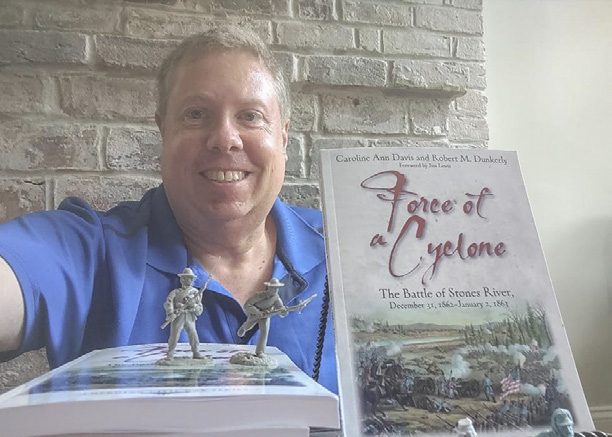
Bert Dunkerly and his toy soldiers are excited about his new book with Caroline Davis! Force of a Cyclone: The Battle of Stones River, December 31, 1862–January 2, 1863, is part of the Emerging Civil War Series and is published by Savas Beatie
This book, years in the making, offers a highly readable account of one of the Civil War’s worst battles. Stones River saw the highest percentages of casualtie of any battle (3.8 percent kille 19.8 percent wounded, and 7.9 percent missing/captured out of 76,400 men engaged).
Bert Dunkerly gets a military escort of sorts for the launch o his new co-authored book, Force of a Cyclone: The Battle of Ston River.
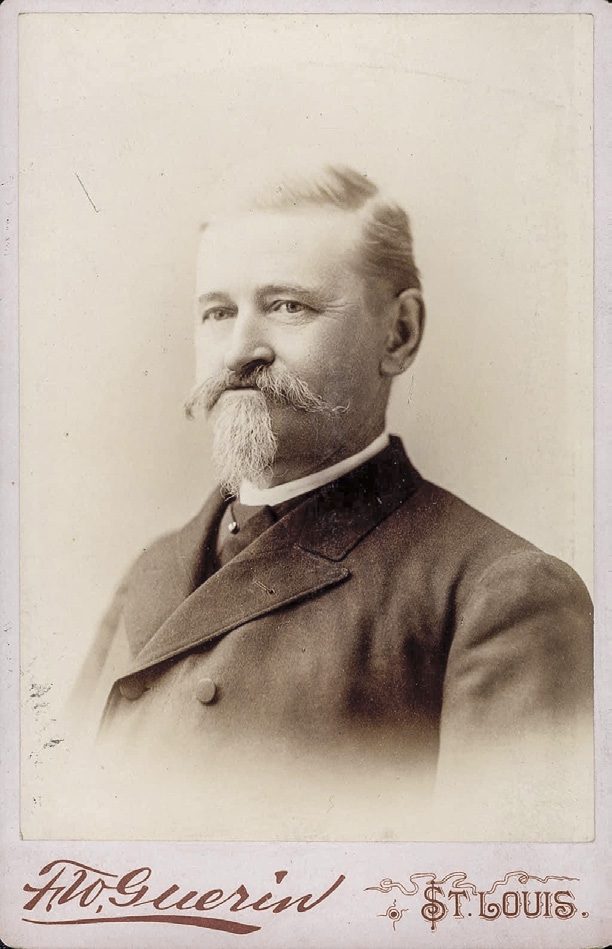
Here’s the latest from Frank Jastrzembski’s “Shroud Veterans” project: A veteran headstone was placed at Colonel Ignatz G. Kappner’s unmarked grave. “Colonel Kappner Austrian, an educated and traine soldier, exiled from his native land for participating in a patr effort to overthrow a despotic ruler,” recalled Charles P. Brow
acting assistant quartermaster a Fort Pickering, where Kappner commanded for most of the war. “Six feet tall, well proportione
courtly and punctilious, he was one of the finest looking milita
men I ever saw.” On April 26, 1865, Kappner and soldiers stationed at Fort Pickering assisted in the rescue of the Sultana’s passengers. The following April, Kappner was honorably mustered out. After the war, he was employed
as a cashier for the German Savings Bank, served as the city treasurer for St. Joseph, Mo., a worked for Joseph Pulitzer as th business manager of the St. Loui Post-Dispatch. On October 20, 1891, Kappner died at his home
and his remains were cremated. His ashes were interred at Mount Mora Cemetery in St. Joseph, beside his wife and daughter.
On the Emerging Civil War Podcast: September 2023
Ignatz Kappner began the Civil War as a private in the 7th New York Militia before heading to Missouri.
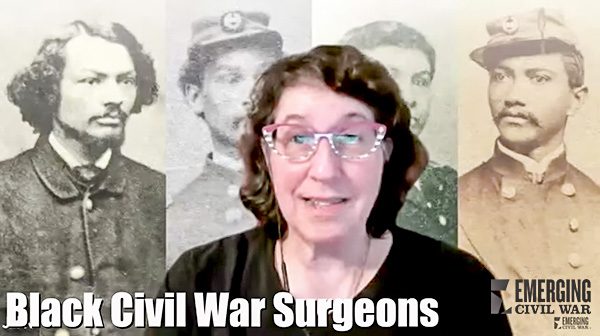
We spoke with Jill L. Newmark author of “Without Concealment, Without Compromise: Th Courageous Lives of Black Civil War Surgeons.” We held a roundtab discussion with historians Fran Varney, Nick Sacco, and Dave Powell about Ulysses S. Grant’s memoirs and memory, based on Frank’s book “Ulysses S. Grant and the Verdict of History.”
efforts of a small handful of B surgeons who helped the Union war effort.
The Emerging War Podcast is available through Spotify, Apple Podcasts and wherever fine podcasts are
( h t t p s : / / w w w. p a t emergingcivilwar), where we are now also offering exclusive
help support ECW. Proceeds go toward defraying the production costs of the podcast.
On the ECW YouTube page: Chris Mackowski discussed the ups and downs of using Confederate Veteran and the Southern Historical Society
Papers as sources. We visited Monocacy on the
anniversary of the battle and talked about the battle’s domin effect. Kevin Pawlak visited the gra of seminal Antietam historian Ezra Carman. He also visited the grave of James Tanner, the disabled Civil War vet who took the first testimony of Lincoln’
sination. also posted the ons of our discu Newmark and our Frank Varney, Ni ave Powell.
Meg Groeling rging Civil War are the news of treasured member nity, Meg Groeli
shared she had mphoma. spell, ’t beat . “You try to r cance eback all of Thursda
Meg came to ECW out of the blue with a guest submission posted on September 22, 2011. The post was, fittingly, relat to her Civil War crush, Elmer Ellsworth. She taught middle school math at the time, but h work with ECW eventually gave her the courage to go back to
school in her 60s to earn her in military history—a childhoo dream her father had dissuaded her from in favor of the math degree that would ensure she g a job. Meg was ever-after grat to ECW for helping her achieve her life-long goal of history. always counted that as one of ECW’s biggest successes. Meg was the crazy aunt who comes to Thanksgiving dinner whom no one knows what to do with—with her purple hair, her multitude of cats, and her unquenchable tendency to find good-natured humor all sorts of random stuff. She had an unparalleled generosity of spi Meg served as a constant vo of support for women’s voices, not just at ECW but in Civil War public history in general. She loved to buoy people up. She loved Elmer Ellsworth. She loved baseball, books, and cat She adored her husband, Robert
analysis of the latest and most scholarship. Contact email: Boo
Toss of A Coin: The Life of a Private in the Civil War. By W. Alan Sprague. Illustrated, self-published, 2022, 219 pp. softcover.
W. Alan Sprague uses the actual letters of his brother’s great, great grandfather, Willi Arnold Fuller of Co. E, 114th New York Infantry to fashion a novel, part fact, part fiction, tell the story of a typical pri in the Civil War. William Arnol Fuller’s letters home provide the recanting of his adventures from enlistment in Greene, New York, to his death at Cedar Cre during the last battle his regi fought. This story also includes Fuller’s comrades, most notable Sergeant Johnson, Smith and Lee, Frank and Hudson Skillman, Daniel Tremain, Jack Chidester, and Calvin Well. Their thoughts conversations, doubts, fears, illnesses, and travails allow t author to tell these stories as human beings simply wondering, “What have we got ourselves into?” The majority of this book deals with the campaign of the 114th New York in Louisiana after arriving from a tortuous sea trip from Baltimore to Fortress Monroe and then to the Mississippi. Accommodations on their journey to the Louisia swamps was a tale of crowded, filthy, disease-ridden, cramped surroundings which made Arnold question the regard the government felt for soldier who volunteered to save the Union. Upon arriving at Bayou Teche
and Camp Mansfield, the next months were spent guarding the New Orleans, Opelousas, and Great Western Railroad and moving camp constantly to consolidate forces or get out o
our readers with timely icant Civil War research and
the path of advancing Rebels. Th camps were swampy stretches of bottom land that bred hordes of mosquitos, contaminated water, snakes, and rotten rations. Here the 114th fought its first battl near Fort Bisland; here comrades died, hospital horrors were forever etched in the soldier’s minds, and Arnold received his first head wound. After a failed expedition to Sabine Pass, the 114th helped build Bailey’s Dam to assist Admiral Porter’s floti and participated in Gen. Nathani Banks Red River Campaign. After the fall of Vicksburg and Port Hudson, the 114th was recalled to the Shenandoah Valley and Winchester where, at the Battle of Cedar Creek, Arnold was killed on October 19, 1864. Of the 1,000 men who first enlisted, only 120 mustere out in 1865. Arnold’s story coul have been written for any of the farmers turned soldiers who did not survive. This book is well written and does a commendable job of bringing the foot soldier’s tria and tribulations to the reader. seldom disappoints the reader for its truthful rendition of th horrors of the Civil War and the human tragedy that this conflict brought to families and friends. It is recommended for historians interested in the life of the common soldier.
Dr. Wayne L. Wolf is Professor Emeritus at South Suburban College, past president of the Lincoln-Davis Civil War Roundtable and the author of numerous books and articles
including They Saw The Bear Dance, None Showed The White
Feather, Homeguard, Hotheads and Heroes of the Civil War, and Surgeons, Sharpshooters, and Skirmishers of the Civil War. He is a frequent lecturer on the li of the Civil War soldier.
Redeeming Grant’s Reputation Grant at 200: Reconsidering the Life and Legacy of Ulysses S. Grant. Edited by Chris Mackowski and Frank J. Scaturro. Photos, notes, index, 288 pp., 2023. Savas Beatie,
Upon learning of the death of Ulysses S. Grant in 1885, the mayor of Boston, Massachusetts, Hugh O’Brien, believed Grant deserved eternal praise from the nation for all he did in leading Union forces to victory, restori the Republic, and enacting measures to safeguard civil rights. “No citizen… has stood so prominently before the public as General Grant, or has rendere more distinguished services to his country,” Mayor O’Brien noted. While indeed worthy of many plaudits Grant’s reputation plummeted in the decades following his passing, his image cast into that of a butcher or corrupt president. Fortunately, in recent decades historians hav begun to reevaluate Grant’s life and legacy and contend, and I believe rightfully correctly so, that Grant deserves a place amon the pantheon of the nation’s gre figures. This collection of fift essays, penned by some of the leading experts on Grant, furthe bolsters that contention. Some essays in thoughtfully conceived volume aim to offer fresh perspectives about Grant’s military life. For instance, historian Timothy B. Smith convincingly argues that Grant’s ability to address situations on campaign and on
the battlefield came not from a deep understanding of military
philosophy but developed as a result of Grant’s “experience an common sense.” Smith quips that Grant was “Clausewitzian when Clausewitz was not cool.” Chris Mackowski cogent
surveys what historians have argued were the turning points in Grant’s career as general. While others have offered such notable engagements as Belmont, Shiloh, and Vicksburg as critical moments in Grant’s career Mackowski forcefully argues that if historians must choose one event as the turning point in Grant’s Civil War career, the Battle of the Wilderness and his decision to push the Army of Northern Virginia afterwards should rank as the supreme turning point.
Three authors, Charl Calhoun, Alvin S. Felzenberg,
and Ryan Semmes investigate aspects of Grant’s political life Calhoun contends, as have other historians, Grant was not “a natural politician,” but this tri of essays reveals Grant’s deep commitment to civil service reform, civil rights, equality, a expanding the United States’ global reach while maintaining “a peaceful coexistence in Europe.” Additionally, som contributions to this volume explore aspects of Grant’s memory. Frank Scatur investigates the rise, fall, and reascendancy of Grant’s image and forcefully argues that Grant unquestionably “belongs in America’s pantheon of great presidents.” Historian Gary Gallagher offers a thoughtful reflection about the various shif in Grant historiography and ponders whether recent efforts by historians to redeem Grant’s reputation will truly “affect popular conceptions of the American past.” While this book’s essays offer much insight into Grant’s generalship, two-terms in the White House, and legacy, this anthology also explores the development of Grant’s character and personal relationship Ronald C. White, author of the acclaimed American Ulysses, offers an engaging analysis of the important role Methodism played in shaping Grant. White convincingly shows how Grant’s religious beliefs instilled in hi values that guided him in all he did. Nick Sacco’s investigation into the relationship between Grant and his in-laws and Grant’s
Publishers: Send your book(s) for Civil War N
disdain for how they treated his wife Julia offers much insight into the difficult family dynami Grant confronted and how he navigated them successfully. Among the most intriguing essays in this outstanding anthology is Ben Kemp’s contribution about the Grant Cottage, the place where Grant spent his final weeks and died. Kemp, currently the operations manager at the site, offers a poignant meditation abo
Grant’s humanity and the power of place. While some might
view the site as rather macabre with its beeswax encrusted floral arrangements from Grant’s funeral on public display, Kemp rightfully contends that while the “objects, settings, and stor there can bring people closer to the past” the place and objects, coupled with a full understandin of Grant’s generosity, can “rene one’s faith in humanity.” Other essays exploring Grant’ career at West Point, the genera humanity at Appomattox impersonating Grant at living history events, and reflections on the Grant family by Ulysses Grant Dietz, Grant’s youngest surviving great-great-grandchild further enhance this noteworthy anthology. This thoughtfully conceived collection of fifteen essays is outstanding. While this exceptional volume will appeal to those interested in Grant and offer a nice complement to the burgeoning literature that is redeeming Grant’s reputation, this splendid collection possess much value for those interested in the power and necessity of revising history.
Jonathan A. Noyalas is director of Shenandoah Universit McCormick Civil War Institute in Winchester, Virginia, a professo in Civil War Era Studies at Shenandoah University, and founding editor of Journal of the Shenandoah Valley During the Civil War Era. He is the author or editor of fifteen book including most recently Slavery and Freedom in the Shenandoah Valley during the Civil War Era, published by the University Press of Florida.
The Generals’ Civil War: What Their Memoirs Can Teach Us Today. Stephen Cushman. Full notes serving also as bibliography, index, 230 pp., Chapel Hill, University of North Carolina Press. https://uncpress
Ever since David Blight introduced us to the power of memory and its quixotic journey, new scholarship has not only been prodigious but most helpful to understanding America’s great tragedy. The exploration and meaning of memory has occupied such recent authors as Stephen Cushman in his new book, The Generals’ Civil War: What Their Memoirs Can Teach Us Today. It’s a spare volume, only 174 pages of text; but Cushman, in this intriguing and painstakingl researched book, deconstructs the memoirs of Generals Joseph Johnston, William Sherman, U. S. Grant, Richard Taylor, George McClellan, and Philip Sheridan.
He faces, head on, the nature of the memoir and its place in historical writing, particularly the American Civil War canon. Cushman’s line of reasoning runs as follows. Thomas Jefferso divided his famous library into three categories: memory, reason
392 page, full-color book, Civil War Artillery Projectil – The Half Shell Book. For more information
Memoirs: History or Literature? and imagination. Under those groupings fell the disciplines o History, Philosophy, and Art. It wasn’t until a hundred years later that the Library of Congre broke with Jefferson’s template and introduced the concept of “general literary studies.” Neat fitting into this new classifica was Mark Twain’s declaration that Grant’s Memoirs was “a great work of literature.” This presents a problem. What is memoir? If it is literature, is true? If it is history, how much is memory and how much is imagination? Cushman maintains that in the nineteenth century, “European romanticism migrated to the New World, bringing with it transformative ideas about th power of individual imagination. (p. 11) It was in this moment in America, 20 to 30 years after th most unimaginable and tragic
“principles” of the battlefield introduced their “first person narratives” to thrill readers longing to hear “the true story. Cushman argues that this was a new “undertaking.” The totality of the war was incomprehensible. A first-person narrative of someone who “was there,” took the impersonal to the personal. For the person who had never experienced the horrors or tediu of war, the narrative made it as comprehensive as possible. Perhaps the most romantic of the lot was Richard Taylor, lieutenant general in the Confederate army and the son of president Zachery Taylor. His Destruction and Reconstruction: Personal Experiences of the Late War was published in 1879
shortly before his death at age fifty-three. It was the chivalri “Sir Walter Scott” versions of Jackson’s Valley Campaign in 1862 and the disastrous 1864 rape of the Valley that Taylor attempted to recreate for his readers. His incredible depth
of recent and ancient military history and extensive background in literature prompted comrade Jubal Early to remark in his review of Destruction: “Whoever undertakes to read it had better have an unabridged dictionary and an encyclopedia of biography at hand.” (p. 63) In stark contrast stood U.S. Grant’s monumental Memoirs. Cushman’s title for the chapter on Grant says it all: “Ulysses S. Grant and the Achievement of Simplicity.” The story of Grant’s writing and publication involving Samuel Clemens, the terminal cancer providing him a non-negotiable deadline, his completion of the manuscript just days before his death, the popularity of the two-volume epic, and its place not only in history, but literature are facto well known to the historical community. Mark Twain thought it great literature; William Dean Howell’s said so too: “I think he is one of the most natural—that i the best—writers I have ever read The book merits its enormous success, simply as literature.” ( 66). Grant’s style wasn’t always so simple and succinct. Cushman attributes his spare, clear, and cogent style to writing telegraph during the war and emulating his commander in chief in his ability to reduce issues with concise language. For Cushman, Grant evokes Ernest Hemingway as well as Twain himself. For all hi simplicity, Cushman faults him for not mentioning his drinking or for his terse description of t Federal disaster at Cold Harbor. Could Grant’s omissions be a case of memory loss or the imposition of imagination?
Cushman drills down on the intersection of memory and imagination in his deconstruction of the Joe Johnston and Sherman memoirs. Instead of giving each man his own chapter, the author focuses on the dueling and sometimes complimentary memoirs of the two. He cites two apparently minor incidents as examples of faulty memory and the intrusion of imagination. The first involves Sherman telling Johnston at Bentonville that Lincoln had been assassinated. Sherman wrote of Johnston’s melodramatic response which the latter denied. The second
revolves around Johnston’s attendance at Sherman’s funeral,
weeks before he succumbed, and his famous refusal to don his hat and proclaim that Sherman would do the same for him. Not true, bu
a fiction and the establishment o a myth that would be another step
toward reuniting the two section of the country. Powerful memory or imagination? Finishing out the “Shoulder Strap” series of memoirs, Phil Sheridan, hoping to achieve at least the book sales Sherman reached, failed. McClellan wrote only half of what was eventually published. He died three months after Grant and his “McClellan’s Own Story,” was published in 1886 with a publication date of 1887. Editor William Cowper Prime finished it at a monumenta 700 pages and it turned a profit for publisher Charles L. Webster & Co. Cushman concludes hi dissection of late 19th century memoirs properly givin Mark Twain his due: “Without Mark Twain, the Civil War memory market would not have developed as it did, and without the Civil War there would never been a Mark Twain.” (p.161). After Cushman, re-reading the memoirs of Civil War generals
All other authors who have wri about Confederate BG John Bell Hood misplaced his location by approximately one half-mile.
should offer new perspectives on our understanding of the war. As the author concedes, it doesn’t matter if you call them history or literature, not having them would hinder our understanding of our past. “Memory that forgets or omits historical events, “he writes, “either willfully or out of ignorance, is memory that changes or reshapes history.” (p. 165)
Salvatore Cilella is the retired CEO of the Atlanta History Center Between 2001 and 2006 he served as President and CEO of the India Historical Society. He is the aut of Upton’s Regulars, A History of the 121st New York Volunteers in the Civil War, University of Kans Press, 2009; editor of The Select Correspondence of Gener Emory Upton, 2017, University of Tennessee Press, and Till Death Do us Part, The Letters of Emory and Emily Upton, 1868–1870, University of Oklahoma Press, 2020.
This book went to #1 in three Amazon New Releases categories. is is a must-read for anyone erested in one of the Civil War’s paigns.” – Scott L. Mingus Sr., c
hor of Unceasing Fury rtis Older’s research on the Batt South Mountain re-examines and nterprets the Maryland campaign, ally quelling all further discuss Lee lost his first major battle
General Johnston Compreh – A Controversial General on Arti The Civil Wars of General Joseph E. Johnston, Confederate States Army: Volume I: Virginia and Mississippi, 1861–1863. By Richard M. McMurry. Illustrations, notes, index.
According to the author, Dr. Richard M. McMurry, Joseph E. Johnston was “the central military figure in the history of Southern Confederacy” (p. xiii). The author’s judgment in this and other matters is both thoughtprovoking and debatable. Dr. McMurry has been decades studying Johnston, one of the Civil War’s most controversial generals. In this first of two volumes, Dr. McMurry examines the relationships betwe whom he calls “Jeff, Bob, and Joe,” Jefferson Davis, Robert E. Lee, and Johnston. Most of the author’s focus is upon the difficult and critical relationsh between Davis and Johnston, a pair of inordinately proud and sensitive men. The genesis of the dispute and increasing bitterness between the president and a senior general occurred in the fall of 1861. Dav placed Johnston fourth on a list officers to be assigned the rank a full general. Johnston proteste at once, arguing that he outranke all of them in the antebellum army as its Quartermaster General while the other officers were colonels. Davis maintained, however, that the colonels with a line rank were senior to Johnston with his staff rank. As a line officer, the Virginian held the rank of lieutenant colonel. Johnston never forgave the Confederate president for this
reference book f Antietam stain on his honor and reputation Nothing seemed to matter more to Johnston than these personal attributes, apparently even more than the Southern cause. Matters between the two men only worsened and adversely affected the Confederate war effort. Johnston was serious wounded during the Battle of Seven Pines or Fair Oaks on May 31, 1862. Lee succeeded him temporarily in command of the soon designated Army of Northern Virginia. When Johnston returned to duty months later, Davis assigned him overall command between the Appalachian Mountains and the Mississippi River. For Davis and Johnston, this ill-defined command structure resulted in more disputes between them. McMurry’s description of the deteriorating relationship between Davis and Johnston is richly detailed, forthrightly argued, and based on compelling evidence. The flaws in each man deepened the festering wound between them and undoubtedly contributed to the July 1863 loss of Vicksburg and Port Hudson. The author’s examination of this period forms a central and significant section of the book. He criticizes all the key figures involved for failing to maintain Confederate control of a key portion of the Mississippi River and to prevent Union capture of the two towns. The author’s assessment of the Davis-Johnston feud and its impact on Confederate fortunes will assuredly stir debate. He argues, for instance, that the May 16, 1863, engagement at Champion Hill east of Vicksburg, was the “most important battle of the war” (p. 246). While he does not elaborate, he must believe the Confederate defeat sealed Vicksburg’s fate. Among Davis, Johnston, and Lee, only the latte maintains his reputation in Civil War historiography. This initial volume is arranged in two books, as the author delineates the narrative. The boo follows a chronological order but is basically a series of essays. While Dr. McMurry’s conclusions will garner responses, they are learned and judicious. His book merits attention by historians an students of the four-year conflic
Jeffry D. Wert is the author of t award winning book, The Heart of Hell: The Soldiers’ Struggle for Spotsylvania’s Bloody Angle.
Artillery of Antietam The Union and Confederate Batteries at the Battle of Antietam. By James A. Rosebrock. Published Antietam Institute, https antietaminstitute.org, 442 pages,
The early American Civil War battles showed the severe deficiencies of an antiquated and diluted “democratic” field artillery organization. The Army of Northern Virginia began to organize and concentrate its limited artillery resources starting in 1862; The Army of the Potomac took longer to appreciate the faults and took more time to reorganize and move command and control upwards. The battle of Antietam in September 1862 is the first major battle where command of American artillery began to be seriously centralized at higher tactical levels since the 1781 Siege of Yorktown. Firepower effectiveness correspondingl increased. Although s evolving, that centralization could be recognized today as emulating modern practices however imperfect and uneven. This comprehensive referencetype book covers all combat units that owned or controlled artiller participating in the first Maryla campaign, and includes not only Antietam proper, but also the related battle of South Mountain and the short siege of Harpers Ferry. Eighteen chapters cover Federal artillery units: fourteen infantry and one cavalry divisional artillery, the artille reserve, XII Corps artillery, and the Federal artillery at Harpers Ferry. Seventeen chapters cover Confederate artillery uni seven infantry and one cavalry divisional artillery battalions,
reserve artillery battalions, two other divisions without artillery battalions, and Evans’ Brigade artillery. At Antietam there was a total of some 116 batteries (57 Federal and 59 Confederate); these are covered in detail. The focus here is on each artillery unit or controlling par as part of a whole. It does not have a separate general narrative chapter of the campaign as none is needed or wanted here as there are many other books and articles that can be consulted for general information. Nonetheless, the sto of each unit is well placed in bo the context of the whole campaign and in specific engagements. The twenty-four Federal and twenty Confederate chapters are devoted to one particular unit. Because o the encyclopedic nature of this reference work, the reader will probably consult it on a unitby-unit basis rather than read it from cover to cover as general history. Each chapter is complete standing alone so there is some redundancy in the text. The information about each uni is presented in a standardized, orderly, and consistent format throughout, permitting the reader to better locate and assimilate t massive amount of information presented. The format, whether corps, division, brigade, battali (reflecting the higher control of artillery) or battery, is as foll introduction, which has officer names and armament of the unit; a short background containing pertinent or interesting facts about the unit’s history and even leading up to the engagement(s); the unit as a part of the overall Maryland campaign; unit details as a specific part of the campaig whether it be Harpers Ferry, South Mountain, or Antietam proper, or some combination; and finally, a conclusion about the outcome or evaluation of the unit The detailed endnotes, are at the end of each chapter, which in this case certainly sets some sort of record for any artillery history book. Adding up the number of endnotes comes to 33 general, 789 Federal, and 667 Confederate for a grand total of 1,489 endnotes. All those sources are organized again in the thirteen-page bibliography using small typeface. The many sources drawn upon encompass primary, official, archival, and published material. Graphically, there are 28 full page-sized detailed engagement maps by Aaron Holley. They
depict artillery units movements over battlefields, in some cases hourly segments. One feature is a range gauge at a map’s bottom that can be used to approximate the unit’s fields of fire. There no other illustrations. A full appendix of statistical summaries includes, among other things, the complete text o General Hunt’s prescient order of Sept. 12, 1862, issued just five days before the main battle along Antietam Creek, laying out in depth the tactical employment of field artillery in combat. Thi seminal order demonstrates unity of command and control and purpose for artillery and is something of a first for American artillery. Up to that time tactic doctrine dissemination was mostly limited to the school, or drill, of the piece. The first book devoted to artillery at Antietam was Curt Johnson and Richard Anderson 1995 Artillery Hell. That book’s title is aptly taken from the personal observation of Confederate artillery officer S.D Lee. The heart of that good book was built around the report writt in 1940 by Joseph Mills Hanson of the National Park Service to develop the Antietam National Battlefield Site for visitors. Th focus was the locating units on the field and the often mixed types of armament used by a single element. The older book is well quoted in this new book and so still stands today. The author has been a voluntee and Battlefield Guide at Antietam for some 15 years. He currently works with Antietam’s artillery detachment, Battery B, 4th U.S. Artillery. He has put all that service to good use here. The amount of research, organizing, and writing that went into this work is amazing. It hardly needs to be said that this book is esse to any study of the first Marylan invasion and absolutely required for any study of Civil War-era artillery. The modern artillery reenactor will need this book for the history of his battery. The contents of the older Artillery Hell are sufficiently dissimilar that both should be acquired for study. Special thanks to the Antietam Institute, Sharpsburg, Md., for assistance with this review.
Peter A. Frandsen is the book reviewer for The Artilleryman magazine for over 20 years. September 2023
and Reconstruction (Conflicting Worlds: New Dimensions of the American Civil War). By Clayton J. Butler. Bibliography, notes, index, photographs, map, 248 pp., 2022. Louisiana State University Press, https://lsupre
It undoubtedly all started wit Jubal Early and his founding of the “Lost Cause” myth. It was moved along seamlessly by the Daughters of the Confederacy, an probably culminated in the Civil War Centennial “Celebration”/ “Commemoration” in 1961– 1965. I write of the notion of t principled, monolithic armies, “Billy Yank” and “Johnny Reb” (ably aided by Bell Irvin Wiley) facing off against each other in solidarity as brothers in arms. The Centennial only fueled the monolithic myth. Thankfully, recent Civil War scholarship has persuasively pushed back against the grain an offered solid and nuanced insigh into the realities of the confli north and south. In his new book True Blue: White Unionists in the Deep South During the Civil War and Reconstruction, Clayton J. Butler has admirably exposed the myth of Southern solidarity. As the title indicates, Butler follows the Confederate Tories well into Reconstruction. The difference is that much more has been written about Unionism in the border states and the upper south. Butler takes on Unionism in the deep south. He devotes one chapter apiece to monitor th First Louisiana Cavalry, the Fir Alabama Cavalry, Bradford’s Battalion, and the Massacre at
Fort Pillow (1864), and one each to Presidential reconstruction of 1865-67 and Congressional Reconstruction of 1867–1877. In a tightly constructed argument
and narrative, Butler lays bare September 2023
the transition members of each “Tory” regiment fared during the
war and their fates after the war Although Confederate Tories were a minority, the story of tho in the Deep South has never been told or appreciated as well. The First Louisiana Cavalry was formed in 1861 of primarily foreign born or northern born immigrants to New Orleans. They were rejected as traitors to the Confederate government primarily because of their nonAmerican origins. Nearly 50% were foreign born, Cuba, Mexico, Spain, Portugal, Germany, France, and several other European countries were represented in the regiment. (p 42). Until the arriv of Benjamin Butler’s command, the regiment was hunted by Confederates spurred on by their government’s conscription act of 1862. To the men of the 1st Louisiana, staying with the Union made more sense than the alternative. They viewed the new government as illegitimate and in conflict with the constitution an Union. The 1st Alabama however, was made up of white, native-born Alabamians when it was formed in late 1862. Confederate forces no longer had the rationale they were fighting against foreign born fighters but “neighbors.” Confederate general Samuel Ferguson attacked the regiment under Colonel George Spencer and later remarked how strange it was; “In the very center of th Confederacy” were “men wearing the enemy’s uniform, killed—as some were—within a half mile of their own houses.” (67). Although they were roundly beaten, the First Alabama Cavalry suffered much less than Major William Bradford’s 13th Tennessee cavalry or “Bradford’s Battalion” at Fort Pillow. Although the narrative of the Massacre at the fort has focused correctly on the slaughter of US Colored Troops, 277 of the 585 white Unionists were killed and 202 taken prisoner. (104) As the author points out, it is not his intenti minimize the losses of the USCT, but to balance the historical record. He attributes Nathan Bedford Forrest’s vicious assault on both troops to “perceived race betrayal.” (105) What is most remarkable in
Butler’s last two chapters is the documentation of the complete
reversal of white Unionists in the Presidential Reconstruction and its follow-on, Congressional
Reconstruction. Always in the minority, the “tory” regiments
quickly succumbed to the “lost cause” onslaught, joining their defeated Confederate neighbors to win the peace for the South. From the start, white Unionists were first and foremost, for the Union. But racial animosity trumped loyalty as emancipation was not part of the original bargain. In t new president, Andrew Johnson, a white loyalist from Tennessee, the saw a chance to return to the old days, the status quo, antebellum. The feeling was mutual. The Lincoln administration, and later Johnson’s, viewed Southern Unionists as foundational to eventual reconciliation an reconstruction. It was not to be. First Louisiana Cavalry’ founder James Madison Wells was a prime example of southern unionism’s tortured histor Wells owned 95 slaves and saw secession as a slippery slope to emancipation. After the war, Johnson installed him as Louisiana’s reconstruction governor. He survived two turbulent years until Military Governor of the Gulf District, Philip Sheridan removed him in 1867 for incompetence. (141) Locally, the social, economic, racial, and political realities pushed Unionists back into the “redemption” fold. As Butler so eloquently points out, “faced with a choice between freedmen and former rebels,” they “could either ally themselves to the revanchist regime, leave their homes, or resign themselves to silence and political impotence.” (129). Most capitulated to the reality on the ground. This powerful book is a much-needed balance to our understanding of the nuances and intricacies of both regions of the country between 1861 and 1877. Butler has combined meticulous research, clear expository writing and authoritative documentation to present a lucid explanation of a period in American History that demands more understanding.
Salvatore Cilella is the retired C the Atlanta History Center. He is author of Upton’s Regulars, (Univ. Kansas Press, 2009). He has edited The Selected Correspondence of General Emory Upton, 2 Volumes. (Univ. of Tennessee Press, 2017). A recipient of the 2019 Founder’s Award, American Civil War Museum.
He has edited “Till Death do us Part,” the love letters of Emory a
Emily Upton documenting their brief and tragic two-year marriage (Univ. of Oklahoma Press, 2020)
and the Memoirs of Dewitt Clinton Beckwith, of Upton’s Regulars, (McFarland Publications, 2023).
The Civil War Political Tradition: The Portraits of Those Who Formed it. By Paul D. Escott, University of Virgin
Group biographies provide variety, invite curiosity as to the author’s choice of subjects and, when they hail from a specific historical era, serve an interpretation of the times. Paul Escott’s collection of ess on ten famous Americans of the Civil War era does all this, an more. Here they are: Henry Clay, John C. Calhoun, Harriet Beeche Stowe, Frederick Douglass, Stephen A. Douglas, Jefferson Davis, Abraham Lincoln, Horace Greeley, Albion Tourgee, and Elizabeth Cady Stanton. Among the influential America statesmen of the prewar era wer of course, the Great Triumvirat Calhoun, Clay, and Webster. Calhoun’s evolution f “fervent, committed nationalist in the 1820s to fierce advocate of Southern rights forms one of Escott’s best chapters. Clay is hailed as a gifted compromiser, but (oddly) Webster is given no chapter. Instead, Escott focuse on Elizabeth Cady Stanton and Harriet Beecher Stowe. Female participation in a book like th is merited, but for the life of
I can’t figure out why he chose to write on Albion Tourgee, the Reconstruction activist. Robert E. Lee or Ulysses S. Grant might have been a more understandable inclusion, even if a little over-familiar. Throughout Escott’s narrative is its implicit understanding th slavery was a problem which America’s ablest political leade could not solve. Henry Clay’s id was to free the slaves and depor them to Africa; others, includin Abraham Lincoln, agreed. The author’s disparagement of these advocates as “devoted to white supremacy and intent on ridding the nation of unwanted Black people” is not helpful. One reads a book like this fo interesting takes on important figures. One of them is Escott’s view of Jefferson Davis, “a shockingly unconventiona southern leader.” As Confederate president he built a strong government, but Escott conclusion that he “did more to encourage the sectional enmity and divisive stereotypes that have lasted to our present day” is deliberately provocative. In contrast is the author’s fawning view of Lincoln, including such assertions that he labored “for an outcome in the long-term that honored the ideals of the Declaration of Independence.” Moreover, Escott’s exaltation of Lincoln as working toward America “liberating itself from the evils of racism and white supremacy,” ignores the fact that racism was not even a word in the nineteenth century, and that “white supremacy” was so intimately ingrained in American culture that most citizens didn’ even talk about it. I just wish historians would remember the times of which they’re writing, their times, not ours.
Steve Davis, of Cumming, Georgia, has finished another book: The National Tribune Remembers the Atlant Campaign. It’ll be published nex year by Savas Beatie.