analysis of the latest and m scholarship. Contact email:
More Than Just Grit: Civil War Leadershi Logistics, and Teamwork in the West, 1862, by Richard J Zimmermann, McFarland & Company Publishers. https://
217 pages, 84 photos. Notes, Bibliography, Index. Softcov
In a November 11, 1979, interview for the San Diego Union, Marine Corps General Robert H. Barrow repeated the famous quote, “Amateurs talk about strategy and tact Professionals talk a logistics and sustainability warfare.” In other words, th are more significant issues troop movements and plans of attack that a successful com
de our readers with timely nificant Civil War research and
leader must master. Likewise, historians, at least those with clear understanding of military operations and leadership, have made similar statements. Due to two prevailing trends, this tru is lost on most professional historians, even those speciali in the American Civil War and other conflicts. First, modern scholarship on conflicts such as the Civil War has, over the past decades, moved away from examining combat operations to focus more and more on social and cultural aspects. While social and cultural history is importa it is surely no more important than military history. Second, many historians now choose to produce hagiographical tributes to their favorite generals with fully understanding exactly how military organizations function and without fully acknowledging the need for objective standard by which leadership can be measured. In essence, Robert Zimmermann’s More T Just Grit attempts to redress these weaknesses in modern scholarship and produce a more objective and comprehensive analysis of leadership. In some sense, Zimmermann seeks an explanation for why Robert E. Lee’s Army of Northern Virginia succeeded in the Eastern Theate while Southern generals in the Western Theater did not.
Zimmermann is in good company with his inquiry. Historian Richard McMurry’s influential Two Great Rebel Armies: An Essay in Confederate Military History (Chapel Hill: University of North Carolina Press, 1996) addressed the issue a quarter century ago. For McMurry, the central reaso behind the Army of Northern Virginia’s success compared with the primary Confederate army in the West, the Army of Tennessee, came down to leadership. The Army of Northern Virginia was stocked with graduates of the U.S. Military Academy, the Citadel, the Virginia Military
Institute, and other smaller military schools. Lee, his corps
and division commanders, and even the regimental commanders had learned to lead from the best This thesis has long held sway with Civil War historians. While other factors contributed to the differences between these two primary Confederate armies, leadership is the fundamental one that separated the two. Zimmermann wishes to add to this interpretation by analyzing those factors that made for a great leader. Nevertheless, he focuses solely on the Western Theater and covers both Union and Confederate leadership. He sought the “observable elements” of leadership with the hopes of discerning a pattern. He believes he has found it. He states, “This book suggests that victorious generals were (1) able to achieve attainable objectives, (2 successful in seizing the initiat at the close of the action, (3) sustained by their lieutenants, (4) reinforced by a competent staff that effectively supervised logistical support, (5) skilled a committing all their resources in a timely fashion, and (6) achieve true strategic success by the end of the campaign.” (page 2) Zimmermann examined the strategic and operational decisions made by Confederate and Union commanders in what he deems the crucial year of 1862. He found that Union commanders won nine of the twelve consequential actions in the Western Theater that year. He states: “This was not an accident nor was it the simple result of bringing superior forces to bear, but rather the outcome resulting from more effective Northern leadership on and off the battlefield.” (page 3) He posits that the contending forces in the West were near parity in terms of resources. Thus, only poor
Confederate leadership propelled the Union to victory more often than not.
introduction by Zimmermann, in which he details his thesis and methodology. He correctly surmises that “the idea of singular or solo leadership does not adequately describe the complexities of the art of command during the Civil War. Staff effectiveness, subordinate performance, and logistical expertise must all be considered when determining the ability of an army commander to succeed in combat.” (page 4) For Zimmermann, the art of military leadership is a dichotomy between the individual skill of
the commanding general and his relationship with subordinates
and staff. He goes on to postulate that the six qualities
mentioned in the preface are the keys to understanding the true quality of military leaders and explaining why the Union was more successful during the 1862 Western campaigns. Zimmermann then delves into each of these elements in greater detail. Finally, he explains that each chapter will cover a particular campaign/battle that he has chosen and will be divided into three parts consisting of an introduction that sets the stage, the engagement’s narrative, and an analysis of how the six factor influenced the battle’s outcome. The final chapter is a summation of the principles and his answer the question of what observable elements of leadership lead to victory or defeat. The campaigns and battles covered included Mill Springs, Fort Henrys and Donelson, Pea Ridge, early fighting along the Mississippi River, Shiloh, Richmond (Kentucky), Perryville, Corinth, Pra Grove, and Stones River. For Zimmermann, it is clear that the generals who integrated all six of the key elements realized decisive victories, while partial achievement resulted in partial victories, and failure to achieve any of the elements resulted in defeat. Has Zimmermann found the objective formula by which leadership can be measured? Not entirely, but this is a giant lea the right direction. Zimmermann i totally correct that non-measurab
Donelson and Shiloh. Still, thes are minor quibbles. Zimmermann
chose not to include the princip and focused instead on his own interpretation and formu which I believe is an outstandin achievement. Overall, his analysis is soli his methodology is sound, his organization is excellent, and his writing is clear and forcefu This book is an important work for the Civil War and military history in general. While one may disagree with his formula and want to tinker or replace it, the fact that he has offered an honest, objective, concrete methodology for measuring military success is critical to professional history. The milita uses objective methodology to train its leaders through a host of training manuals, classes, and field exercises. A military professional knows what a good leader is. Unfortunately, many historians do not. They rely on personal biases, self-serving period memoirs, and modern social and cultural sensibilitie to make determinations that should and must be objectively measured. Zimmermann’s work hopefully will find a broad audience because it is a muchneeded call for a redress of Civ War scholarship and focus.
John D. Fowler, Ph.D., is the author of several books and articles on the Civil War Era. He is the author of Breaking the Heartland: The Civil War in Georgia. He is currently a Professor of History at Dalton State College.
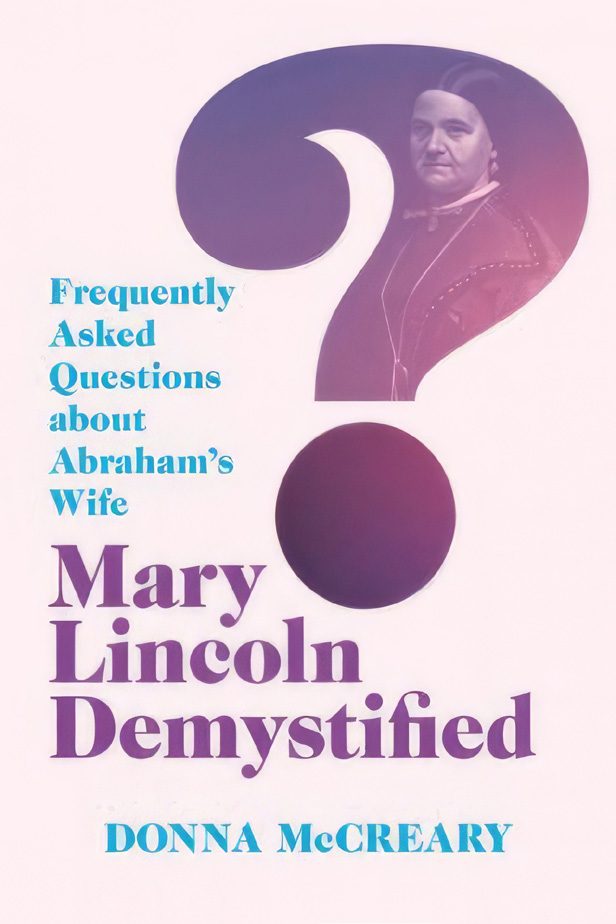
Mary Lincoln Demystified: Frequently Asked Questions about Abraham’s Wife. Donna D. McCreary. 366 pp., 2022. Southern Illinois University Press, http://siupress.siu.ed
In 1972, physician and surgeon with a specialty in psychiatry, Doctor David Reuben published his ground breaking and eyeopening book entitled Everything You Always Wanted to Know About Sex: But Were Afraid to Ask It has been followed by imitators with titles such as Everything Yo Always Wanted To Know About Acting (But Were Afraid To Ask, Dear) [2013]; Everything You Always Wanted to Know about God (But Were Afraid to Ask): The Jesus Edition (2009); and Everything You Always Wanted to Know About Birds …But Were Afraid to Ask (2005). You get the idea. Now comes Donna McCreary with her Mary Lincol Demystified: Frequently Asked Questions about Abraham’s Wife. It’s a mind-boggling potpourri of important facts and trivia from a woman who has portrayed Mary Lincoln as an interpreter for twenty years. She is an author,
lecturer, and performer; this book is a culmination her myriad experiences and talents. Her many enthusiastic audiences prompted her to put pen to paper and lay out in pristine detail everything she could discover about the wife of the 16th president. McCreary’s knowledge of Mary Lincoln is encyclopedic and deep. The question of Mary’s sanity is covered extensively, encompassing an entire chapter. As sad as her night of horror April 14, 1865 was, her ordeal with her perceived mental issues was equally tragic. She couldn’t understand why her surviving son Robert would label her a lunatic and have her committed to an institution. Was she insane McCreary comes down on the side of “perhaps” and “perhaps not.” Critics and authors have speculated that Mary suffered from everything from PTSD to syphilis. (138) Nothing is left untouched— Mary’s attitudes toward African Americans and slavery is dealt with as are her relationships wit her family, what became of the Lincoln family afterward, her lov interests before Abraham; her extravagance, her temperament, and her personality. The first fi chapters are biographical with chapter five dealing exclusively with the assassination. McCreary fields such questions as who took Mary to the Peterson House; where were Tad and Robert at the time of the assassination; an eventually what Secretary of War Stanton really said. She maintain that whether he said “Now he belongs to the Ages” or “Now he belongs to the angels,” Stanton’s comment “demonstrates the great admiration and respect that Stanton felt for Lincoln.” (106) The author presents a wellbalanced view of Mary Lincoln, her foibles, her moods, her joys, and her sorrows. Mary wrote of that night and author McCreary points out that although the
evening was a political and historical earthquake, “For Mary it was about the changes in her family, the destruction of her l She lost her comforter, her love her husband, her all.” (110) One of the “burning questions often asked by Lincoln scholars and Civil War trivia masters is: Did Lincoln really say that “One ‘d’ was good enough for God, but not for the Todds?” It doesn’t appear that McCreary chose to wade into this historical debate Perhaps she was comfortable with Stephen Berry’s extensive research revealed in the quote i his House of Abraham: Lincoln and the Todds, a Family Divided by War. Berry maintains that the original line probably came from governor David Tod of Ohio and Lincoln appropriated it and used it when the occasion presented itself. According to Berry, “the gag has existed for as long as there have been Todds and Tods.” (197). This is not a book for that b lounge chair in your study as a winter fire warms you as you curl up with it and that glass o brandy. But it is one you need to have at the ready to answer all the questions you always wondered about Mary Lincoln, the Todds, and the Lincolns. And admirably, when McCreary doesn’t know the answer, she doesn’t guess but offers the pro and cons of the issue. She has constructed the work so that the reader can dip into the text at point. It’s probably the best an only accessible resource on Mary Lincoln.
After 43 years in the museum field, Cilella devotes his time collecting American print and maps and writing. His most recent books are Upton’s Regulars: A History of the 121st New York Volunteers in the Civil War (U. Press Kansas, 2009). His two-volume Correspondence of Major General Emory Upton, (U. of Tennessee Press, 2017), received the 2017–2018 American Civil War Museum’s Founders Award for outstanding editing of primary source
materials. Upton’s love letters 1868-70, (Till Death Do Us Part) was published in 2020 by the
Oklahoma University Press. His current book, the From
Antietam to Appomattox with Upton’s Regulars: A Civil War
Memoir from the 121st New York Regiment (McFarland Press) was published May 2023.
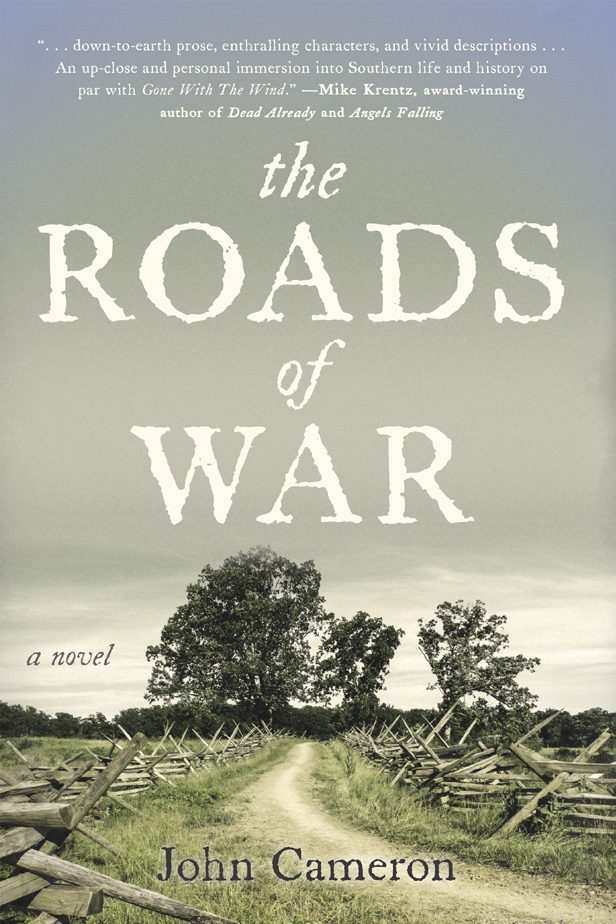
The Authenticity of Battle The Roads of War. By John Cameron. TouchPoint Press, https://touchpointpres com/bookstore. 2022, 209 pp.,
John Cameron has penned an engaging novel. Part fact, part fiction, it explores the tr and tribulations of a group of Civil War recruits from the 30th North Carolina Infantry. Louis McCormack, Neil Buchanan, Davey Morris, Tandy Strider, Sam Goodin, and Hardy Graham, all poor farmers, leave home to protect their state from Norther invaders. What they found was a war in which they were faced with decisions that ranged from leaving their families, survivin camp life with its disease, overcoming the temptations of whiskey and women, and reconciling themselves to the loneliness and emptiness of fighting for a lost cause. Neil Buchanan lost both legs and died in a Confederate field hospital. Hardy Thomas must decide whether to return to his unit af recovering from his wounds. Davey Morris meets a widowed woman whom he could desert for, and Louis McCormack thinks only about surviving the war and wondering whether he will have a home or family to return to. The author also explores the plight of women in war-ravaged
Virginia and North Carolina. What must they do to keep their families safe at home? How can they protect themselves from ravaging bands of soldiers? How can they plow fields, pay taxes, and raise crops while the men are away? These concerns forced women to compromise their values, take on male roles and become mothers, fathers, and breadwinners. They, too, are casualties of war. The 30th North Carolina, part Gen. D.H. Hill’s Division, fough at Malvern Hill, Sharpsburg,, Gettysburg, and several smaller engagements. Here, raw recruits first experienced debilitating wounds, the death of comrades, and the horrors of killing field field hospitals, and a ravaged countryside. They questioned the decisions of leaders, including even Gen. Robert E. Lee, on why the war was continuing when all they could see was defeat in the future. How many more young men must die for the wealthy who started the war? The reader will be treated to the real life of Rebel soldiers, the glamorous exploits of battle and leaders. Starvation, disease mental anguish, temptation, and loneliness are all brought to be on the husbands and sons absent from home for up to three years. This novel is a well-written pie that puts the common soldier’s words, thoughts, and dreams into a story of loss, tragedy, a redemption. For a fictional nove it is worthy of a place on the s of any historian interested in t common soldier’s life.
Dr. Wayne L. Wolf is Professor Emeritus at South Suburban College and the author of numerous books and articles on the Civil War, including Civil War Letters, Heroes and Rogues of the Civil War, The Last Confederate Scout, and Soldiers, Sailors and Scoundrels of the Civil War. He is past president of the Lincoln-Davis Civil War Roundtable and a frequent speaker on the lecture circuit.
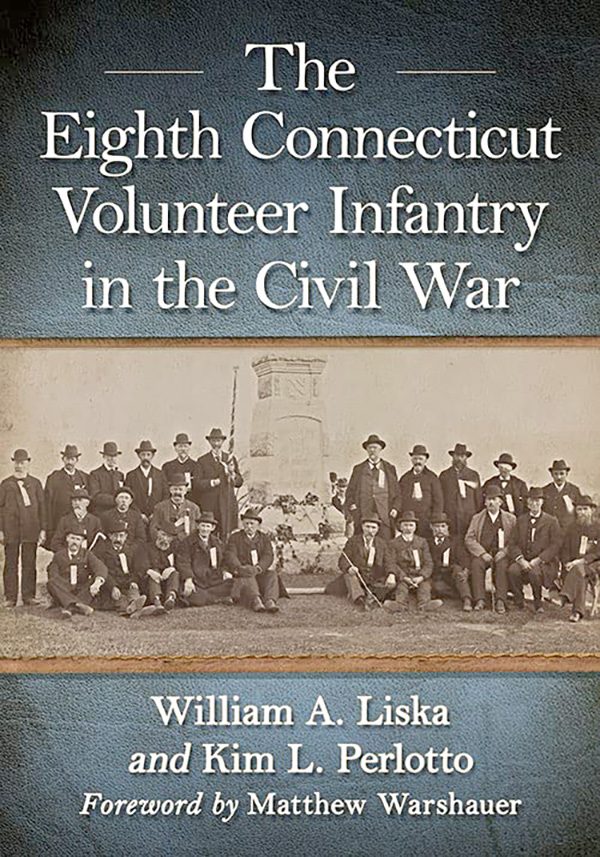
Connecticut regiment experience The Eighth Connecticut Volunteer Infantry in the Civil War. By William A. Liska and Kim L. Perlotto. Photos, notes, index, 289 pp., McFarland,
Regimental histories have crowded Civil War bibliographie since the conflict itself. In a index of the obligation they felt to history, Union veterans produced more than 700 unique volumes in the late nineteenth and early twentieth centuries. the centennial era and beyond, tradition persisted with popula narratives penned by the likes of John J. Pullen, Alan T. Nola and Richard Moe. Modern historians have once more revived the form. The best recent additions to the genre h narrated the conflict from some oblique angles, or else interve in larger interpretive debates. Susannah J. Ural’s treatment of Hood’s Texas Brigade, for instance, revealed how families and communities sustai one of the Army of Northern Virginia’s most devoted brigade Lesley J. Gordon’s chronicle of the 16th Connecticut asked what happened when a regiment broke in battle. Mark H. Dunkelman studied “esprit de corps” in the 154th New York. Whereas older unit histories tended to privilege the most conspicuous, well-disciplined, and h fighting regiments, newer work
many faces is focusing attention on outfits that experienced the war in more ordinary ways. Enter William Liska and Kim Perlotto’s history of the 8th Connecticut Volunteer Infantry, well informed by research in diaries, manuscripts, and officia records. While the authors do not aim to engage in larger scholarly debates; and they consulted few secondary sources, they have selected a regiment whose wartime service resonates with recent trends in the historiograp As the authors point out, owing to the length of its service, the regiment sampled virtually every experience the war had to offer. Indeed, this book foregrounds what is too often taken for granted in our military histories the demands of toggling between camps and campaigns, offensives and occupations, furloughs and front lines. Harvested from every corner of the Nutmeg State, the 8th Connecticut first stood to attention at Hartford in Septembe 1861. With no more than a month of training under their belt plat they embarked for Annapolis via New York City. Their first wartime errand was to join Burnside’s expedition along the coast of North Carolina. While the unit met the Confederates in important battles at Roanoke Island, New Bern, and Fort Macon, their deadliest enemy was disease. Unhygienic camps, poor weather, and deficient rations conspired to lengthen the regimental sick rolls well into t summer. Returning just in time to chec Lee’s Maryland invasion in the fall of 1862, the 8th Connecticut was packed off to the Army of the Potomac. Their demanding itinerary during the second week of September supports the contention that McClellan moved into Maryland with great alacrity. The regiment played no significant role in the battle of South Mountain, but it was much less fortunate three days later a Antietam. On the afternoon of September 17, 1862, a daring, forlorn assault on the Confederat right halved the regiment’s strength.
The 8th Connecticut played a minor part in the fiasco at Fredericksburg, after which they settled into a winter encampment at Newport News. When spring came and temperature rose, they filed into the defensive works ringing Suffolk, a key Union garrison in southeastern Virgini After Confederates under James Longstreet lifted their siege, the regiment held the region on occupation duty before taking advantage of a much-needed furlough. Returning south in the spring 1864, the men joined Maj. Gen. Benjamin Butler’s Army of the James, which readied an offensiv on the Bermuda Hundred south of Richmond. There, the 8th Connecticut saw action at Swift Creek and Drewry’s Bluff. The Bermuda Hundred operations, of course, rather quickly came to grief. The Army of the James, however, would play a key supporting role once the Army of the Potomac battled its way closer to Richmond in the bloody Overland Campaign. Grant summoned the regiment, now part of Baldy Smith’s XVIII Corps, to the crossroads at Cold Harbor, where costly frontal assaults appreciably lengthened Federal casualty registers. The Eighth continued its supporting role throughout the lengthy siege of Petersburg. Operating north of the James River, it assaulted Fort Harriso in an attack that presaged Grant fifth offensive at Peeble’s Farm It would prove the regiment’s la major action before mustering out in December 1865. In a brisk final chapter, the authors treat the 8th Connecticu regimental association, reunion activities, and commemorative efforts. Still, they have curiou little to say about the lives an struggles of the regiment’s veterans. How did survivors reckon with the meaning of their service? How did the nature of their wartime service shape their experience of veteranhood? Though these and other important questions remain to be answered, Liska and Perlotto have devotedl chronicled the campaigns of the 8th Connecticut.
Brian Matthew Jordan Associate Professor and Chair of the History Department at Sam
Houston State University. He is the author or editor of six book on the Civil War era, including
Marching Home, which was a finalist for the 2016 Pulitzer P
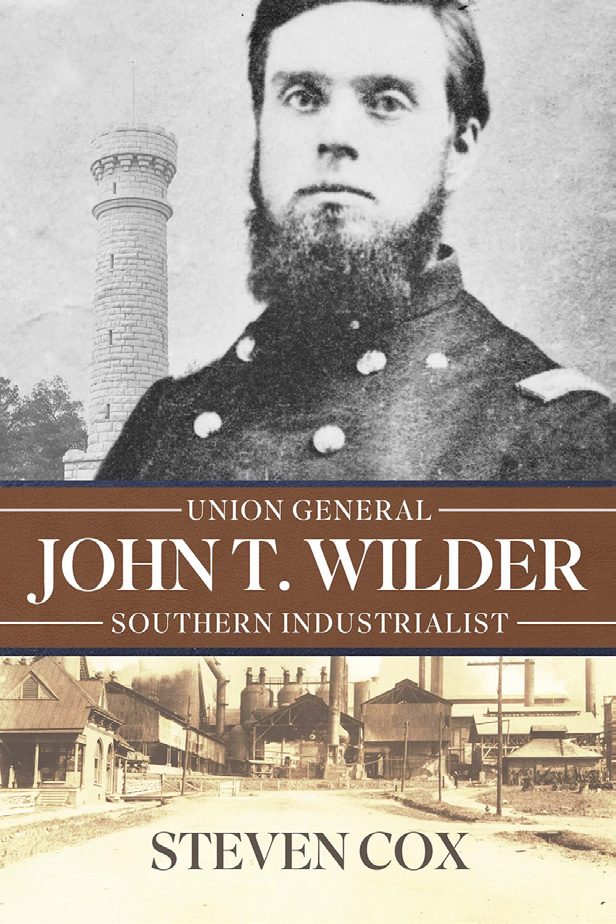
Civil War Renaissance Man Union General John T. Wilder: Southern Industrialist. By Steven Cox. Illustrated, bibliography, index, Mercer
Samuel Cole Williams wrote the first full biography of General John T. Wilder in 1936. It concentrated eighty percent o its total length on his Civil Wa years. In order to fully explain the career and influence of Gen. Wilder, Steven Cox has penned this latest biography which trac Gen. Wilder’s early beginnings as an apprentice, millwright, an hydraulics expert, through his military career, to his postwar contributions rebuilding East Tennessee. After the war, Gen. Wilder, through his construction projects, ranging from mills and mines to hotels, railroads, and military parks, never ceased helping rebuild the Chattanooga area where he had fought years earlier. John T. Wilder fought most of his Civil War career as colonel of the 17th Indiana Volunteer Infantry. This regiment was part of a larger unit, affectionately known as Wilder’s Lightning Brigade. He originally mustered into service as Captain of the 17th Indiana and rose through the ranks to brevet brigadier general by the war’s end. From his first battle experience at C Mountain, through his leadership at the Battles of Munfordville, Tullahoma, Hoover’s
Ringgold, and Chickamauga, he displayed outstanding leadership
resourcefulness, ingenuity, and bravery, earning the genuine admiration of his troops and
his commanders. In June 1864, he left field service due to a continuing battle with dysentery
Briefly returning in October 1864, he served in administrativ roles until the war’s end. While garrison duty ended his military service, it did not mea an end to his entrepreneurial contributions to rebuilding the South during Reconstruction. In fact, he was one of the few “carpetbaggers” who genuinely gained the admiration of the people of Eastern Tennessee. In this area he built the first blast furnace in the South, was elected mayor and postmaster in Chattanooga, started a free scho system in Chattanooga, opened two hotels on Roan Mountain, served on the Board of Directors Chattanooga University, and Vice President of the 3C’s Railroad. He additionally operated four mines in the town of Wilder, named after him, promoted the establishment of the Chattanooga and Chickamauga National Military Park, and became the pension agent for Knoxville, Tennessee. While these were his major contributions, smaller endeavors included founding factories, mines, railroads, and social causes. He never stopped until his death in 1917. Two historical lapses appear i the text. Andrew Johnson served as Vice-President in March 1865, not 1864. Moreover, Fort Donelson and Fort Henry were Union victories, not losses. The errors appear to be from confuse sentence structure rather than historical inaccuracies. Aside from these errata, the book is very readable, well-researched, and contributes to a better understanding of this remarkable Union leader, Souther industrialist, and devot husband and father.
Dr. Wayne L. Wolf is Professor Emeritus at South Suburban College and past president of the Lincoln-Davis Civil War Roundtable. He is the author of numerous books and articles on the Civil War, including Civil W Letters, The Last Confederate Scout, Heroes and Rogues of the Civil War (4 Volumes), and Two Years Before the Paddlewheel. He is a frequent speaker on the role of the common soldier in th Civil War.
I Thank the Lord I am Not a Yankee: Selections from Fanny Andrews’s Wartime and Postwar Journals. Edited by Stephen Davis. Notes, index, 320 pp., 2023. Mercer University
On November 15, 1908, The Baltimore Sun published an admiring review of Eliza Francis Andrews’s recently released The War-Time Journal of a Georgia Girl. The paper branded Andrews’ book as “truly a fascinating and historically valuable record of events transpiring in Georgia fr the fall of 1864 to the beginnin the Reconstruction period.” Sinc its initial release by D. Applet and Company in 1908 historians have extensively used Andrews’s diary and numerous publishers have reprinted it. Despite the value of earlier editions, this one, edited by the prolific Stephen Davis, is a masterpiece of editorial scholarship. In addition to extensive annotation
Andrews’s writings within the Civil War era’s broader context, this edition includes a bevy of Andrews’s postwar perspectives which have largely lived in obscurity. In the final days of 1864, after Union general William T. Sherman’s March to the Sea, twenty-four-year-old E Andrews and her younger sister Metta departed their home in northeast Georgia to visit their sister “in the opposite corner o the state.” Andrews sensed the journey would reveal scenes she had never witnessed and thought it wise to record all sh
saw. Fortunately for historians, not just those interested in the conflict in Georgia, but those who study the Civil War’s impact on civilians and landscapes,
While Andrews’s journ offers valuable perspectives about wartime devastation in Georgia, the conflict’s economic toll, and the war’s impact on Confederate soldiers, it offers important insight into an array of topics, most notably slavery’s destruction. Since Andrews’s journal straddles the transition period from the Civil War’s final months to the early period of postwar Reconstruction, her musings laced with rhetoric one would expect from an ardent Confederate supporter, exposes some of the struggles freed people confronted in transitionin to freedom. Her writings also illustrate how difficult it was f former enslavers to confront the reality that Union triumph meant slavery’s annihilation. Additionally, this journ provides perspectives about an array of Confederate political and military figures including Jefferson Davis, Zebulon York, and Braxton Bragg. Andrews is even-keeled in her assessment of individuals. For example, although Andrews freely admitted that she “was never a special admirer” of Bragg, she thought him a good disciplinarian. A lack of discipline was certainly something that Andrews witnessed as she encountered Confederate soldiers journeying home after the surrenders of Confederate forces in the spring of 1865. While Andrews did all she could to provide necessities to paroled Confederate veterans, the boldness of some, such as a contingent of troops from a Texas regiment, to take private propert bothered Andrews a great deal. Beyond offering insight into
final months and the war’s immediate aftermath Andrews’s journal also shows how those who supported the Confederacy struggled with some of the war’s most dreadful legacies. Despite her hatred for “Yankees,” something her postwar journals indicate she maintained until her death in 1931, Andrews seemed bothered by the tragic end suffered by thousands of Union prisoners of war at Andersonville Although Andrews believed that the camp’s commander, Captain Henry Wirz, should not be held liable for the horrific condition at Andersonville and that some
culpability for the horrific loss of human life there should be shouldered by the United States government for the transformation of its exchange policy, Andrews
those who once supported the Confederacy would “suffer some terrible retribution…for letting such things happen.” The editor’s inclusion of selections from Andrews’s 1870 journal, which includes her thoughts during her travels in New York and New Jersey during the late summer of that year, an eight articles Andrews penned fo Scott’s Monthly Magazine about a array of topics including manner fashion, and judging character further enhance this volume. Smartly edited and wonderfull contextualized Stephen Davis’s edition of Andrews’s writings ha wide appeal. For those intereste in Georgia’s Civil War era this volume is essential. Historians, students, and buffs seeking an additional voice about war’s tragic consequences and the transition from war to peace wil find this book quite useful.
Jonathan A. Noyalas is director of Shenandoah Universit McCormick Civil War Institute in Winchester, Virginia, a professo in Civil War Era Studies at Shenandoah University, and founding editor of Journal of the Shenandoah Valley During the Civil War Era. He is the author or editor of fifteen book including most recently Slavery and Freedom in the Shenandoah Valley during the Civil War Era, published by the University Press of Florida.
All other authors who have wri about Confederate BG John Bell
Hood misplaced his location by approximately one half-mile.
Available as an Audible Audiobook, ebook and hardcover on Amazon
A Worthy Tribute Clara Barton: Civil War Humanitarian, edited by Terry Reimer, The National Museum of Civil War Medicine Press, https://
What a pleasure to review a book that will appeal to so many. Its excellent writing and historica relevance make it valuable to those who want more information about Clara Barton and the roles she play during her lifetime. In addition, its striking format, compelling illustrations, and readability make it valuable to readers who initiall might only have a passing interest in the topic of Barton or Civil War medicine in general. Clara Barton: Civil War Humanitarian is a bookshop winner. Many of the essays were initiall published in Surgeon’s Call: Journa of the National Museum of Civil War Medicine, the magazine of the museum in Frederick, Maryland. They follow Barton from her initial visit to welcome the 6th
This book went to #1 in three Amazon New Releases categories. is is a must-read for anyone erested in one of the Civil War’s p paigns.” – Scott L. Mingus Sr., cohor of Unceasing Fury
rtis Older’s research on the Battle South Mountain re-examines and nterprets the Maryland campaign, ally quelling all further discussio Lee lost his first major battle ac
Massachusetts Infantry, fresh from being attacked in Baltimore on thei way to Washington in mid-April 1861, to an intriguing “thought experiment” concerning the effect her humanitarian efforts might have in outer space. There are illustrations on every page. These vary from artifact photographs to letters written to Ms. Barton from mothers and wives asking for help in finding missing loved ones who never returned from the war. Letters, drawings, wa photographs, original copies of the Rolls of Missing Men, and portrait photographs of those who supported Clara Barton in her various endeavors can be found sprinkled throughout this beautifully designe book. At the end of each chapter ar excellent footnotes and suggestions for “Further Reading.” Most importantly, this book make a valuable contribution to Barton’s legacy. Historiography would have one believe that Clara Barton was a nurse during the American Civil War. She did some nursing but was not a member of any nursing corps. Instead, Barton saw her mission through a much larger lens. She worked tirelessly, alone and with the U.S. Sanitary Commission, to gather provisions and medical supplies for the Union Army and provided help wherever needed, battlefield or hospital. Barton beg the Missing Soldiers Office at her home in Washington. Her chance meeting with released Andersonville captive Dorence Atwater helped create the Rolls of Missing Men, lists of those who had perished at Andersonville Prison camp. With his help, Barton increased her efforts search for soldiers reported missin during the war. She was able to locate over 22,000 of them, living and dead.
Her work with the U.S. Sanitary Commission and the federal government led her naturally to the International Red Cross during the 1870 Franco-Prussian War. Returning home, Barton inaugurated the American Red Cross. She responded in person to the victims of the Spanish American War, the Jonestown Flood, and the Galveston Hurricane in 1900. Her home and the Missing Soldiers Office were rediscovered in 1996 and opened as a museum and performance space in 2015. The Washington site is under the auspices of the National Museum of Civil War Medicine in Frederick, Maryland, which is responsible for
this book. It is a worthy tribute t Clara Barton, whose life continues to inspire.
es & Belts fied Relic & Document & Head Gea & Currency Flags
ar Show rgia Trade Ingle Park GA 30720 & 5, 2023