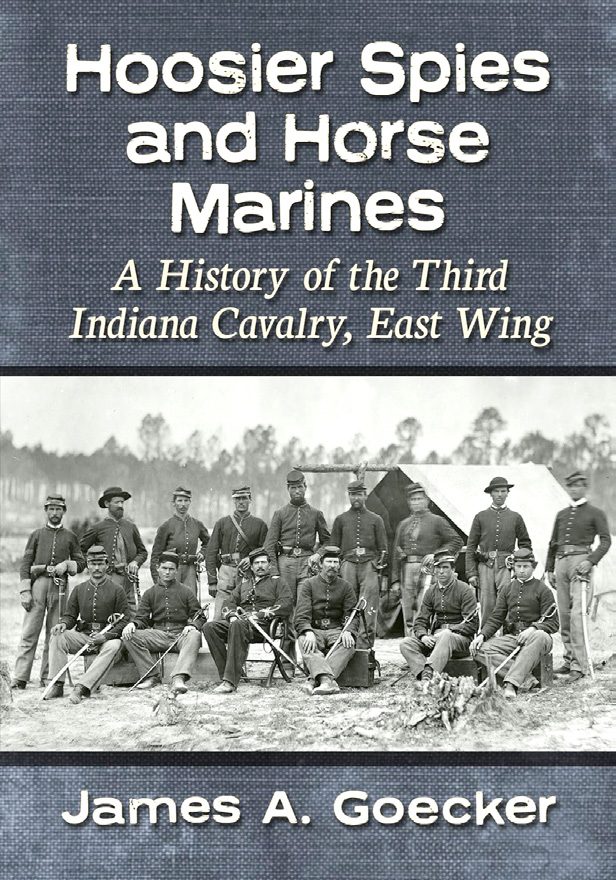
Hoosier Spies and Horse Marines: A History of the Third Indiana Cavalry, East Wing. By James A. Goecker. Illustrated, Bibliography, Notes, Appendices Index, McFarland Publishing, 2023, 283pp., softcover.
It has been since 1906 when William Pickerill published his account of the 3rd Indiana Cavalry. Now James Goecker, concentrating on the East Wing of the 3rd Indiana Cavalry, which fought with the Army of the Potomac, comprehensively tells the story of the farm boy
enthusiastically enlisted in 18 and began a four-year journey a scouts, spies, pickets, and cav combat troops. Originally, 750 recruits enlisted in the East W provided their own horses and equipment, and left Indiana for training camps in Washington, D.C. Their duties over the next four years included roles as counterinsurgency spies, border patrol, policemen, messengers, attack troops, and prisoner gua They acquired the moniker “Horse Marines” when General Joseph Hooker complimented them on their capture of the sl “Victory of Baltimore.” The first real combat for the 3rd Indiana cavalry July 23, 1862, while scouting near the North Anna River. This was the beginning as their service included battles and skirmishes from Gettysburg, Manassas,
the Wilderness, and Antietam to lesser encounters at Quebec Schoolhouse, Catoctin Mountain, Brandy Station, Yellow Tavern, Barbee’s Crossroads, Aldie, And Ream’s Station, to name a few. In total, they were involved in over 70 battles and skirmishes where they suffered 41 deaths, 232 wounded, 178 discharged for disability, and 107 taken prison 13 of whom died in prison camps. Yet, their tribulations were not over as some of the unit’s final deaths occurred when the Sultana sank on their final voyage home. The author does an excellent job of blending the Third’s exploits with the human side of the Civil War. From the starvati endured during long marches to the sadness at seeing horses sho as they fell exhausted from the endless marches, to viewing an execution of deserters, and fina to crossing the battlefields and seeing the death and destruction left after each engagement, thes events humanized the story of th regiment. Likewise, appendices were included which not only included the individual fate of each soldier but also their post exploits, and categorized the trauma of their wounds, physical and mental, which followed them for years. This volume is well written, thoroughly researched, and places the 3rd Indiana Cavalry in the context of battle tactics political maneuvering, camp monotony, pranks, and tragedies that so characterized the Civil War. For those Hoosiers who wish to learn more of the horse soldiers who represented their state and the best of their yout so courageously, this book would well serve their purpose.
Dr. Wayne L. Wolf is Professor Emeritus at South Suburban College and the author of numerous books and articles on the Civil War including They Saw the Elephant, Heroes and Rogues of the Civil War, and The Last Confederate Scout. He is the past president of the Lincol Davis Civil War Roundtable and a frequent lecturer on the circu
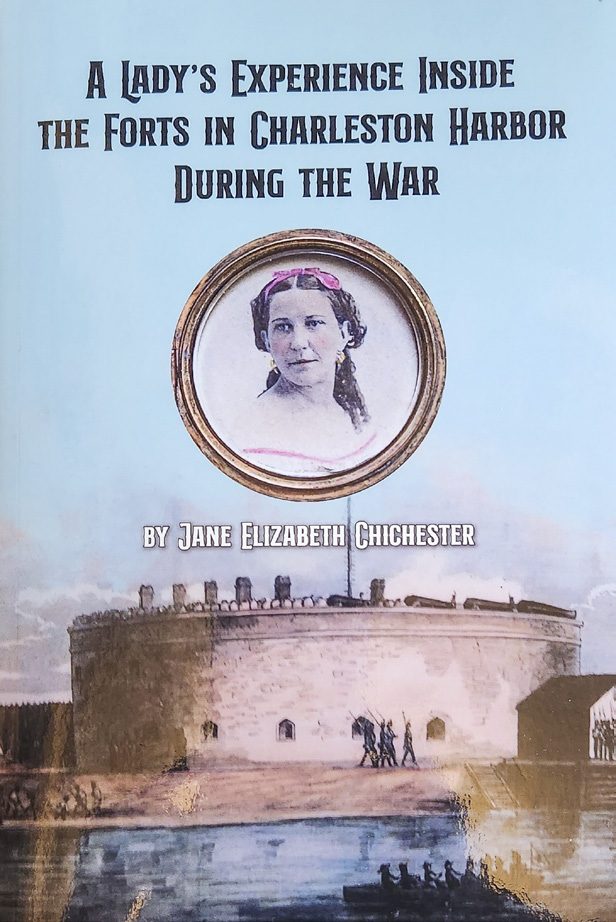
A Lowcountry Woman’s Experiences of the War in C Jane Elizabeth Chichester, A Lady’s Experience Inside the Forts In Charleston Harbor During the War. Edited by Karen Stokes and Jill Hunter Powell. Charleston: The Museum at
In 1895, during the heyday of Confederate memoir writing, Jane E. Chichester penned a reminiscence of her war experiences. As the wife of a Confederate officer in Charleston, she spent a good dea of time in Castle Pinckney and Battery Wagner. Mrs. Chichester’s memoir, originally published by the Unit Daughters of the Confederacy in 1895, is presently hard to find. It has now been reprinted by the Museum at Market Hall in Charleston, SC. Her husband, Capta Charles Chichester, serv in Charleston’s Gist Guard Artillery. He and his unit were stationed at Battery Wagner and underwent the Yankees’ shelling in the summer of 1863. On July 10, she writes, “…the artilleris in the fort opened fire upon the advancing line of the federals, not only stopping their progress but causing them to turn and run back beyond the range of their heavy guns, which they loaded and fired with all the deliberat and calmness that they were accustomed to do when only drilling.” I found much of interest in Mrs. Chichester’s description of the building of Wagner. Slaves did much of the work, but local planters withdrew them when the Yankees neared. It was left to t garrison to finish the labor. “I was heavy and tiresome work,”
ton she writes, “especially under the broiling summer sun, and some of the men demurred and grumbled at having to perform such labor, saying that they wer there to fight as soldiers and n to work like negroes.”
Chichester’s Experience will doubtlessly be compared to
Mary Boykin Chesnut’s Diary from Dixie. Both are charming and mellifluous. But while Mrs. Chesnut spent much of the war in the parlors of the Richmond elite, Mrs. Chichester was in Charleston’s Confederate works. When Federal gunboats bombarded Battery Wagner on July 10, 1863, one of the monitors’ shells killed Capt. Langdon Cheves. “My husband had his body carried carefully into one of the bomb proofs,” sh writes, “and as soon as the atta was over, had a box made, and sent it over to the city,” where Captain Cheves was buried. In helpful notes, editor Karen Stokes adds that Cheves is burie in Charleston’s famed Magnolia Cemetery. Mrs. Chichester’s style is les that of a personal diary than th of a learned address. She in fac presented her narrative as a spe to the local United Daughters of the Confederacy chapter, which encouraged its publication. A number of Southern ladies had their spoken remarks published in Confederate Veteran and the Southern Historical Society Papers. Jane Chichester did
Wartime photograph of The Museum SC, Home of the Confederate Muse
not—a fact that adds even more value to this enterprising, er booklet. Karen Stokes of Charleston i an archivist at the South Caro Historical Society. Her books include Days of Destruction:
Augustine Thomas Smythe and the Civil War Siege of Charles (University of South Carolina Press, 2017), edited with W. Eric Emerson. I bought Days of Destruction a few years ago while visiting the Museum at Market Hall, Home of the Confederate Museum, with Jack Melton (very much worth the visit; the Museum has an origi copy of the Charleston Mercury Extra, blaring its famous headline, “THE UNION IS DISSOLVED”). We quote Karen and Eric’s Days of Destruction in our 100 Significant Civil War Photographs: Charleston in the War, which Historical
2020. Mary Boykin Chesnut, Eliza Frances (“Fanny”) Andrews and Phoebe Yates Pember are renowned Southern women diarists of the war. On my bookshelf I have placed Jane Chichester’s Experience right beside them.
Stephen Davis, of Cumming, Georgia, is editor of I Thank the Lord I Am Not a Yankee: Selections from Fanny Andrews’ Wartime and Postwar Journals (Mercer University Press, 2023
rket Hall in Historic Charlest ibrary of Congress) April 2024
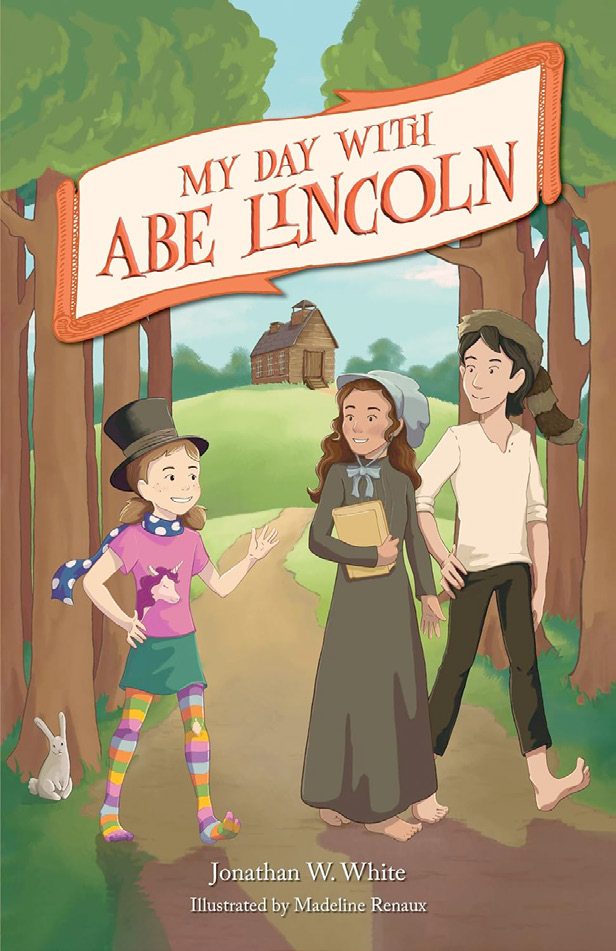
Young people oftentimes find it challenging to connect with t past. That difficulty largely st from history being presented as conglomeration of mundane dates and facts associated with people and events with which children are unable to find any meaningfu connection. As challenging as it might be to cultivate an interes the past among children, history educators have long recognized the benefit of historical fictio as a mechanism to promote an appreciation for history. If executed properly historical fiction can transport children to a bygone era, introduce them to history’s importance, cultivate curiosity, and inspire a lifelong affinity for the past This children’s book, authored by one of today’s most prolific Civil War historians and Lincoln scholars, serves as an exemplar of historical fiction for childr ages six to ten. At the book’s epicenter is a young girl, Lucy Millaway, who exists in the twenty-first centu
world and dreads the idea of waking up in the morning to go
to school. After employing an array of weapons in her arsenal to get out of school, including feigning illness, Lucy decides t annoy her parents by dressing in an odd array of clothes. Afte Lucy completed her outfit with a black top hat from her brother’s magic kit and uttered the word ‘Abracadabra,’ she found herself transported back in time to Spencer County, Indiana. There, Lucy met Abraham Lincoln. In White’s imaginative story, one firmly grounded in the best scholarship about Lincoln’s April 2024
formative years, Lucy does not encounter Lincoln the iconic figure, but rather a boy her own age unaware of the important role he would one day play in American history. Throughout the course of the day, Lucy met with Lincoln, interacted with family members, learned about various aspects of his childhood including the sadness he felt following his mother’s death, frightening moments when Lincoln almost died, his affinity for history and poetry, and his struggle with spelling. White’s book, beautifully illustrated by Madeline Renaux, does what all good historical fiction intended for young audiences should, it engages one’s imagination. Additionally, it aims to inspire young people t want to learn more. In the book’s final chapter, after Lucy returne
home, the author conveys Lucy’s palpable excitement about how her encounter with the young Lincoln prompted her to visit her school’s library to check out a book about Lincoln. Parents and teacher searching for a well-written and magnificently illustrated work of children’s fiction that is informative, entertaining, and engages the imagination will find this excellent volume essential. While this book offers an excellent way to introduce young children to Lincoln and can become a catalyst for young people to seek more information about our sixteenth president, seasoned scholars should find White’s initial foray into children’s literature inspiring. Instead of lamenting children’s lack of interest in th past, historians might consider following the lead of this Lincol Prize winning author and consider venturing into the realm of
children’s literature to introduc a new generation of children to
the past’s personalities, events, and lessons.
Jonathan A. Noyalas is director of Shenandoah University McCormick Civil War Institute in Winchester, Virginia, a professor in Civil War Era Studies at Shenandoah University, and founding editor of Journal of the Shenandoah Valley During the Civil War Era. He is the author or editor of fifteen books including most recently Slavery and Freedom in the Shenandoah Valley during the Civil War Era, published by the University Press of Florida.
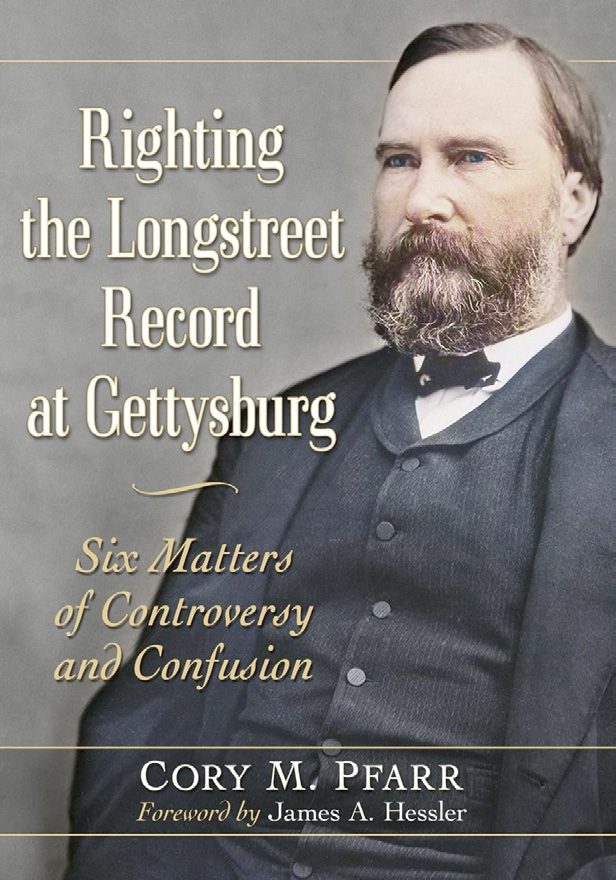
Reinterpretation of L Righting the Longstreet Record at Gettysburg: Six Matters of Controversy and Confusion. By Cory M. Pfarr. McFarland, mcfarlandbooks. com, 2023. 171 pages, notes, bibliography, index. Paper
James Longstreet stands wi Robert E. Lee and Thomas Jonathan “Stonewall” Jackson in the great triumvirate of generals in the Confederate Army of Northern Virginia. H fought from First Manassas through Appomattox and serve
Founded by Heath Jones seller – it’s a haven like Minelab, Garrett, endorse the metal dete and personalized servi
as Lee’s senior subordinate for most of that time. Yet, perhaps no other Confederate general has engendered the odd mix of scorn and admiration from Civil War historians and enthusiasts as James Longstreet. While he is celebrated by many as Lee’s “Old Warhorse,” he is also viewed by others as the man who cost Lee a victory at Gettysburg. Longstree thus, stands as an enigma and ha attracted the attention of many scholars attempting to discover his true identity, his true abil and his true past. Cory M. Pfarr is one of those historians. Pfarr actually began his study of Longstreet in an earlier work, Longstreet at Gettysburg: A Critical Reassessment (McFarland Press, 2019). Indeed, that book and this one need to be examined as a pair. In the earlier monograph Pfarr sought to rehabilitate the reputation of Longstreet and his actions at Gettysburg. He pointe out what historians have long known: Longstreet’s attitude on post-war reconciliati friendship with northern general support for the Republican Party and especially his criticism of Lee’s generalship led to savage personal attacks by the Lost Cause creators (especially Jubal
istory Seekers is more than a relic hunters. Specializing in and Nokta/Makro, we actively us from our team’s firsthand exper ney in uncovering treasures.
A. Early). The Longstreet who emerged from the pens of the Lost Cause advocates elevated Lee’s generalship to mythic proportions while placing failures of the Army of Northern Virginia, most notably at Gettysburg, squarely on the shoulders of Longstreet. Pfarr posits that the Lost Cause’s portrait of Longstreet’s actions at Gettysburg, namely his insubordination and slowness, still influences historians today long after most Lost Cause effect on Civil War historiography have faded. Pfarr then examines Gettysburg, focusing primarily on the events of July 2 and 3, 1863. He makes extensive use of primary sources such as battle reports, written orders, first-ha accounts of the participants etc. to trace the locations of the key personnel such as Longstreet and also looks at what orders were given and when. Pfarr’s conclusion is that Lee and other Confederate generals, but not Longstreet, are largely to blame for the Rebel defeat in Pennsylvania. Pfarr’s book attracted a good bit of attention for his challeng to established notions about what occurred at the battle from the Confederate point of view. His continued effort to salvage Longstreet’s reputation led to the publication of his second work on the general’s actions at Gettysburg. This time Pfarr focuses on what he views as six critical aspects with a chaptersized essay covering each. The first, entitled “The Rever
Jones Pens an Essay: Examining the Roots of the LongstreetGettysburg Controver examines how Reverend Jones and others manipulated the historical record to characterize Longstreet as disloyal to Lee and his memory. The second essay,
Longstreet’s July 2 Attack,” explores the relationship between Sickles and Longstreet in terms of their support for each other’s actions on July 2. Interestingly, Pfarr supports the idea that both generals made good choices. In “The Force of Circumstances: Reconnaissance Activities on Longstreet’s Front, July 2,” the third essay, Pfarr addresses Longstreet’s performa on July 2, arguing that many historians either do not correctl
day or choose to ignore them in order to frame Longstreet as a poor commander. Likewise, in “A Severe Case: Diagnosing the Treatment of Longstreet’s
Countermarch,” Pfarr minutely recounts events surrounding Longstreet’s countermarc on July 2 and concludes that historians who criticize Longstreet for wasting time fail to understand the situation or again ignore the evidence. In the book’s fifth essay, “Under Hill o Longstreet? Anderson’s Division on July 2,” Pfarr examines whether General Richard H. Anderson’s Division was under Longstreet’s supervision on the second day of the battle. Finally in the last essay, “Suppressed No More: Helen Longstreet’s Lee and Longstreet at High Tide,” the author argues that due to their own bias, historians have labeled Longstreet’s widow’s (Helen Dortch Longstree attempts to defend her husband’s performance at Gettysburg as unreliable. Taken together, the six essays are an interesting and thoughtprovoking look at one of the most important Civil War commanders at one of the War’s most importan battles. Pfarr makes excellent us of primary material, marshals his evidence, and presents persuasive arguments in most cases. Even if most historians ar not as convinced of Longstreet’s actions at Gettysburg as Pfarr, the author will certainly force interpretations to be nuanced if not completely changed. Pfarr’s two works together offer an important reexamination of Longstreet’s actions at Gettysburg as well as how the historical record can and is
often manipulated over time. The author offers not only a reinterpretation of historical events but also a look at how history is to be examined in orde to get closer to the truth While Pfarr does a good job of demonstrating how many early
the facts, he is perhaps overzealous in his analysis of modern historians. Indeed, his perceived disregard for the scholarship of such notable modern historians Robert Krick, Noah Trudeau, and Earl Hess, to name but a few, is suspect. Whi historians can and most often do disagree on many aspects of analysis, such disagreement is not indicative of intentiona disregard for evidence; it is simply a different interpretati Perhaps other historians are indeed wrong in their analysis, but it is not to say their work should be dismissed out of hand This work, like its predecess will be more appreciated by academic historians and serious students of the war than by the casual reader with an interest the conflict. There is some gen history, but the focus of both on specific events. And without strong background in the minute aspects of the campaign and bat of Gettysburg, a reader is apt get lost. That being said, thos who have such a background, will find the two books togethe to be well documented, well argued, and well written.
John D. Fowler, Ph.D., is the author of several books and articles on the Civil War Era. He is the author of Breaking the Heartland: The Civil War in Georgia. He is currently a Professor of History at Dalton State College.
Second Day at Gettysburg, July 2, 1863—Culp’s Hill and the North End of the Battlefield.
By Kristopher D. White and Chris Mackowski. Illustrated,
As Gen. Robert E. Lee spent t night of July 1, 1863, formulati his battle tactics, while in physical discomfort, Gen. George Meade, having arrived late on th battlefield, began consolidating thousands of reinforcements in strategic positions. Gen. Meade’ immediate thought was to attack the Army of Northern Virginia and halt the progress the Rebels had achieved on July 1, 1863. Topographical impediments and an early morning attack by Gen. James Longstreet on the Federal left, tactically dictate defensive posture. Cemetery Hill McNight’s Hill, and Culp’s Hill became the Union defensive line where Gen. Meade could “stay and fight it out.” As Day 2 dawned on Gettysburg, Confederate forces attacked and advanced. Each thrust was repelled, leaving the oak and hickory forests looking like a desolate and forbidden picture of carnage. Cemetery Hill and Culp’s Hill had provide the Union with clear fields of fire, a series of stone walls fo protection, and a height advanta over the charging Rebels. The Yanks likewise controlled all three roads by which supplies and reinforcements could be fed to Meade’s troops.
to the Confederates, July 2 solidified the Federal defensive positions and held the rebels
to their successes at Devil’s Den, the Peach Orchard, lower Culp’s Hill, and portions of the Emmittsburg Road. Gen. Meade’s commanders all agreed they were in a strong position to defend against any attack. Likewise, they had cemented two of their objectives, secure Baltimore and Washington and keep their lines of communication and retreat open. Conversely, Gen. Robert E. Lee had failed to alter his flawe attack plan and decided to let it play out without the necessary cohesion or coordination. This set the stage for the disaster on Day 3. Included in this book are four appendices that lay out walking tours of downtown Gettysburg, a driving tour of Culp’s Hill, the extensive efforts to preserve Culp’s Hill, and the early art an photography of Culp’s Hill and East Cemetery Hill. These allow the visitor to experience both th battle’s movement and the human side of the conflict. As is the c with previous literary endeavors by Kristopher White and Chris Mackowski, they utilize extensive research, primary source material photography, and human interest tidbits to craft a superb, readab account of the crucial northern flank on the second day at Gettysburg. This book is part of the Emerging Civil War Series, and like the other volumes in thi series, deserves a place on the shelf of every historian interest in Gettysburg. The authors, and publisher Savas Beatie, deserve praise for their continuing effor to tell the story of the Civil Wa factually, dispelling myths that have no basis, and painting a picture of the sacrifices of the men who fought for their values, homes and country.
Wayne L. Wolf is Professor Emeritus at South Suburban College and Past President of the Lincoln-Davis Civil War Roundtable. He is the author of numerous books and articles including Heroes and Rogues of the Civil War, They Saw the Elephant, and The Last Civil War Scout.
Gen. Albert Sidney Johnston The Iron Dice of Battle: Albert Sidney Johnston and the Civil War in the West. Timothy B. Smith. Maps, photographs, bibliography, endnotes, index. 248 pp., 2023. Louisiana State University Press. lsupress.org.
At the outbreak of the Civil War Albert Sidney Johnston was considered by many to be the South’s premier soldier. His death at Shiloh and the loss of that critical battle were seriou blows. It was thought, during and after the war, that if only bullet had not pierced an artery in Johnston’s leg on the Shiloh’ first day, things could have bee different. Timothy Smith is an historian at the University of Tennessee a Martin and a prolific author. In his newest work Smith analyzes Johnston’s career and assesses the general’s qualities as a commander. Was he as capable as his contemporary and postwar supporters claimed? How valid are the harsh critiques of some modern historians? How serious a setback did the Confederacy suffer when Johnston bled to death in the afternoon of April 6, 1862; and how might the course of the war have changed i Johnston had lived? The Iron Dice of Battle is a “think-piece,” the author states the preface, not a full biograph The first two chapters deal quickly with Johnston’s early
life and pre-Civil War career. The West Pointer served two stints in the United States Army separated by service in the Army
resigned his commission to join the Confederacy. Smith posits
that one trait Johnston exhibite earlier in his life, his propens to take inordinate risks, advers affected his performance as a commander in the Civil War. Johnston was commissioned as a full general in the Souther army, second in seniority among the five initial holders of that rank. He was immediately sent to command Department No. 2, a vast region stretching from Cumberland Gap to the Mississippi River and beyond. He served in this capacity until hi death. Chapters 3 through 6 and a conclusion constitute Smith’s insightful think-piece. There are two biographies of Smith’s subject, one written by general’s son William (1879) and one by Charles Roland (1964). Roland also authored a shorter work on Johnston, published in 2000. Smith discusses these authors’ positive assessments of Johnston’s generalship and compares them to the writings of more recent historians, mainl Thomas L. Connelly and Larry J. Daniel, whose appraisals are largely negative, sometimes harshly so. Though Smith writes that “the truth lies somewhere in the middle” of the contrasting views his conclusions place him closer to Daniel and Connelly than to William Johnston and Roland. Johnston’s job, defending a li several hundred miles in length, was a tough one. The resources at his command were grossly inadequate for the task at hand; most of his subordinate generals were mediocrities and some far worse; the region’s geography, mainly its river system, favored the Federals, the side with the strong brown-water navy. Johnston made mistak He put too much trust in the generals under his command, failed to assert his authority over them, and make sure they were doing what had to be done. In Smith’s words he was “too gentlemanly and lenient with his subordinates.” Several times Smith uses the word “meek,” an adjective not often employed to describe generals leading troops in war.
In Smith’s view, Johnston’s most serious flaw was the trait
mentioned above, his proclivity to make unwise, high-stake bets when things weren’t working out for him. A commander must take risks, but Johnston frequently crossed the line, Smith writes, between “acceptable risk taking to irrational behavior.” Of cour his other shortcomings were sometimes the reason he believed he had to throw the dice and hop for the best. Much went wrong in Kentucky and Tennessee in the early month of 1862 and during the precipito retreat that followed the loss of Forts Henry and Donelson. The blame for this disaster was partly Johnston’s. However, considering the strategy dictate by Richmond, the lack of men and arms, and the geographical realities, it is difficult to se any commander could have done much better. As for Shiloh, the high-stakes battle necessitated the debacle in February, Smith argues that the outcome would no have been different if Johnston had remained in command on day two. Smith writes: “Beauregard did not throw away Johnston’s victory; in fact, there was no victory to throw away.” Nevertheless, Smith concludes that Johnston’s death did seriou harm to the Southern cause. “While it is debatable how much of a difference his death made on the field of Shiloh itself, i actually in the future command of the western Confederacy that Johnston’s absence was most significant.” The story of the western armies under the leadership of Johnston’s successors is well-known. In the book’s conclusion, Smith quotes Jefferson Davis: the loss of Sidney Johnston “was the turning point of our fate; for we had no other hand to take up his work i the West.”
Gould Hagler is a retired lobbyi living in Dunwoody, Ga. He is a past president of the Atlanta Civil War Round Table and the author of Georgia’s Confederate Monuments: In Honor of a Fallen Nation, published by Mercer University Press in 2014. He has been a regular contributor
es & Belts fied Relic & Document & Head Gea & Currency Flags
ar Show rgia Trade Ingle Park GA 30720 & 5, 2023