Civil War News book reviews provide our readers wi
analysis of the latest and most significant Civil W
A Fine Introduction to The Battle of Nashville
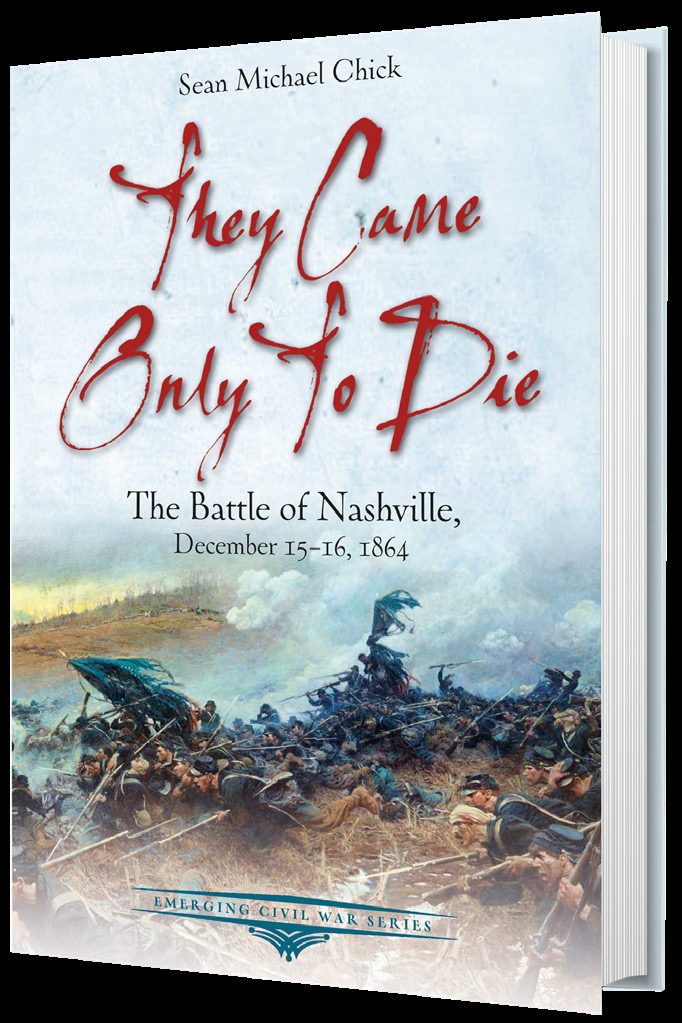
They Came Only to Die: The Battle of Nashville, December 15-16, 1864. By Sean Michael Chick. Savas
The decisive Battle of Nashville in December 1864 the death knell for the Army of Tennessee and Confe General John Bell Hood’s ill-conceived campaign int Tennessee. The near destruction of the Confederacy’ major western army essentially left the already rav Rebel heartland completely defenseless and, coupled Lincoln’s election the previous month, rendered fur resistance to Union forces pointless. 66 Civil War News Magazine | March-Apr
There was a time as late as the early twentieth century when the Battle of Nashville, Hood’s Tennessee Campaign, and other major military events in the western theater of t
Civil War were neglected in favor of scholarship focused on the monumental struggle between Robert E. Lee and his Army of Northern Virginia and the Army of the Potomac, with its ever-changing commanders. However, by the middle part of the century, focus shifted to what noted historian Thomas L. Connelly called the “Confederate Heartland.”
Many major, well-written and detailed works covering the western theater and the Tennessee Campaign have since emerged that assign a new importance to the events of late 1864 in Tennessee. Stanley F. Horn’s The Decisive Battle of Nashville (1956), Wiley Sword’s The Confederacy’s Last Hurrah (1993), and James Lee McDonough’s Nashville: The Western Confederacy’s Final Gamble (2004) serve as
examples of such writings. Other major works cover the
western theater as a whole as well as key personalties such
as Hood or his Union counterpart Union Major General George H. Thomas. One could be forgiven, then, in thinking that another monograph on the Battle of Nashville was not needed or even welcomed. That, however, is not the case. Author Sean Michael Chick has produced an account of the battle for Savas Beatie’s Emerging Civil War Series. Like most titles in this series, this book is designed as a introduction to the subject, and like all the others, it fo a standard pattern of offering a solid yet not overly detai summary of a campaign and/or battle, placing the event in historical context, and then providing the reader with lots of extras in the form of appendices. Chick’s book does just that. Military historians and wargamers are probably already familiar with Chick, who has designed more than two dozen well-received military board games. Of special note for Civil War historians would be his work on Cruel Morning: Shiloh 1862 (2017), Pemberton and Grant: The Vicksburg Campaign of 1863 (2017), Rally ‘Round the Flag: The Battle of Perryville and Stones River (2021). All are designed to give the players an engaging simulation of the command decisions faced by the generals involved in these battles. All are well conceived, engaging, educationa and enjoyable for the armchair general. In They Came Only to Die, Chick tries his hand at telling the story of the Tennessee Campaign and the climactic battle at Nashville in a scant 80 pages or so. The result i brief overview, along with excellent maps and photographs (both period and contemporary) that will engage his readers. Again, while there is nothing new or revealing in Chick’s well-written account, its brevity will appeal to those who only want to know the highlights of the battle and its importance to the overall war. For scholars and serious students of the war who already know much about the campaign, battle, and significance, the latter portion of the book, especially the appendices, offer several gems. The Epilogue gives a good bit of information on the remembrance of the battle, including current debates over the appropriateness of Civil War monuments in contemporary society. Appendix A is a useful driving tour of important sites for the battle. Give that the battlefield is largely lost in the urban sprawl of Nashville, a self-guided tour such as this is invaluable to
anyone wanting to “walk the battlefield” or what is left of it. Appendix B, “I Live Over There and I’m Crazy . . . : Th Sad Fate of Thomas Benton Smith,” by David Powell is a powerful vignette of a man who served as a Confederate brigade commander during the battle. He was captured and beaten by a Federal officer to the point that he suffered a traumatic brain injury that ruined his postwar life. Suffer post-traumatic stress disorder, depression, mood swings, dementia, hallucinations, and violent fits, Smith had to be institutionalized in the Nashville State Hospital. His horr sad story is one of those gems often found in the appendice of volumes in the Emerging Civil War series. Such personal accounts bring home the brutality of war and its aftermath in ways a conventional retelling of a battle or campaign cannot. Mark Wahlgren Summers’s “‘Now I Walk with God.’ Benjamin Harrison in War and Peace” (Appendix C); Joseph D. Ricci’s “John Bell Hood’s Postbellum Years” (Appendix D); and Frank Varney’s “George H. Thomas and the Verdict of History” (Appendix E) all offer insight into three important commanders at the battle. The last two appendices by Gregory L. Wade and Ross Massey explore the Confederate retreat from Nashville and efforts at battlefield preservation respectively. All the appendices as well as Chick’s account of the bat are tightly woven and make for an enjoyable read. In sum, Chick and his collaborators have provided readers a wellwritten, engaging account of the Tennessee Campaign and the battle for Nashville. As with most books in the Emergin Civil War Series, it is a fine introduction to the subject serves as a stellar example of a practical guidebook.
John D. Fowler, Ph.D., is the author of several books and articles on the Civil War Era. He is the author of Breaking the Heartland: The Civil War in Georgia. He is currently a Professor of History at Dalton State College.
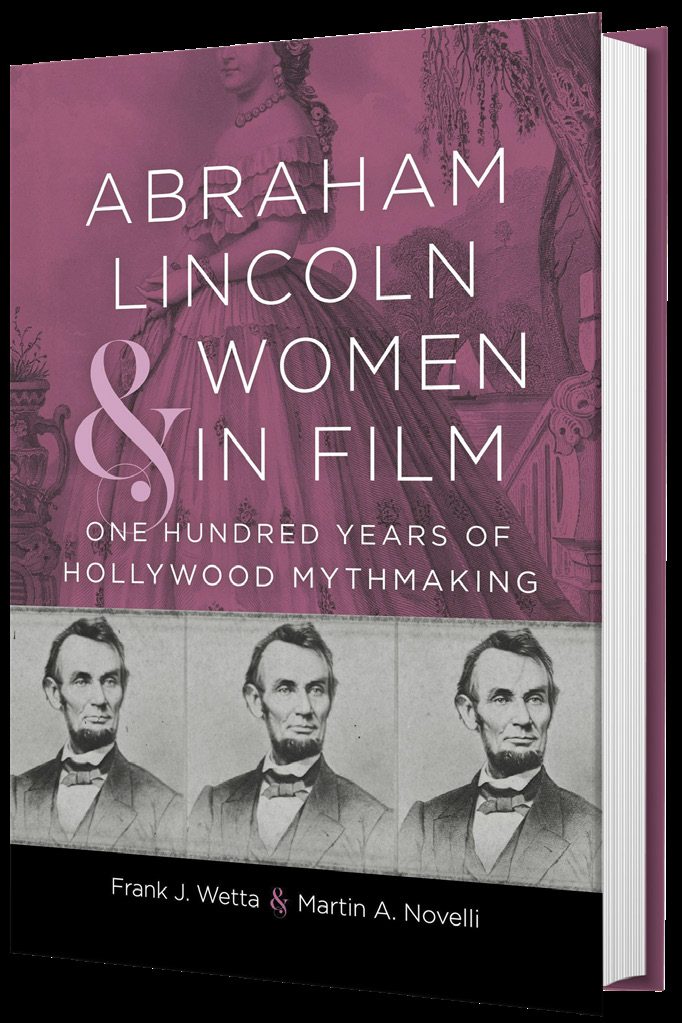
Abraham Lincoln & Women in Film-One Hundred Years of Hollywood Mythmaking. By Wetta, Frank J. & Martin A. Novelli. Baton Rouge, LA. Louisiana State University Press. lsupress. org, 2024. 240 pages, notes, bibliography,
Reviewed by Tom Elmore Abraham Lincoln has been depicted in more films and television shows than any other president in history. So many, that there are books and articles about the men who portrayed him and how they interpreted one of the most beloved and complicated figures in American history. However, very little has been said about the actresses who played the women in Lincoln’s life until now.
Historians Wetta and Novelli, who have written in the past about Hollywood’s take on history, have examined how the ladies in the president’s life have been brought t life on screen. They wisely arrange their book by themes with the first one looking at Nancy Hanks Lincoln, the president’s birth mother and Sarah Bush Johnson, his adored stepmother. Lincoln himself, viewed the former as an angel and the few depictions of her in film and television reflect this view though in reality, not much is known about her. Johnson is generally portrayed (correctly) as a loving woman who sees the potential her stepson had and encouraged his learning. The life of Anne Rutledge, who Lincoln may or may not have been engaged to and/or loved is still something of a mystery which has allowed Hollywood script writers to have free reign over how they showcased her in movies and TV. The authors argue that the modern romantic view can be traced to Carl Sandburg’s popular six-volume biography of Lincoln, which has been a major influences on film and television productions about the president since the books were published between 1926 and 1939, most notably a sixpart mini-series adaptation in 1974. Though Rutledge is no
Civil War News Magazine | March-April 2025 67
a major part of any bio-pic of the president she is often depicted as the real love of his life and her untimely dea is the reason behind his depression. Also a small chapter is devoted to Mary S. Owens who some claimed Lincoln proposed to after the death of Rutledge. (She said “no.”) Not surprisingly, Mary Todd Lincoln gets the most attention, with one-third of the book devoted to the controversial former First Lady. The authors argue that there are two Marys in both the public and academic mind. One is an overbearing, unpopular, meddling, jealous wife who wears Lincoln down and adds to his depression because he is in a loveless marriage. The good one, a refi Southern belle, highly educated woman who helps her own ambitions. Consequently, trying to decide who is the real Mary becomes a difficult task. From the 1930s to the 1960s the “bad” Mary graced he screens, then when the feminist movement began, the “good” Mary arrived at the theatres. Mary’s life in Hollywood is broken into three chapters; the first shows how she was depicted before Lincoln ran for president, the second with her life as the First Lady and the third her life as a widow. The authors praise thre actresses for their “nuanced” portrayals, Sada Thompson in Sandburg’s Lincoln, Mary Tyler Moore in Gore Vidal’s Lincoln, and Sally Field’s Oscar winning performance in Steven Spielberg’s film Lincoln. The book ends with a “Coda” which tries to tie Shirley Temple and Marilynn Monroe to the Lincoln mystique. While interesting, it does not feel that it belongs in the The book is very well researched, with snippets of scrip from the various films cited included, including some part that did not make the final cut. It also includes a filmog of the movies cited in the book. For anyone interested in classic movies or the life of Abraham Lincoln, this is an excellent book to read.
Tom Elmore has contributed articles about Hollywood and the Civil War for the Emerging Civil War website
books and magazine articles about the Civil War.
A Thorough Examination of German Immigrants in the Ohio Infantry Units
A Thousand May Fall: Life, Death., and Survival in the Union Army. By Brian Matthew Jordan. Twenty-seven photographs and maps, notes, index, 360 pp., Liveright
When visitors come to Gettysburg and travel the auto tou route around Barlow’s Knoll, it’s unlikely that they notic 68 Civil War News Magazine | March-April 2025
the rather typical monument to the 107th Ohio Regiment. To a large degree, this is simply because the visitor’s attention has already become saturated by so many similar monuments or distracted by more impressive monuments preceding it along the route, that the monument fails to st out. So it goes for the memory of the 107th Ohio Infantry Regiment that, like so many routine regiments that fail to stand out in the sea of units or are overshadowed by more famous regiments associated with famous commanders, or that have popular movies telling their story. It is, however, regiments such as the 107th Ohio that, b virtue of their typical nature, remain essential to study a the soldiers that served in them continue to provide us wit the basic understanding of their essential experience. Alle Mathew Jordan, a history professor at Sam Houston State University, has written a solid account of this outfit and its story well reminding us that “historians have just begu to chart the war’s human geography.” The 107th was part of a recruiting drive in Ohio during the summer of 1862 that followed the production of several regiments of German ethnicity. Governor William Tod, a War Democrat, appointed Seraphim Meyer, a lawyer from Canton as the outfit’s first commander. Of the 944 men initially raised, nearly seven in ten were foreign born and they ranged in age from fifteen to fifty. They got three we of ad-hoc training before being sent off to Kentucky where they felt they were missing the war and grumbled about home front politics (the men of the 107th were strongly pro-Union and not sympathetic to “traitors” at this stage). Their baptism of fire came at Chancellorsville where, as is commonly known, they were on the Federal right flank and exposed to Stonewall Jackson’s devastating envelopment which sent the Union troops in retreat. Jordan provides a good description of this debacle, which resulted in Colonel Meyer being captured, his son Edward, the captain of Company C, grievously wounded, and many of the regiment’s men becoming casualties. Their brigade commander, Nathaniel McLean, and division commander,
Charles Devens, were later cashiered and the 107th, like many German troops of the XI Corps, came to be associated with poor battlefield performance. At Gettysburg, again led by Colonel Meyer exchanged after six weeks at Libby Prison, the 107th must have felt they were living through Groundhog Day. Sent up while the rest of the brigade was already in an untenable posit the 107th did their best. Hit hard on their right flank b Richard Ewell’s Confederates, they joined the rout of the XI Corps and retreated through Gettysburg. Colonel Meyer performed poorly and was arrested by Adelbert Ames but was later acquitted. The regiment spent the rest of the war in variety of campaigns in the deep South. For the most part, 1864 was taken up with garrison duty where, interestingly, a sligh majority of the disillusioned men voted for McClellan in the fall. The following spring saw the Ohio men back on t march, covering over five hundred miles and seeing them finish the war near Sumpter, S.C. The best part of this book is Jordan’s portrayal of the lives of the 107th men after the war. This covers all the typical problems of veterans reacclimating to civilian li including dealing with the memory of the conflict, the se of loss of purpose and focus, career and family problems, and most especially, dealing with the chronic problems of war wounds, many incurred at Gettysburg. The men formed a regimental society, and much ink was spilled to set the record straight about the regiment’s performance at Chancellorsville, with some success. Jordan’s epilogue expands on this and includes an elegant telling of the veterans return to Gettysburg to dedicate the monument in September 1887 that meant so much to the men, and that so many tourists don’t notice today. This is a fine and builds on the scholarship focusing on local units, Ci War soldier life, ethnic community in the armed forces, combat action at Chancellorsville and Gettysburg, but mos crucially in covering common soldiers’ sense of place, purpose, and memory.
Dave Weaver is a Gettysburg Licensed Battlefield Guide and teaches history at Shippensburg University.
Family War Stories: The Densmores’ Fight to Save the Union and Destroy Slavery. By Keith P. Wilson. Preface, introduction, notes, appendices, bibliography, index, 265
Family War Stories: The Densmores’ fight to Save the Union and Destroy Slavery is the story of the Densmore family of Red Wing, Minnesota, and their Civil War. The author, an Australian scholar, has mined the archives for
letters and other information on the Densmores’ and produced a narrative based on those sources. The Densmores’ were a well-off Republican family in Red Wing, consisting of mother and father, three sons and two daughters. They sent two sons, Benjamin and Daniel, to the war. Benjamin enlisted in the Goodhue County Rifles at the start of the war, which later became part o 3rd Minnesota Infantry, and was captured and paroled by Nathan Bedford Forrest in Murfreesboro, Tenn., in 1862. After being released from his parole he was with the 3rd Minnesota during the Dakota War. After that they were sen to Kentucky. Later Benjamin was commissioned as First Lieutenant in the 2nd Tennessee Heavy Artillery, African Descent (later the 4th Regiment, U.S. Colored Heavy Artillery) spending the rest of the war with that unit on garrison duty. Daniel enlisted, and was later commissioned a Lieutena in the 7th Minnesota Infantry, seeing action in the Dakot War. After the unit moved south, Daniel was commissioned a Major in the 4th Missouri Volunteers, African Descent (later the 68th USCI). Daniel and his unit saw action in Tennessee chasing Nathan Bedford Forrest and guerrillas, at Tupelo and in the Mobile Campaign. Although both were sick during some of the war, both sons had good wars and came out unscathed. The Densmores’ letters reveal that although they were Republicans and abolitionists, they had the usual prejudi against African Americans for their time and place. Interestingly, the volume also mentions prejudices agains Hungarian Americans. The family had deaths during but unrelated to the war plus the usual trials and tribulatio of a home front family. They missed their two boys in the Army and did not want to send their 16-year-old son to th Army when he was old enough to go. There is an interesting story about the Densmores’ requirement to have Benjamin find a black servant (called a contraband in the letters) to come to Minnesota and help the widowed daughter with the housework. There is background on what they would pay her and what the Civil War News Magazine | March-April 2025
family expected of her. Someone was found and the family was happy with her and her work. She only stayed a couple of years and moved back to Missouri after the war. Family War Stories: The Densmores’ fight to Save the Union and Destroy Slavery contains is well-written, well researched and interesting. It will be of special interes those with an interest in Minnesota in the Civil War, the Dakota War of 1862, Minnesota regiments, US Colored Troops, and family life during the Civil War. It is highl recommended.
CAPT Joe Derie is a longtime Civil War buff with a special interest in Civil War naval history and the Civil War in the West. He is a retired USCG officer and a licensed officer of the Merchant Marine, currently self-employed as a marine surveyor and marine accident investigator in Portland, OR.
The Confederate Navy Medical Corps: Organization, Personnel and Actions. By Guy R. Hasegawa. Images, appendices, chapter notes, bibliography, index. McFarland
Yes, the Confederate States had a navy, and yes, that navy had a medical corps. This book takes a deep dive int the structure, organization, and operations of that medic corps; it is unique in that it is the first-ever treatise to that subject. The details contained in this book and t depth of research involved to provide that detail is inde impressive. This information is organized in chapters and 70 Civil War News Magazine | March-April 202
sections within chapters which, along with the index and t appendices, make this work easy to use as a reference. Tha being said, reading it cover to cover gives one an overvie of the Confederate Navy medical corps that makes the effort worthwhile. A number of references are made to warships, such as the commerce raiders, Sumter, Alabama, Florida, and Shenandoah; the ironclads Virginia, Arkansas, Atlanta, and Tennessee; and blockaders Underwriter and Water Witch. These names are very familiar to those of us who ar interested in the Civil War at sea. Mention of these ships was made to relate the exploits of their surgeons, somethi else you rarely find in other books. There is a surprise and that is the high level of cooper that existed between the army medical service and that of the navy. Navy surgeons served the army and army surgeons served the navy, sailors were admitted to army hospitals and soldiers were admitted to navy hospitals. The concern was for the greater good not inter-service rivalry. This i surprising because of the numerous stories extant of army officers having naval guns thrown off railway cars to make room for army materiel and not allowing sailors who found themselves in the army to transfer to the navy where they were sorely needed, even though the Confederate Congress passed a law making it mandatory that such transfers be expedited.
common illnesses encountered by naval surgeons. Some explanations of treatments and drugs used will border on the arcane to readers without the benefit of a medical background. Numerous books have been written on Civil War medical care, many of them are included in this book’s bibliograph None, however, are dedicated solely to naval medical services, especially the Confederate Navy. This book explores every conceivable facet of that medical service and goes into considerable detail on each aspect despite the dearth of records available. It will likely stand for quite a while as the only complete and definitive source of information on the Confederate Navy’s Medical Corps. William Dyer is a retired architect living in Atlanta, GA. For the last few years, he has been assisting the Editors of Civil War Navy—The Magazine by reviewing issue proofs of that magazine for accuracy of nautical aspects, officer uniform descriptions and grades, and other historical accuracies. He has written articles for that magazine, and he created the Nautical Terminology page for the Resources tab on its website, civilwarnavy. com. The Lost Cause: What’s in a Name?
The Limits of the Lost Cause: Essays on Civil War Memory. Gaines M. Foster. Footnotes, index, graphs, appendix: 280 pp., LSU Press, lsupress.org. 2024, Baton
Civil War, Rebellion, War of the Rebellion, Slaveholder Rebellion, War Between the States, Confederate War, the Abolitionists War, War for Secession, The Late Unpleasantness, The War of Northern Aggression, The Lost Cause. What’s in a name? In eight brilliant essays, Gaines M. Foster, the Murphy J. Foster Professor of History Emeritus at Louisiana State University, peals back layers of memory that led, not to the cause, but to the “cause’s cause.” Americans agree on one main historical fact, the north won the civil war; the south lost. Beyond that, historical mem paints shades of grey on the solidly black and white fact who won and who lost, and perhaps more importantly, how they described “it.” Take the fundamental element of naming the conflict. We learn from Foster’s exhaustive research, that southerners rejected the descriptor “Rebellion” and preferred “Civil War.” They often bragged about being “a good old rebel,” but didn’t like their efforts to maintain slavery and the illusion of a “cavalier” utopia of milk and honey demeaned by implying that they rebelled. Immediately after the war, “The War of the Rebellion” was used sparingly in the north, but in the 1880s and beyond, the Federal government settled on “Civil War” after the Official Records of the W of the Rebellion was finished (1880–1901). The term “Civil War” promoted unity and reconciliation, it didn’t have to imply anything more, including slavery and state’s rights. Even the United Daughters of the Confederacy, purveyors of the Lost Cause, lost out on their bid to name it the “W Between the States.” Foster, in Limits of the Lost Cause, presents eight, ti argued essays delineating the facts that the “Lost Cause” was not all it was cracked up to be. From the acceptance of a strong central government by southern democrats in the 1920s until the 1960s, to the use of Klan language and symbolism in Thomas Dixon’s novel The Clansman and D.W. Griffith’s movie The Birth of a Nation, Foster
shows that southern and even northern voices avoided the term “Lost Cause” to hide their racist and segregationist tendencies. Foster argues that so long as the strong centra government addressed itself to friendly national social issues and didn’t mess with individual rights, the south wa united. In its pre-WWII show of strength by getting, for example, several southern U.S. army bases named after Confederate generals, the “solid south” created a monster that later turned on it with Federal actions such as voting rights legislation and Supreme Court rulings such as Brown vs. Board of Education in 1956. Foster also examines the use of the Confederate flag, not as a reminder of the Lost Cause at all, but a new banner of Christian Nationalism, racism, and antisemitism. He cites the Charleston massacre of nine AfricanAmericans in 2015, and the 2017 demonstrations and riot in Charlottesville as examples of appropriation of the flag by white supremacists. Even D. W. Griffith sparingly used the flag. Instead, he relied not on the image of the origin Ku Klux Klan, but on a Christian version of Scottish Clan rites that had nothing to do with the Lost Cause. The “new” Klan used the image of the Burning Cross and, on individual white robes and hoods, a cross in a circle, not the Confederate infantry cross and stars. The burning cross was an ancient Scottish ritual of baptism into “the clan.” Foster goes on to show the blatant racism of Griffith’s interpretation of Dixon’s novel. The author convincingly demonstrates Griffith’s “contribution” to the rise of the modern Klan in the 1920s. The Klan’s methods, costuming and practices were all adopted from Birth of a Nation. In one of the more intriguing essays, Foster explores “parallels between the aftermath of the Vietnam War and the Civil War.” First published in 1990, it compares Americans’ ability to come to terms of losing in the Civil War and Vietnam. Both have produced countless narratives of what happened and the similarities are eerie. The Civil War has produced thousands of books and pamphlets initially explaining the Northern win and Southern loss; and later, films depicting the conflict. Foster describes n one but three Vietnam wars, one being the actual combat; two, the war at home; and three, “the new offensives” seen in histories, memoirs, novels…popular movies, prime-time television shows, and even comic book series.” Historians and Americans says Foster, should “analyze, not glorify, th war.” Both wars require understanding, not polemics. Foster daringly takes the case of “not-the-Lost Cause” all the way to modern politics and its corrosive influences He traces modern unrest directly to white, Christian Nationalism, antisemitism, bigotry, and racism. This short and well-reasoned historiography is not about battles; whic regiment stood its ground where; but of the ongoing use or non-use of the iconography and terminology of the tragedy we now call the Civil War. As the late comedian George Carlin might argue, the war was anything but civil.
After 43 years in the museum field, Cilella devotes his time to collecting American prints and maps and writing. He has written extensively on Emory Upton: Upton’s Regulars: A History of the 121st New York Volunteers in the Civil War (Kansas, 2009); a twoCivil War News Magazine | March-April 2025 7
volume Correspondence of Major General Emory Upton, (Tennessee, 2017), received the 2017–2018 American Civil War Museum’s Founders Award for outstanding editing of primary source materials. He edited Till Death Do Us Part: The Letters of Emory and Emily Upton, 1868–1870 (Oklahoma, 2020) and The Memoirs of Dewitt Clinton Beckwith of Upton’s Regulars (McFarland, 2023).
A Sobering Reminder of Our Connectedness to the Past
The Civil War and the Summer of 2020. Edited By Hilary N. Green and Andrew L. Slap. Photos, notes, index,
Every time I visit Harpers Ferry National Historical Pa and walk through its outstanding exhibition that chronicl the Niagara Movement’s important connections to that historic community I am drawn to the seal of the Niagara Movement. At the seal’s center is a representation of the monument crafted by Augustus Saint Gaudens to Colonel Robert Gould Shaw and the 54th Massachusetts Infantry. The use of that monument represented the passing of the torch from the allies of freedom who fought during the Civil War for slavery’s destruction and equality, to the next generation who had to combat Jim Crow. That seal signified the “unfinished task” that remained before supporters of political and social equality in the immedi decades following the Civil War’s wake. While undeniable that progress has been made in breaking down barriers to equality, this collection of essays offers a reminder tha Civil War’s ghosts still haunt the nation and will contin do so until there is an honest reckoning with the past. Edited by two scholars of the Civil War era, Hilary Gre James B. Duke Professor of Africana Studies at Davidson College, and Andrew Slap, professor at East Tennessee State University, this volume brings together sixteen outstanding historians from diverse backgrounds to explor the Civil War’s relevancy today, something that became “increasingly” apparent during the summer of 2020. 72 Civil War News Magazine | March-April 2025
The volume’s first four essays, centered around the theme of violence, explore the mechanisms employed during the Civil War era to subjugate black people and draw parallels to groups in the present day who continue that legacy of intimidation. The essays in this section, however, offer mu more. For example, Jaime Amanda Martinez’s contribution reveals historic sites’ awesome responsibilities in educati the public. After Indigenous people protested a Black Lives Matter rally on June 26, 2020, at UNC Pembroke, Fort Fisher State Historic Site installed a new exhibition that shows the “shared” history of black people and Lumbee Indians, particularly their use as laborers in building the Fort Fisher and Wilmington, North Carolina, defenses. Seven cogently crafted essays focused on resistance comprise the book’s next section. Throughout these chapters, historians explore how black people stood up to discrimination during the conflict and how those responses echo in the present. For example, Emmanuel Dabney’s thoughtful contribution draws parallels between the attacks black soldiers in blue uniforms suffered from whites, including white Union soldiers, who detested black recruitment, and the attacks black protesters confront toda as they continue to engage “in the freedom struggle.” While the book’s first two sections offer meaningful insight into the connections between the struggles of black people during the Civil War era and the challenges they confront today, it is arguably this volume’s final section that is the book’s most noteworthy. Each of the book’s fina essays offers thoughtful perspectives about the power and place of monuments and the meaning embedded in place names. Scott Hancock’s insightful essay, which makes a clarion call to “deal with our past truthfully,” reveals the guilt of Union veterans in solidifying the ideas of the Lost Cause, something forcefully argued by historian David Blight in his now classic Race and Reunion. Anne Marshall’s essay, focused on the history and relocation of Confederate monument in Louisville, Kentucky, is arguably the best in what is truly an exceptional volume. Marshall’s essay explores the merits of monument contextualization and contemplates the impact alterations to the historical landscape might truly have on a community. The sixteen essays throughout this volume are cogently argued, concise, accessible, and thought-provoking. There is no denying that some of the essays might make some uneasy, but it is important to remember that history does not exist to make one comfortable. History’s purpose is to help us draw lessons from the past and aid in individual an societal maturation. Individuals seeking to understand the Civil War’s connections to the present and how the conflict legacies that still haunt us today might be addressed will find this volume of significant worth.
Jonathan A. Noyalas is director of Shenandoah U niversity ’ s M c C ormick C ivil W ar I nstitute in Winchester, Va., a professor in Civil War Era Studies at Shenandoah University, and founding editor of Journal of the Shenandoah Valley During the Civil War Era. He is the author or editor of sixteen books including most recently “The Blood-Tinted Waters of the Shenandoah,” published by Savas Beatie.