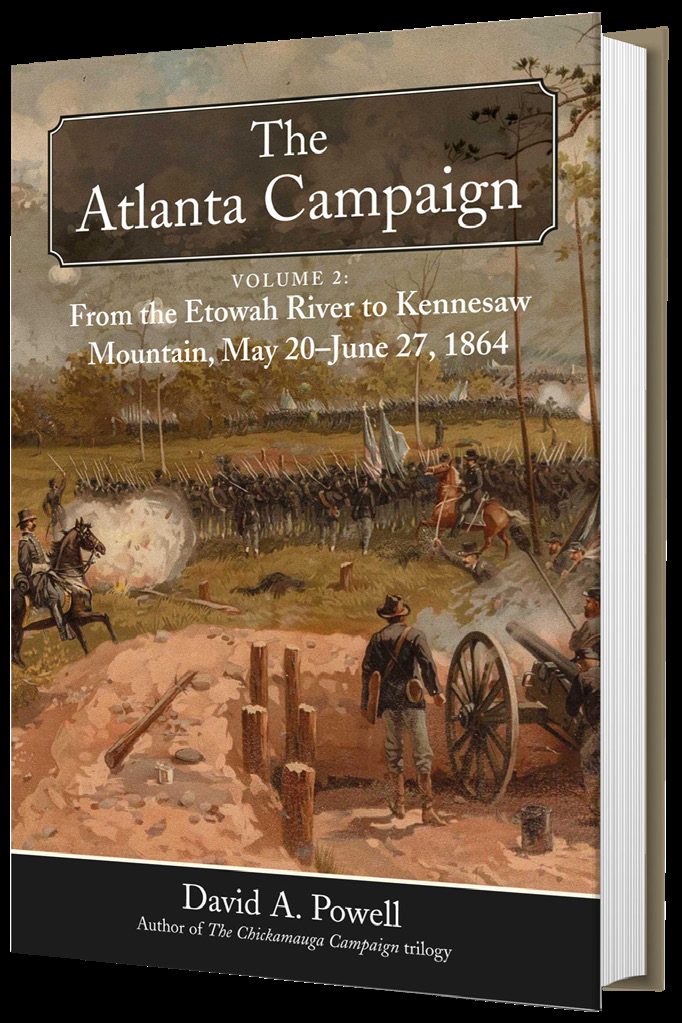
The Atlanta Cam iver to Kennesaw y David A. Powel ootnotes, index,
and clashes of the Confederate and Federal armies during the period after the major battle at Resaca, May 14-15, through the unsuccessful Federal assault at Kennesaw
Mountain on June 27. Powell is well known for his three volumes on the Chickamauga Campaign and other works on the war in Tennessee and Georgia. As anyone familiar with Powell’s work would expect, this volume is thoroughly researched and well written. The book certainly achieves Powell’s stated goal “to present a detailed operational (an
sometimes tactical) history of one of the Civil War’s most complex military events.” The reader travels with the armies as they maneuver over the northwest Georgia terrain, along muddy roads, up and down hills, across numerous creeks, over fields, and through the woods. We learn what the army commanders planned and ordered, and Powell drills down from there. From corps to divisions, brigades, and regiments, we get excellent descriptions of what happened as the commands filtered downward. For each day, the book covers the action from the perspectives of generals, privates, and every rank in between. The movement was almost constant, as was the fighting. Engagements large and small are covered with skill. Through soldiers’ letters, diaries, and postwar accounts, Powell lets the participants speak directly to us about wha they did and what they saw at the retail level, where the bullets were flying. The big fights in this part of the campaign were at New Hope Church, Pickett’s Mill, and Dallas in late May and at Kennesaw three weeks later. Powell offers excellent depictions of these battles and a solid analysis of what th generals and colonels did right and wrong. The detail can be challenging. In a single paragraph (pp 319-320), Powell names fourteen Confederate cavalry officers—two corps commanders and the commanders of three divisions and eight brigades, plus the commanders of a demi-brigade and a regiment. Federal commanders of the various units are also identified as the narrative sets stage for a June 20 cavalry engagement. The author devotes five pages to describing the action and a further three to discussing the casualties and assessing the performance of the two sides’ leaders. This minute analysis of one of the relatively quiet days is typical of the work. In this case, we learn how Wheeler’s horsemen prevented Garrard’s outnumbered Federals from establishing a bridgehead on the east side of Noonday Creek north of Kennesaw Mountain. Powell provides an order of battle for both armies, an essential feature in a work such as this. Even so, the cons page-flipping can be tiresome. I wrote out the essential parts and taped the pages above my desk so I could see at a glance the armies and their corps, divisions, and brigades. I looked up very frequently, and I am confident every other reader will do the same. This study is written for readers with a deep interest i Civil War and this important campaign. It demands, and is well worth, a close and careful read. Gould Hagler is a retired lobbyist living in Dunwoody, Ga. He has been a regular contributor to CWN since 2016.
A Union Soldier’s Letters of Hope and Idealism Set Within War’s Fury
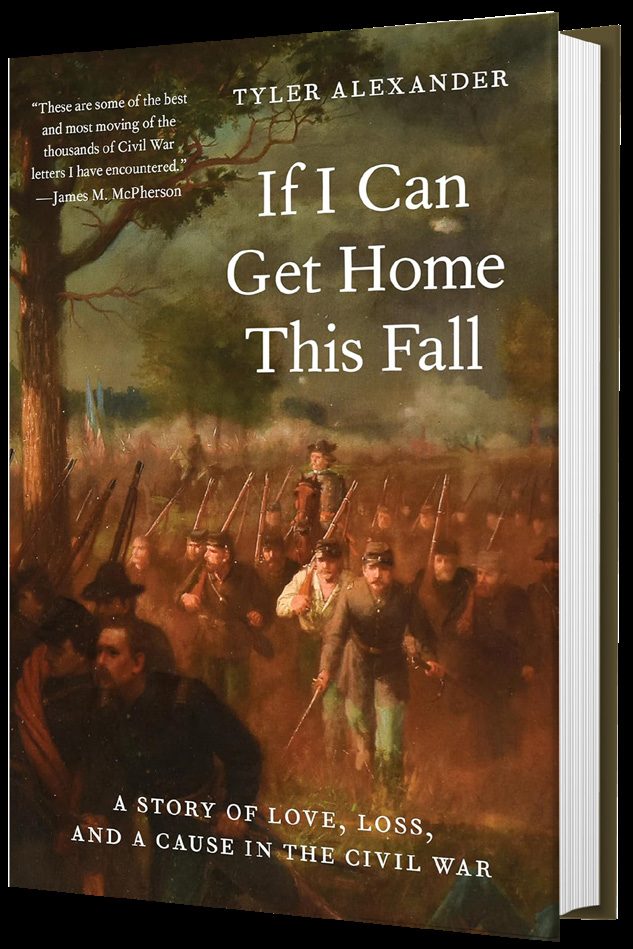
If I Can Get Home This Fall: A Story of Love, Loss, and a Cause in the Civil War. By Tyler Alexander. 344 pages, 21 photographs, five illustrations, index. Potomac
The American Civil War’s historiography is filled with innumerable collections of letters written by men in both blue and gray to loved ones back home. Many are simple transcriptions of the missives; the better ones ad important notes and context. The best ones, including thi new collection by Tyler Alexander, blend the letters with historical narrative to enhance the subject’s story fully If I Can Get Home This Fall tells the story of Dan Maso of Glover, Vermont, who enlisted at age 22 on October 15, 1861, as a corporal in Company D of the Sixth Vermont Infantry, part of the famed Vermont Brigade, and was late promoted to sergeant. In early 1864, Mason reenlisted, accepting a commission as a captain in the newly formed 19th U.S. Colored Troops (USCT), where he served for the remainder of the war. The latter position appealed to Mason for two reasons. He was an ardent abolitionist who wanted to make good soldiers of black men, and the much higher pay would benefit a young man starting out in life The 19th USCT was composed mostly of formerly enslaved men from Maryland and then saw action in the Overland and Petersburg campaigns. During the Battle of the Crater Mason suffered his one near-death battlefield experience. After the war’s conclusion, the 19th was transferred to Texas for postwar duty. It was in Brownsville, Texas, tha Captain Dan Mason died of dysentery on November 20, 1865; his hopes and dreams of an idyllic future were not to be.
Alexander has built his book around Mason’s correspondence to his fiancée and later wife, Harriet “Hattie” Clark, though sadly no letters from her to Mason survive. Nonetheless, Mason’s approximately eighty letters to Harriet are hardly the limit of the primary source mater utilized by the author. Alexander deftly weaves Mason’s voice together with other pertinent primary sources to add significant historical context. Mason’s diary entries, his letters to newspapers and other family members, and letters and diary entries from regimental comrades are all used to produce a splendid book that often feels like equal parts letters collection, biography, and military unit history. T author’s skillful narrative shines a light on Mason’s lette and the other primary sources by placing them properly within the contentious battlefield and Vermont home-front issues of the era. The book further shines by placing human emotion at the heart of historical upheaval. Through Mason’s letters, we see more than just a soldier; we see a young man grappling with the heavy questions of his time—patriotism, the draft, and the fight for racial equality among them. Vermont in general, and Mason in particular, were somewhat of a Northern outlier, as both man and state displayed a strong commitment to abolition from the opening of the war. Alexander enhances this intimate portrait by connecting these issues to the broader world, showing how Mason’s experiences were shaped by the rise of black soldiers and the heated political debates in his native Vermont. This engaging and absorbing book is much more than a two-dimensional collection of battlefield letters discussin dates, troop movements, tactics, strategy, or the weather. It is a cohesive, multilayered look at a tumultuous era tha fully captures Mason’s military life while also tracing a young man’s burgeoning romanticism, political idealism, and desire for racial equality, all set against the harsh realities of the American Civil War.
Paul Taylor is an award-winning author of nine books pertaining to the American Civil War era. His latest book i ’Tis Not Our War: Avoiding Military Service in the Civil Wa North, and was published in June 2024 by Stackpole Books.
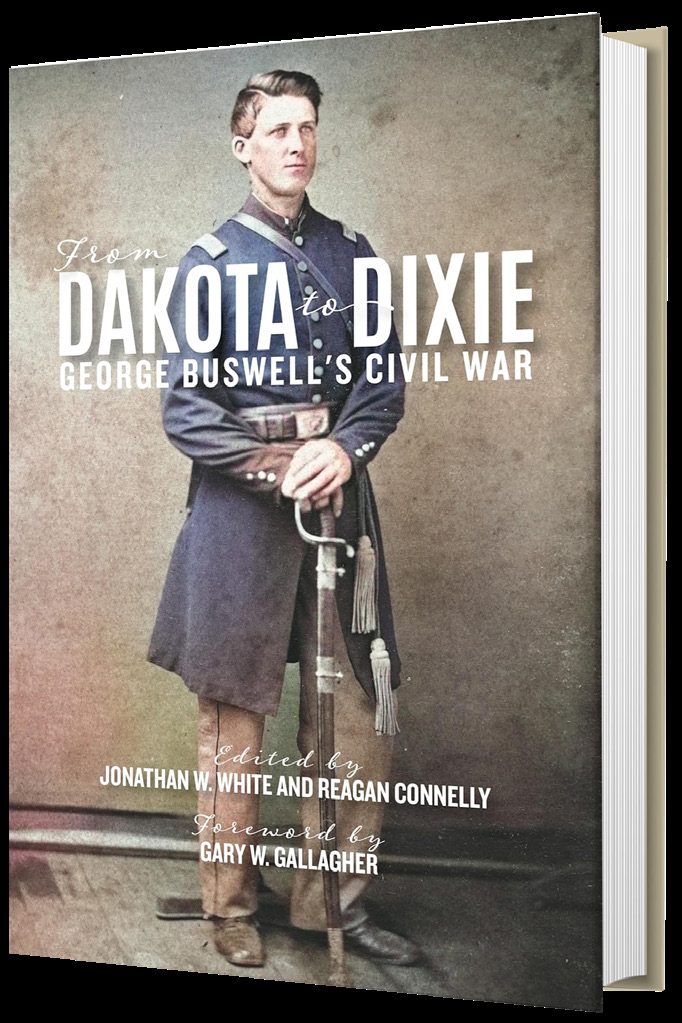
From Dakota to Dixie: George Buswell’s Civil War. Edited by Jonathan W. White & Reagan Connelly. Photos, notes, index, 262 pp., 2025. University of Virginia Press,
Three years after the Civil War’s end, George Buswell, a veteran of the Seventh Minnesota Infantry and Sixty-Eighth United States Colored Troops, dusted off the diary he kept from August 13, 1862, to December 31, 1864, and copied it into three journals. Like the diaries of so many Civil l War News Magazine | Vol. 52, No. 4, July-August 2026
War soldiers, Buswell’s ended up in an archive, accessible only to researchers. Fortunately, historian Jonathan White one of our time’s most prolific and important historians, and Reagan Connelly, one of White’s former students at Christopher Newport University, recognized the significance of Buswell’s diary and the value of making it accessible to a broad audience. While Buswell never fought in any of the Civil War’s most significant engagements, his diary will be of great interest to anyone seeking a deeper understanding of the conflict’s transformative impact on soldiers’ political perspectives. When Buswell enlisted as a private in the Seventh Minnesota in August 1862, he was a Democrat. By the time President Abraham Lincoln stood for reelection in 1864, Buswell’s wartime experiences transformed him into a Republican, one who now ardently detested slavery and advocated for the recruitment of black troops. Buswell’s thoughtfully annotated diary also offers valuable insight into something historians of the Civil Wa era often overlook—the Dakota War of 1862. While Buswell viewed the conflict between Indigenous peoples and United States forces in the Upper Midwest as disconnected from the Civil War, a perspective challenged by some historians today, his observations offer powerful accounts of the Dakota War’s brutality, including the massacre of thirtyeight Dakotas in late December 1862. Additionally, Buswell’s diary is filled with thoughts on the course of the conflict and its leaders. No matter wher Buswell was stationed, he always kept informed about what was happening in various theaters and recorded his thoughts about events and people in his diary. For example when Buswell learned about the massacre of black Union soldiers at Fort Pillow in the spring of 1864, he believed that the government “should retaliate and learn the Johnni something.” Several months later, when Buswell learned of Union General Philip H. Sheridan’s smashing victory at the Battle of Cedar Creek, he characterized Sheridan as “a noble fighter” whom he believed “possessed” the confidence of his troops so much “that they would go 68 Civil War News Magazine | Vol. 52, No. 4, July-A
with him anywhere.” When he learned that General Ulysses S. Grant was appointed general-in-chief in 1864, he speculated, correctly so, that with Grant at the helm, “success will finally be ours.” An observant soldier and an excellent writer, Buswell also immersed himself in the localities where he was stationed. His reflections from those experiences reveal much. For example, historians studying the connection between wartime loyalties and religion will find Buswell’s reflections fascinating. While in St. Louis, Missouri, in the autumn of 1863, Buswell attended religious services at various churches. Buswell’s diary demonstrates a correlation between certain sects and loyalty to the United States. Buswell found that members of the Union Methodist Church in St. Louis were far more welcoming to Union soldiers than members of a Unitarian congregation. The two churches were “such a contrast,” Buswell wrote on November 8, 1863. Anyone interested in the war’s impact on communities will likewise find Buswell’s thoughts enlightening. For example, while in Nashville, Tennessee, in December 1863, Buswell wrote extensively about how the war impacted the city and its inhabitants. Before the conflict, Buswell wrote, “Nashville must have been a beautiful city… and a thriving one, but all… is now suspended, except… the war business.” While countless soldiers on both sides kept diaries durin the Civil War, not all diaries are equally valuable. Althou Buswell’s diary includes thoughts commonly found in many diaries—such as weather conditions, complaints about the hardships of soldier life, and longing for home— this diary is arguably one of the most significant publishe in recent years because it offers deeper insights into some of the most critical topics that historians and students of conflict continue to grapple with including how the Civil War changed soldiers’ views on politics and race, its impac on civilians and local communities, and how soldiers tried to make sense of a war that at times seemed endless. For these reasons and more, Buswell’s diary, masterfully edited and annotated, should be on the shelf of any serious studen of the Civil War.
Jonathan A. Noyalas is the Hugh & Virginia McCormick chair in Civil War History at Shenandoah University and director of Shenandoah’s McCormick Civil War Institute. He is the author or editor of seventeen books, including most recently General Philip H. Sheridan: Life, War, and Memory, published by Routledge.
After the Fire: Richmond in Defeat. By Nelson D. Lankford. Illustrations, photographs, endnotes, bibliograph index, 350 pp., 2025, Charlottesville, University of Virgin
Fleeing Confederate soldiers torched tobacco warehouses and bridges in Richmond, Virginia, on April 3, 1865. High winds carried flames and embers onto wooden roofs of shops and houses, leaving thousands homeless and businessmen penniless. The ashes and charred remains in the so-called “Burnt District” symbolized the defeat of the Confederacy. While Appomattox marked the end of a four-year struggle, it ushered in more years of a different kind of struggle for the citizens in its former capital and across its former eleven states. The Civil War left the region impoverished, with its social and economic foundations in ruin. The graves of hundreds of thousands of the fallen, bitter animosities among neighbors in divided communities, and dark uncertainties about the future had also resulted from the conflict. All Southerners—whites and former slaves, Rebels and Unionists—confronted difficult, novel issues in the days, months, and years in the war’s aftermath. The folks in every village, city, and state were burdened with seemingly irreconcilable problems in the changing social, political, and economic landscape—deep-seated poverty, the role of the federal government and military occupation, and the status of freed African Americans. In the early postwar years, solutions rarely appeared. In this excellent work, Nelson D. Lankford, author of a very fine book on the burning of Richmond, offers a detaile and discerning portrait of the former Confederate capital from the days immediately after the fires to the summer of 1869. His book covers the bitter, unending disputes, the daunting efforts to restore the city’s economy, the clash between the military and the locals, the lingering division caused by the war, and the roles of an array of individuals who shaped these years. Beneath all of these matters, however, lay the integrati of the newly emancipated African Americans into the city’s life. It is a central theme of the book, examining t importance of the Freedmen’s Bureau, the attempts to secure equal rights, suffrage, and ownership of their churches, an the establishment of schools for their children. The author
describes the state’s constitutional convention, which granted equal rights and manhood suffrage to Virginia’ whites and African Americans. In turn, Richmond’s white, pro-Confederate populace opposed the policies of the administration of civilian governor Francis Harrison Pierpont, and the daily pres of blue-clad army officers and men under Generals Alfr Terry and, later, John Schofield. Ladies held memorial services for Confederate dead in Oakwood and Hollywood cemeteries in May 1866, while Joseph Mayo, who was mayor during the war, was elected again in 1866. The r past hung over the city like a shroud. An interesting aspect of the book is the author’s po of individuals who had significant roles in the city’s during these years. In his final chapter, titled “Left the author summarizes the lives of both whites and Afr Americans. Based on impeccable research, longstanding knowledge of Richmond’s past and present, and fine writing, Lank book is a model of historical inquiry and narration. Jeffry D. Wert is the author of The Heart Of Hell: T Soldiers’ Struggle For Spotsylvania’s Bloody Angle.
The First Confederate Soldier: George Washington Lee and Civil War Atlanta. By Robert Scott Davis. Illustra Notes, Appendices, Bibliography, McFarland Publishing Company, 213 pp., softcover, 2026.
George Washington Lee began his Civil War career by forming an independent company, Lee’s Volunteers, on
l War News Magazine | Vol. 52, No. 4, July-August 2026
February 15, 1861, thus arguably earning the title of one of the first soldiers to enlist in the cause of Southern secess Forced by recurrent bouts of tuberculosis, he resigned his commission twice before July of 1862, returned to Atlanta, and accepted the post of Provost Marshal for Atlanta. It is here that the chaos and seedy side of the Civil War consumed his time until the South’s surrender. George Washington Lee, in his role as provost marshal, was characterized as a patient, tactful, fair administrator whose job was to protect the people of Atlanta from themselves as well as from the swarm of spies, thieves, counterfeiters, deserters, guerrillas, resistance leaders, scoundrels, swindlers, and every other imaginable miscreant that the war spawned. He exposed the underbelly of wartorn Atlanta, not the Atlanta of Gone with the Wind, but the Atlanta beset by crime, corruption, and vice. In carrying out his duties, he faced at least three assassination attemp illness, military sorties to assist Confederate forces, and internal challenges posed by everything from bootlegging and prostitution to organized crime and saboteurs. Amid all these obstacles, he structured his life and responsibilities into four distinct stages. First, he tried to rally middle-c white artisans, like those from his own background as a tradesman, to the Southern cause. Second, he rose from private to colonel, commanding troops from Savannah to Richmond and fighting for the Southern cause despite health issues. Third, he raised companies for Confederate service while protecting civilians in Atlanta. Finally, in December 1864, he helped restore Confederate authority in Atlanta and North Georgia after both armies had left the burned-out city behind. This was no easy task, as Atlanta was a ruined shell of its former self, beset by putrid smell garbage, filth, and desperate refugees. When the war ended, George Washington Lee stayed in Georgia and pursued success as an entrepreneur, always dreaming of business success but never quite achieving it. By 1878, after a series of business failures, he had los all of his property and managed only a third-rate boarding house. Finally succumbing to tuberculosis, he died on April 3, 1879, at age 47. This text and its seven appendices provide a wealth of information on Civil War Atlanta, including, but not limited to, the life and exploits of Colonel George Washington Lee. Other prominent Atlantans and ordinary citizens also appear in the narrative, showing how they survived war, occupation, devastation, and Reconstruction. While the textual organization is at times challenging, the research is accurate, voluminous, and illustrative of the trials and tribulations of a city at war. For any Civil War historian, book provides valuable insight into the seedier side of life in a besieged city. As such, it is recommended as a balance to traditional battle histories.
Dr. Wayne L. Wolf is Professor Emeritus at South Suburban College and the author of numerous books and articles on the Civil War, including The Last Confederate Scout, Civil War Letters, and Heroes and Rogues of the Civil War. He is the past president of the Lincoln-Davis Civil War Roundtable and a frequent lecturer on the circuit. 70 Civil War News Magazine | Vol. 52, No. 4, July-Au
The WPA Narratives: Voices of the Formerly Enslaved in Louisiana. Edited by Andrea Livesey. Photographs, bibliography, index. 526 pp., 2025. Louisiana State
Author Andrea Livesey’s first book opens up a wealth of information to researchers everywhere. The material sh writes about languished in obscurity until she brought it light. While new to authoring a volume of her own, she is a veteran scholar with several articles on Louisiana alre to her credit. She lives in Liverpool, England, a place w a noteworthy Civil War connection of its own. As part of the Works Progress Administration’s Federal Writers’ Project, interviewers were sent to speak with formerly enslaved people across America. The Louisiana version of these important interviews was recorded betwee 1936 and 1940. As another world war began the following year, they were boxed up and forgotten. These resources remained an untapped source of valuable information for decades. Finally, Andrea Livesey rediscovered them and developed the material into this fine volume. For the mos part, the collection is arranged by interviewer, although some accounts remain unattributed. One of the most interesting recollections Livesey uncovered concerns the interaction between a fairly young enslaved girl, between twelve and fourteen years old at t time, and some Northern soldiers she encountered during the Civil War. The memory was retained by Charity Parker. She related, “I sho’ remembers when dose Yankee soldiers came to our place. We was playin and dey comes up an’ sez Lil girl, don’ youse know you is free? I says, No, we ain free, and dey say What’s yah marse? We knew har he was but we would n’t tell, we says We don’t know! and den too